Listen on
Overview
Generating novel therapeutic proteins presents a unique data challenge: unlike images or text, humans lack the intuition to validate protein sequences generated by AI models. This gap makes scaling R&D expensive and slow. Building functional synthetic biomolecules requires more than just advanced AI; it demands a systematic approach that tightly couples sophisticated machine learning with rapid experimental validation.
In this episode, host Ross Katz speaks with Ryan Mork, Director of Data Science at Evozyne, a company developing synthetic biomolecules. Ryan details how Evozyne confronts this challenge, not by relying on a single AI model, but by integrating diverse deep learning architectures within a rapid, iterative experimental design cycle. This method allows their systems to learn quickly from sparse biological data, accelerating the discovery of new therapeutic enzymes. The conversation covers Evozyne’s evolution-based design strategy, their focus on enzyme engineering, and the enduring importance of human expertise in vetting high-throughput assay data for reliable model feedback.
Key Takeaways
Generative AI for Biology Demands a Rapid, Iterative Feedback Loop
Unlike generative AI for text or images, protein design lacks a human oracle to validate model outputs. Evozyne addresses this by tightly coupling diverse deep learning models with a continuous experimental cycle. This iterative process, where lab data directly refines models, is essential for identifying functional synthetic biomolecules and ensures models learn effectively from sparse biological results.
Select Models Based on Protein Family Performance, Not a Single Flagship
Evozyne avoids a ‘one-size-fits-all’ AI approach. Instead, they test a suite of deep learning models — from autoencoders to T5 transformers — to determine which architecture performs best for a specific protein family. This pragmatic, data-driven model selection contrasts with companies relying on a single foundational model, allowing for more precise and effective biomolecule generation.
Human Expertise is Irreplaceable in High-Throughput Assay Data
Even with automated liquid handlers, human expertise in the wet lab remains critical for designing rigorous assays and interpreting experimental data. Data scientists must intimately understand the caveats of biological data collection to properly featurize and abstract it for models. This tight coupling between experimentalists and data scientists directly impacts model reliability and output validity.
Related: CorrDyn specializes in data engineering and machine learning for complex scientific domains. We regularly assist clients in biotech and life sciences with data challenges. For insights into improving data-driven operations in this field, see our article on how biotech manufacturers gain data value.
Full Transcript
Jason: Hi everyone, this is Jason, producer of Data in Biotech. Before we get started, I wanted to let you know about our latest white paper. It’s a comprehensive guide to implementing machine learning models in biotech manufacturing. It’s a complete overview of all the potential problems of ML adoption, and more importantly how to solve them. To download it, simply visit connect.corrdyn.com/biotech-ml. We’ve also dropped the link in the show notes of this episode. Let’s get into it. Welcome to Data in Biotech, a podcast from CorrDyn where we explore how companies leverage data to drive innovation in life sciences. Every two weeks we sit down with an expert from the world of biotechnology to understand how they’re using data science to solve technical challenges, streamline operations, and further innovation in their business. Joining us today is Ryan Mork, the director of data science at Evozyne, a company at the forefront of synthetic biomolecule development. In this episode Ryan shares his journey into the biotech field, the innovative work being done at Evozyne, and how they are using LLMs and experimental data to create therapeutic biomolecules. We dive deep into the challenges and breakthroughs in protein engineering, the role of evolutionary history in their design approach, and the future of generative AI in biotechnology. Here we go.
Ross Katz: Ryan Mork, welcome to the Data in Biotech podcast.
Ryan Mork: Thanks for having me, appreciate it.
Ross Katz: Just to kick us off, can you give us a brief introduction to your background and what brought you here today?
Ryan Mork: Sure. My background is, I spent a long time in my undergraduate and graduate career focusing on biological systems, everything from bacterial to neural to households. Trying to understand how biological systems interact with people. I have a PhD from UChicago in biophysics, and then from there I moved a couple years to Tempus AI, which is a company that recently IPO’d in the Chicagoland biotech space. Spent about three and a half years there working mostly on medical records and how to parse those for meaning and to derive very patient-centric insights from medical data. And then I transitioned to Evozyne in 2021, working mostly in the protein engineering space, using deep learning models.
Ross Katz: So can you introduce us to Evozyne and what the organization does?
Ryan Mork: How I like to describe it is, instead of taking ChatGPT and training on the internet to serve as a creepy bot, we train massive large language models on all of proteins and all of biology to make synthetic biomolecules for therapeutic purposes. At a very high level that’s what we do — taking the discoveries of transformer models and applying them to the protein engineering sphere.
Ross Katz: What you’re doing is very data science heavy. Can you talk to us a little bit about what the data science team at Evozyne does and the different roles that you play inside of the organization?
Ryan Mork: Sure. I’m the director of data science here, which means I do a heavy mix of management as well as strategic scientific decision making as well as actual hands-on project work to this day. The thing that I neglected to describe — the big part of what drives our deep learning models, and why you’re interviewing me today — is data. We’re a combined wet and dry lab. We are continuously developing synthetic proteins that have gone over multiple iterations of improvement through experimental data. Our data scientists are analyzing the data, munching the data, developing new models, giving that information back and developing the next iteration of synthetic biomolecules. Rather than saying we can develop the next therapeutic in just one run of a model — that’s probably unlikely — it’s going to take us four or five rounds. But we’re developing systems that are very amenable to learning very quickly with increasing amounts of experimental data.
Ross Katz: Can you categorize the types of models that you’re developing, in between exploring the vast design space for potential proteins and having a therapeutic that’s actually applicable to a given disease category with a given intervention path?
Ryan Mork: Sure. We work with multiple different scales of models — from large pre-trained language models to very bespoke custom models for specific protein families. And we let the data — I’m going to say this a lot — let the data speak for itself. We have a suite of models, from very simple to very complex, everything from perceiver models and autoencoders to full T5 models from NVIDIA. For a given protein family we try a suite of those models, and whichever model is most performant in generating synthetic biomolecules in the lab, that’s the one we run forward with on a project. Most companies typically have their flagship large language model or large foundation model and say this is the model we’re going to use to solve all of our problems. We’re much more — well, if a bespoke model works for this program, that’s what we’re going to use.
Ross Katz: Can you walk me through the development process? It sounds like at the very beginning you’re starting with data gathered from previous research and publicly available datasets, using that for the development of the original models, then building on those and incrementally gathering experimental data that feeds the models. And as you’re doing this selection process on the proteins, you’re also doing a selection process on the models you’re using to predict the outcomes you care about. I’d be really interested in understanding how that process works from the data all the way through.
Ryan Mork: Of course. We can be much more concrete. One of our programs is a collaboration with the Gates Foundation to develop a heat-tolerant synthetic variant of a plant protein. I think this is a very digestible poster child of how our process works. So what we did was, we started with the natural sequence space — going through all the NR and metagenomic databases to gather as many protein sequences as possible. We took all those and basically said, which model best captures that phenotypic space, and started with that model. Then in tandem the lab literally tested several thousand of those proteins experimentally and characterized them in high throughput. We asked which model best captures the genotype-phenotype relationship, and then we used that model to generate synthetic molecules optimizing in that space for more thermally tolerant enzymes. We took that first round of synthetic sequences, fed that experimental characterization data back on top of our natural sequences, and repeated the process of generation, synthesis, test in the lab, updating the model.
Ross Katz: So the genotype-phenotype relationships — that’s taking the sequence information you have and understanding how the protein actually behaves in the world. The idea is that you’re using the model that best characterizes those relationships, but then you’re also going in and using these generative models to generate new candidates that you’re then synthesizing in the lab and testing against these different assays. And the model already has a prediction about how those new proteins are going to behave, so you’re comparing and contrasting the experimental results with what the model produces. Am I understanding you correctly?
Ryan Mork: Yeah, you’ve got the gist of it. The important thing to differentiate — and I haven’t been as clear on this — is that there’s a difference between a model architecture and training that model.
Ross Katz: Right.
Ryan Mork: We choose a model architecture that best captures that genotype-phenotype relationship, and then we iteratively train that model with more and more experimental data as we get it from the lab. That first round encompasses all natural proteins we’ve evaluated — that’s the first model, which generates synthetic proteins with predicted properties. We evaluate those, add those data to our natural dataset, train a new model with that information, and repeat the process of generation, synthesis, test in the lab, updating the model.
Ross Katz: How do you decide through the modeling process which proteins you’re then going to take into the lab and gather data on?
Ryan Mork: Great question. We prefer multiple different approaches. There’s always that inherent risk versus reward tradeoff, variance-bias — there are a bunch of different names for it. Essentially, we can choose things that are very similar to natural sequences that are probably going to work but probably aren’t going to be thermally stable. That’s our ultimate goal: maintaining activity with increased thermal stability. At the same time we could try a bunch of things that are predicted to be very thermally stable but are very different from natural sequences and probably not going to function in most cases. For example, there are pretty thermally stable cyanobacterial sequences that are very different from the plant systems we’re working on. Those probably wouldn’t even work in that plant. What we really do is, for every project, first ask from a product perspective how far can we go? In this case, we’re trying to maintain high identity to a natural plant protein for a number of reasons, including the question of to what extent it actually is a GMO. But at the same time, we want to make sure it’s compatible with a bunch of different plant systems we can’t fully test. So we tended more on the conservative side. But we typically try to sample from that whole gamut to get an idea of what we can actually do. And then in later design rounds, we typically stay increasingly conservative as the models become more and more confident of the activity profile of those enzymes.
Ross Katz: I’ve read on your website that you use an evolution-based design approach for protein engineering. Could you explain what that means in the context of the model you just described?
Ryan Mork: Sure. Evolution is a fancy word for sequence. Rather than trying to develop foundational models on all proteins and all protein structures, we’re saying let’s focus on that protein family in and of itself — the entire evolutionary history going back, often to bacterial systems of that protein family. We’re developing models on that full family tree, that full family phylogeny, as opposed to saying we have a structure we really want to emulate, let’s get sequences like that structure. We’re going straight from sequence to function and relying on the deep evolutionary history embedded in that protein family. To clarify for a general audience: it’s surprising to people that many enzymes in our bodies have bacterial equivalents. They are ancient and they still align at 30% identity. There are metabolic enzymes in your body and my body that are alignable and have almost identical structures to bacterial proteins today. When I say the full evolutionary history, I’m referring way back, billions of years evolutionarily.
Ross Katz: That’s really interesting. The idea here is to not just start from the end point of evolution, but the hypothesis is that earlier versions of the proteins we see today could have gone in different directions that might have had the phenotypic profile you’d want, and using that as a starting point can bootstrap these models further along. Am I thinking about that right?
Ryan Mork: You’re talking about doing something fancier than we’ve explored. For example, there’s ancestral state reconstruction — given all modern proteins, you can develop ancestral reconstructions of those back in time. You could bootstrap current models that way — we haven’t explored that. But the idea is that the current end state evolutionarily shows the fitness landscape of the protein, because these are coming from bacteria, they’re coming from pangolins, they’re coming from all over the world, and those all have to have dramatically different functions. So we have this really rich fitness landscape of these proteins in extant sequences today.
Ross Katz: That makes sense. So the evolution-based design approach means you’re looking at the full family tree as it exists today — all of the related proteins in that family space. When I saw “evolution-based design approach” I sort of assumed there was an evolutionary deep learning element where the models were embodying evolutionary principles, but it sounds like that’s not the case — that you’re basically using whatever model best characterizes the function space you’re trying to get into, and it’s not necessarily that you’re embedding the ideas of evolution directly into the model itself.
Ryan Mork: Correct. And often in terms of phylogenetic organization our models recapitulate that organization as well. We’re leveraging latent variable models — they take a sequence and embed it into some sort of low-dimensional space. Often that low-dimensional space is organized phylogenetically. When I say we’re learning the principles of evolution, we have developed a latent variable model that is organizing those sequences as would a phylogeny. By sampling from that region you’re sampling from the evolutionary organization of those sequences.
Ross Katz: Should I think of those as embeddings?
Ryan Mork: You’re correct. Latent variable models — variational autoencoders, autoencoders, perceivers — you can even look at the latent embeddings of a large transformer model. All of those are latent representations.
Ross Katz: The idea of embeddings is that through training on large quantities of data, you’re gaining information about each entity you’re training on — in this case each protein sequence — and over time you learn spatial representations of which proteins are closest to each other in terms of their phenotype or whatever you’re training the model against. Internally I’m imagining you have a variety of these different latent space representations of proteins according to the different types of models you’re training. Do you find yourself reusing them or exploring them next to each other? Are there insights you’re gaining from the latent spaces themselves, or is it just that that’s one of the reasons the models work so well — they’re able to encode relationships that we wouldn’t be able to see using classical methods of exploring proteins?
Ryan Mork: I’m going to take this question in a slightly different direction: why are we doing what we’re doing? I’m telling you we’re taking all these large language models, representing proteins in more constrained embedding spaces — why all this? It goes back to why we’re a generative modeling company in the first place. We need machine learning models and deep learning models to make proteins because humans can’t. I definitely cannot look at a protein sequence of 300 amino acids and guess that if we change those seven residues, it’s going to be more thermally tolerant or have a higher catalytic power or interact with this other enzyme. That’s very challenging to do. But computers are decent at it. Our whole goal is to develop models capable of doing what humans are not capable of. The reason we’re learning these latent variable representations or embeddings is so we can sample from that space and generate new synthetic biomolecules, guided by experimental data. That’s the whole idea.
Ross Katz: Can you talk about how the models you’re developing are used internally? I’m imagining it’s not just models recommending proteins to be synthesized and then tested, and then models learning — that somewhere in the loop, especially as you get toward developing a therapeutic, there’s some human intervention, some people asking questions about what the models are doing or why they’re coming to certain conclusions. Could you shed some light on how the models are used outside of just that process?
Ryan Mork: Generative design is primarily what they’re used for. It’s a fascinating question to understand how we can divine or dig into what design principles these models are putting forward — and that’s a very challenging question. I’m going to move one step back: we still struggle with the question of how do you evaluate whether a model’s bunk or not. Once you have that answer you can go on to fancier questions, like what are we learning about structural biology, what are we learning about protein fitness landscapes using these models? We’re still at the more basic question: how can you tell that a model can generate synthetic biomolecules outside of just testing them in the lab? As I said before, humans can’t look at a protein sequence and say that is going to fold into a functional protein that catalyzes some reaction. We can’t look at a string of 300 letters and be like, that can work. And I can tell you right now that you can develop a lot of models that fool most modern tools like AlphaFold but make totally non-functional enzymes. The benchmark in the field is does AlphaFold say this can fold into a functional protein? But all of our models that generate nothing functional can pass that test. It’s continually a process — since we can’t look at sequences and evaluate them ourselves — of developing more and more careful metrics and auxiliary models, just to make sure that we have a functional generative model in the first place. That’s where most of our focus is right now and where we have a lot of human intervention time and thought.
Ross Katz: So the auxiliary models — the idea is to take an ensemble approach where, assuming the model is not bunk, a group of other models developed differently, bringing a different perspective or modeling approach, can help to do evaluations that the generative model can’t make itself. Am I thinking about that right?
Ryan Mork: Exactly. I like to think of other generative models and how this is actually an easier problem. I was literally just using a structural image model today to make an invitation to a party. I can make 20 pictures and be like this model is producing nothing that looks like a human being or an airplane or a balloon, because I know what all those things are. Essentially humans are oracles when it comes to images and writing. But humans can’t vet proteins. So we have to rely on auxiliary models, and that’s why it’s in my mind one of the most challenging aspects of modern protein engineering today.
Ross Katz: So you have generative models, then auxiliary models being used to evaluate them, and then you have the experimental process for creating the data. Is your sense that this approach is pretty consistent among companies doing protein design, or is there anything that Evozyne is doing differently?
Ryan Mork: What I would attribute as differentiating us is that experimental iterative design cycle. We’re fully capable of saying we are not going to get it right the first time — maybe not even the second or third time. So we have to develop systems that are very fast, robust, and can learn from data very quickly in a very sparse context. That’s what differentiates us: a focus on experimental data and efficient compute. Another differentiator is that we are working mostly in the enzymology space. Most protein engineering companies are coming at this from a structural perspective — they want to develop new binders that are usually binding to things. We focus on making enzymes as therapeutics. That’s a huge difference in terms of our product portfolio, and here’s why: structural people don’t like to touch enzymes because you can’t simulate their full range of movement. For a non-technical audience, imagine you’re trying to design a hand to hold a pencil — going from a fist to holding a pencil and back again. That’s about the amount of movement a protein structure has when it’s performing a reaction. Crystal structures are only going to be in that fist conformation or maybe in that pencil conformation. How do you model that whole movement? Most people don’t try. They work on antibodies — antibodies bind to things, they don’t change that much when they bind to things, you can manage that. We’re saying we know you can’t do structural, so let’s use a large amount of experimental data and a large amount of sequence data to get at that more complex design space.
Ross Katz: From an experimental perspective, are you more on the fully automated side, or is your wet lab populated by individuals running experiments for you? I’m assuming from a high throughput perspective you’re mostly fully automated.
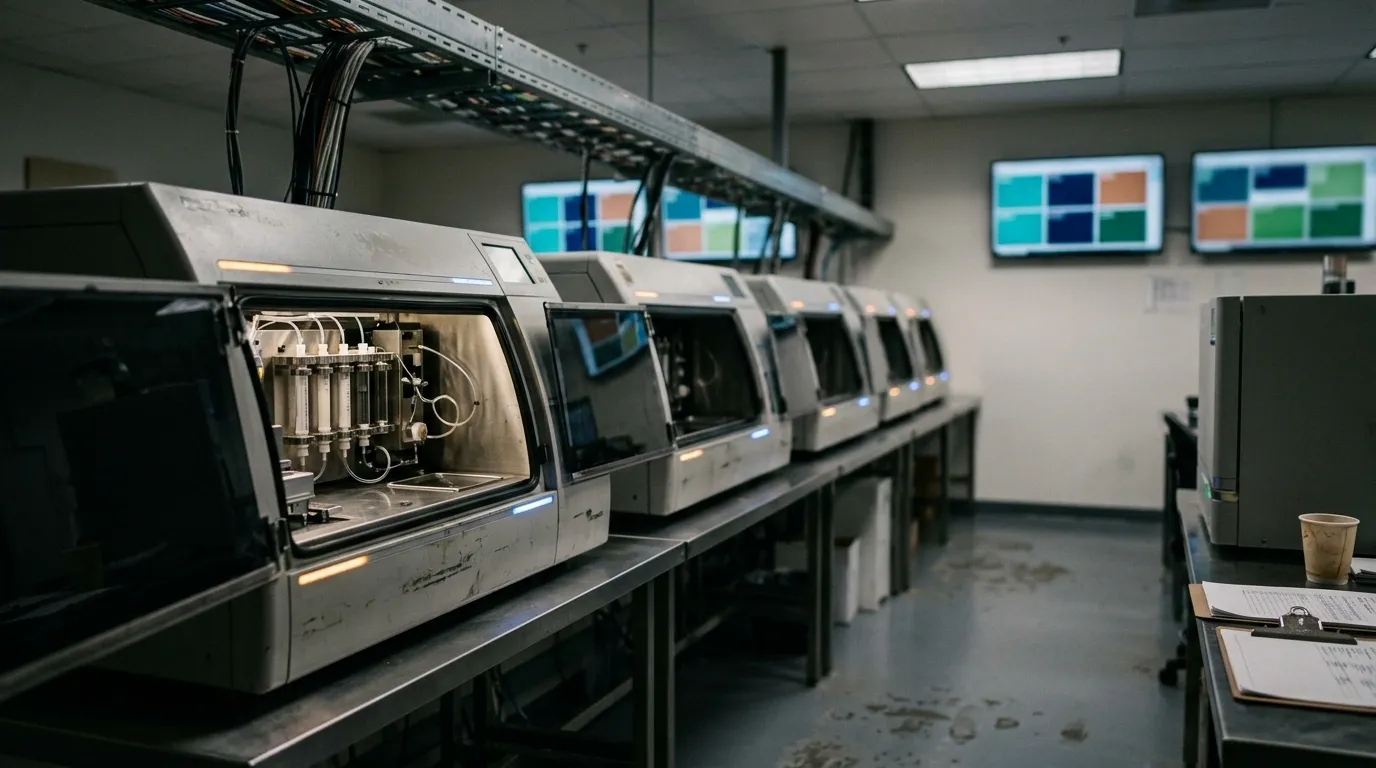
Ryan Mork: I wish. Most of our assays are done using automated high throughput liquid handlers — that is state of the art. But a lot of the low throughput characterization still happens with individuals. They’re still the ones writing the programs for those machines to run those assays, characterizing them in low throughput to ensure the high throughput measurements are correlated with high-quality low throughput assays. There’s always a tradeoff between a very high time-resolution low throughput assay that gives you exactly the kinetic measurements you want, and a massive high throughput screen that basically only gives you a binary yes-no. There’s always a tradeoff in data resolution when you talk about how high throughput an experiment is.
Ross Katz: As a data science team, what kind of interaction with or understanding of what’s happening in the wet lab do you expect, and how does knowledge sharing work across the boundaries of the organization?
Ryan Mork: This is probably another differentiating factor for Evozyne: just half an hour ago I saw one of the experimentalists in — I would say it’s a productive argument — with one of the data scientists about the experimental system itself. At Evozyne everyone’s expected to understand at least at a moderate level what their colleagues are working on: experimentalists understanding how we’re modeling these proteins, and data scientists understanding how the experimental systems are actually developed and improved. It’s a very intimate coupling. We’re all in person here, so I literally pass by the experimental wet labs every day, grabbing coffee and asking how things are going. When we’re working on microfluidics experiments, I’m literally in those meetings talking about the experimental approaches themselves. Very tight coupling.
Ross Katz: That makes sense — from a data scientist’s perspective you want to understand the caveats and assumptions in the data being gathered, because that has a deep influence on what the models might pick up on and where noise is being introduced. And from an experimental approach you want to understand the blind spots of the models. Are there any other benefits you’ve seen that I’m missing?
Ryan Mork: You really did hit on the two major ones. Most data scientists work with data that comes from humans — records, human text — and we have an intuition as to how we want that data processed. But kinetic measurements from a high throughput screen or count measurements from a bacterial screen come with a lot of caveats. Biology is messy and hard and complex, so you really do want someone intimately involved in that process to understand how to properly featurize and abstract that data. You want the way you develop features — the things the model sees — to effectively remove the noise and magnify the signal, so you have to understand where the data is coming from.
Ross Katz: Given that you’re training a bunch of different types of models and throwing a lot of different models at different types of problems, how do you think about tooling for the data science team and developing a tooling ecosystem that enables that kind of work?
Ryan Mork: We have an internal engineering team developing our platform — that’s part of their responsibility. I have a decent say in all that. We also collaborate with NVIDIA and leverage their tooling. What we’ve wanted to develop is an ecosystem that allows a lot of plug and play around core infrastructure. At our last NVIDIA GTC meeting we were sitting on the BioNeMo board and collectively came up with the term “duplos.” You don’t want atomic-range changes to modeling and updating — you want to act at the duplo level, where you can plug and play different architectures together to make intermediate models that you can try out. To be more specific: say I want to plug in a new loss component and use a specific layer, and I want a pipeline that supports optimization of that automatically. You’re abstracting away the more nuanced fine-grain back propagation optimization, but you have access to the core structure of the model and its training nuances. That’s what we look to do.
Ross Katz: Where does the data science team spend most of its mental time and energy? Is it on designing new architectures, testing out new and emerging models, applying existing models to different problem spaces, or all of the above depending on the project?
Ryan Mork: Developing those systems in and of itself is extremely time consuming. Debugging them, validating them — it requires experimental work because as I said earlier we can develop models that pass all of our in silico tests but then are all non-functional in the lab. Developing new architectures, developing even the code behind new architectures is fraught because bugs are very, very hard to find. That’s probably where I’d say we spend more of our time than I would like.
Ross Katz: Can you give a little insight into what an R&D roadmap looks like for a data science team — or your vision of one?
Ryan Mork: My vision? It would involve outlining what major goals you’re trying to accomplish, recognizing what your models can’t do currently, what your processes are weak at, or what the field has demonstrated superior capacities for. And organizing those by the time it will take to implement, the time it will save you, or the new features it may unlock. That’s how I would start structuring that roadmap, and then enumerating it given your personnel, their unique talents and experiences and capacities.
Ross Katz: As we head toward the end of our conversation, I’m interested in zooming out and getting your perspective on the landscape more broadly. Sitting as you do in the heart of generative AI for biotechnology, what do you see the future holding in one year, three to five years for the development of the field?
Ryan Mork: I think it’s going to get better and better at the structural-sequence relationship. Companies like Generate Biomedicines and Xaira — those are all more structural companies. I think they’re going to have a lot of success in developing binders to new targets. Antibody engineering will become more and more ML- and AI-driven to the point where they’re going to do some remarkable things very fast. I can see that because it’s a system where they’re getting a ton of data, they already have a ton of structural information, and the models are only getting better. For problems that are plaguing the market in terms of small molecule therapeutics, the direction the field is going — and we’re going to get into some science here — is predicting small molecule binding to proteins. That’s hard because proteins are not rigid bodies like you see in crystal structures. They’re moving objects. Small molecules often bind in ways that the crystal structure says is closed or not available. Making models that can predict the full conformational scope of a protein and capture how you can inhibit that — I think that’s a really exciting direction for the field in the next couple of years, which should revolutionize the ease with which we develop inhibitors. Those are the two most obvious directions where a ton of research is going. NVIDIA is backing both of those heavily and that’s where I think the field will really be going in the short term.
Ross Katz: What about for Evozyne? I’m interested in hearing the journey you’ve been on as a data science team that’s been building the car as you’re driving it, and where you see that journey taking you in the one to three year time horizon.
Ryan Mork: For us, experimental data is still critically important, primarily because we’re focusing on enzymes and it’s non-trivial to model the full enzymatic range of movement during a chemical reaction. We’re not trying to go from a structural perspective. Our goal in the medium term is to hone in on a set of protein families that are cross-functionally predictive of functionality, so that for a given target we have an a priori model we know will be highly performant. That lets us tackle 10 or 20 projects as opposed to our much slower two to three at the moment — because right now we’re limited by more or less bespoke targets and bespoke assays. To summarize: it’s more of a throughput story. Rather than improving any specific one thing, we’re going to be targeting 10 things simultaneously with a fifth of the research budget. That’s where we want to go.
Ross Katz: Given that the assays are so important for feeding the models, are you riding the back of innovations in the assay field, or are you targeting trying to improve those assay processes yourself in order to move even faster and increase throughput?
Ryan Mork: We are absolutely riding both the wave of AI/ML and high throughput assay modalities. We’re starting a bunch of new programs right now, going through the state-of-the-art, most high-throughput, data-intensive assays and vetting them for cost and implementation in our own labs. As an example, there are some really cool techniques like Raman microscopy where you can get the full morphology of the cell and do that for a whole population of cells — an unprecedented resolution, Z-stacking a full three-dimensional representation of a cell for hundreds of cells simultaneously. That’s an incredibly rich biological dataset that we are, I would say, flirting with at the moment.
Ross Katz: Can you give a little insight into how that process works? There’s a parade of cutting-edge tools trying to get into organizations like Evozyne, and evaluating them is not a light lift — adopting them is high in terms of expense but also expertise and training and process. How do you get effective at bringing in these new technologies and leveraging the benefits they promise?
Ryan Mork: There are actually two parts to this: vetting and prioritizing which ones, and then actually experimenting. For vetting, you’re relying upon a team of experts across those fields. We have people everywhere from those who bring pharmaceutical drugs to market, to experimentalists in the lab, to data scientists — all simultaneously vetting different experimental technologies for us to test internally. It’s a very in-depth vetting process that involves everyone along the whole pipeline, from people actually going to be doing it to people going to be trying to sell those drugs, weighing in on what those assay technologies are capable of doing. The testing process is a hybrid approach: relying upon CROs that claim they’ve done it before, industry labs, academic labs that claim they can do it — making them show us what they can do. From there, if it looks good, bringing that expertise in house. If you’ve ever heard the phrase “good hands” for experimentalists — that person has good hands, they can generate great data — with high throughput methods and the latest assay technologies, that unfortunately still hasn’t changed. You do have to get people that have done it before, that have learned from people that developed the methods, and really recruit them in house. People are really driving that capacity.
Ross Katz: From an outsider’s perspective there’s this idea that if you adopt the right technology or the right software platform, you’re setting yourself up for a world where the human element becomes less critical to the quality of the outputs. But from someone at the extreme of what that encompasses, it sounds like any hopes for that kind of world are a long way off in terms of the human element influencing the data being created. As we bring this to a close, can you share where people can go to learn more about the work you do and about Evozyne?
Ryan Mork: Our website keeps up to date with our publications — we typically use BioRxiv when we’re sharing major publications. And I’m hoping everyone can keep up with our LinkedIn page, which also posts program updates, hiring, all right there. We’re in a stage right now where we’re executing, so I hope the next update you see is that we have something going into IND status. That would be awesome. More so than announcing a brand new cool foundational tool, we very much want to actually make things that will change people’s lives in the clinic.
Ross Katz: Everyone will have to keep an eye out for the IND status that’s to come. Wishing you luck and rooting you along, and really appreciate you taking the time today Ryan. We’ll look forward to connecting down the line.
Ryan Mork: Appreciate talking to you. Have a great day.
Jason: And that’s it for this episode of Data in Biotech. If you enjoyed the episode please subscribe, rate, or leave a review in your podcast platform of choice. See you next time.