Listen on
Overview
Developing treatments for neglected diseases often faces significant hurdles: slow timelines, high costs, and a lack of innovation. Many existing therapeutics, like traditional antivenoms, rely on decades-old methods. This scenario presents a critical challenge for data leaders aiming to deliver business outcomes and competitive advantage through accelerated discovery.
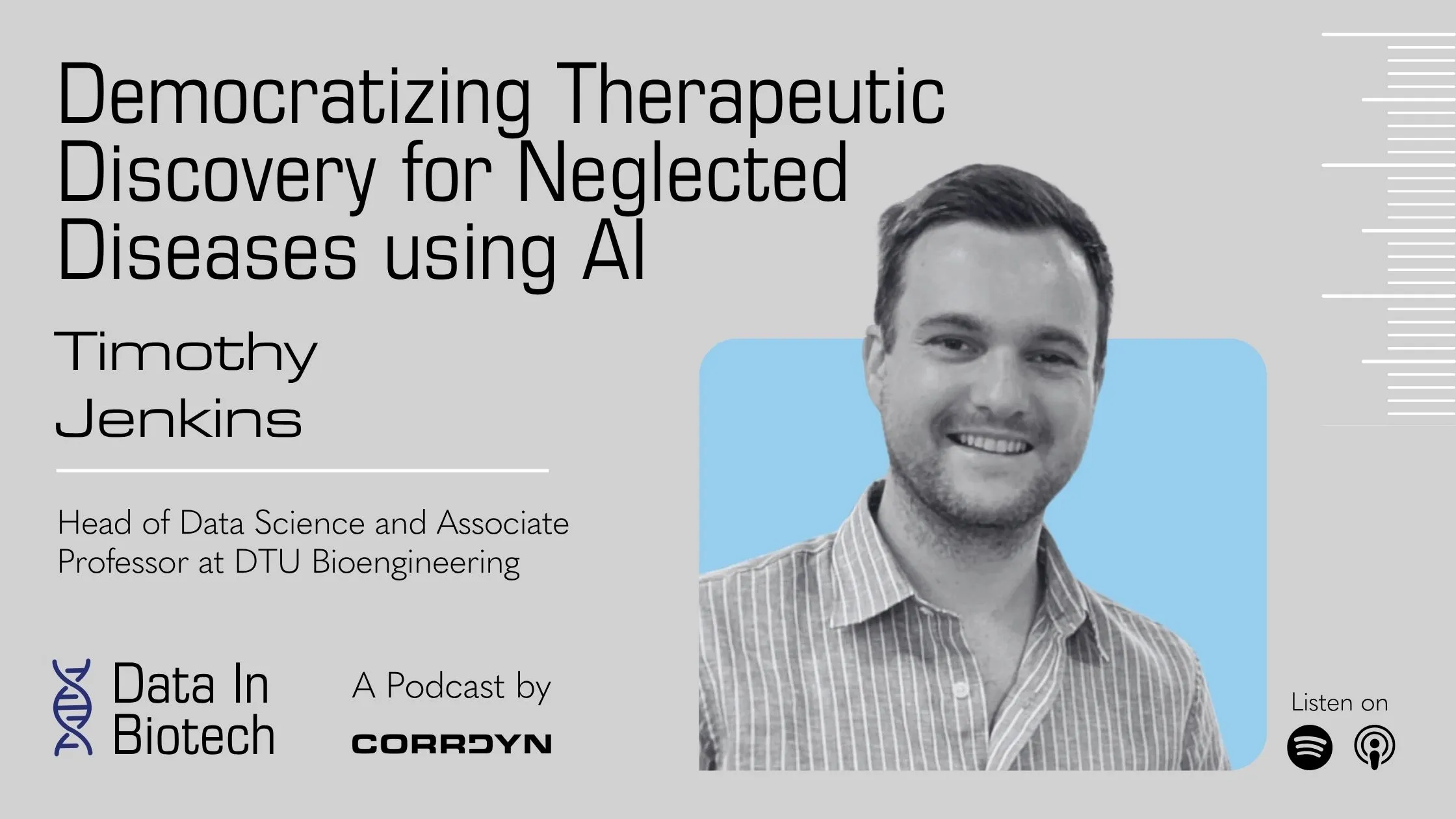
In this episode, host Ross Katz speaks with Timothy Jenkins, Head of Data Science and Associate Professor at DTU Bioengineering, who shares how advanced AI models are fundamentally changing therapeutic discovery. Jenkins brings a unique perspective, having transitioned from zoology to leading an AI-guided drug discovery research group focused on solving real-world problems.
The conversation explores the practical application of AI in de novo protein design, detailing how deep learning architectures like AlphaFold and diffusion models accelerate antivenom development from years to months. We discuss the technical approaches, the critical role of open science in democratizing access to these tools, and the commercial viability of AI-designed proteins. Jenkins also offers early insights into how quantum computing might further accelerate vaccine design.
Key Takeaways
AI Dramatically Accelerates Therapeutic Discovery Timelines
Modern AI techniques like de novo protein design can shorten therapeutic development cycles from several years to a few months. This rapid iteration allows researchers to achieve better outcomes faster, as demonstrated by antivenom binders developed in 1.5 months that surpassed those from two years of traditional lab work.
AI Generates Highly Stable and Scalable Protein Therapeutics
AI models, trained on datasets of well-behaved proteins, inherently design proteins that exhibit superior stability and express well in industrial production settings. This characteristic addresses critical manufacturing and cost concerns, making AI-designed treatments more viable for widespread use in challenging environments.
Open Science Democratizes Access to Advanced Drug Design Tools
The availability of open-access AI tools, such as those from David Baker’s lab, allows smaller teams and researchers in resource-limited regions to participate in therapeutic discovery. This expanded access removes historical barriers of specialized lab equipment and significant upfront investment, fostering a more inclusive research community.
Quantum Computing Shows Early Promise for Enhanced Vaccine Design
Initial research suggests that quantum-informed generative adversarial networks (QGANs) can generate more diverse and immunogenic peptides for vaccine development compared to classical methods. This indicates a future where quantum approaches could further accelerate the identification of effective vaccine components.
Related: CorrDyn provides data engineering and machine learning services. We also specialize in the biotech and life sciences industry and help biotech manufacturers gain more from their data.
Full Transcript
Jason: Hi everyone, this is Jason, producer of Data in Biotech. Before we get started, I wanted to let you know about our latest white paper. It’s a comprehensive guide to implementing machine learning models in biotech manufacturing. It’s a complete overview of all the potential problems of ML adoption, and more importantly, how to solve them. To download it, simply visit connect.corrdyn.com/biotech-ml. We’ve also dropped the link in the show notes of this episode. Okay, let’s get into it. Welcome to Data in Biotech, a podcast from CorrDyn where we explore how companies leverage data to drive innovation in life sciences. Every two weeks we sit down with an expert from the world of biotechnology to understand how they’re using data science to solve technical challenges, streamline operations, and further innovation in their business. In this week’s episode, we speak to Timothy Jenkins, head of data science and associate professor at DTU Bioengineering. Tim shares his journey from studying zoology and venomous snakes to leading a research group focused on AI-guided drug discovery. Studying the evolution of protein structure prediction, spearheading collaborative approaches in protein design, and managing the technical overview of anti-venom discovery. He also impacts a very exciting case study on the use of AI in developing solutions for neglected diseases, particularly focused on anti-venom for snake bites, and finally shares his take on the integration of quantum computing with protein design. Here we go.
Ross Katz: Tim Jenkins, welcome to the Data in Biotech podcast.
Timothy Jenkins: Thanks for having me, excited to be here.
Ross Katz: Well, just to kick us off, can you provide us a brief introduction to your background and what brought you here?
Timothy Jenkins: I can make it a long or short story. I’ll give you the short one and then we can dive deeper. My name’s Tim. I’m associate professor and head of data science at DTU, the Technical University of Denmark, just outside Copenhagen. I run a small research group focused on AI-guided drug discovery and development.
Ross Katz: And what got you into that field?
Timothy Jenkins: It’s actually quite a wound path. I started with zoology in Australia, working with venomous snakes, and then I got increasingly interested in the venoms themselves rather than just the animals producing them. That led me more and more down the molecular route and then the therapeutic route. During my PhD at the University of Cambridge, I realized that I really like computational approaches a lot more than wet-lab-based approaches, at least for myself. I started venturing down that road and looking more into the other end of the spectrum of how do we actually make therapeutics and how can we make them fast. AI seemed like a smart way to go. That’s how I ended up where I am now.
Ross Katz: It’s really interesting that you’ve been thinking about or working on snake venom for a long time. What made you passionate about exploring things related to snake venom?
Timothy Jenkins: Travel. That is probably the single best explanation. I traveled a lot when I was a child. When I was four years old, I was in Indonesia and that was the first time I got to hold a snake. It was a guy who had this little ice cream truck, but instead of ice cream, he had snakes. I guess most kids would have been disappointed — I was thrilled, and I was in love ever since. When I was six years old, I went to Australia and told my mom that I would study venomous snakes in Australia when I grew up. At the time she laughed at me and tapped me on the back like, “Sure, kid.” 12 years later, I could tell my mom that I told her so. She couldn’t really complain that I was moving to Australia.
Ross Katz: That’s an amazing story. Can you talk to us about DTU Bioengineering — the organization’s mission and what challenges you work on over there?
Timothy Jenkins: DTU Bioengineering is one of the many departments at the university and it’s got several hundred employees. It’s very much focused on biotechnology and biomedicine. We’ve got a very diverse range of groups. Most of them are very wet-lab focused and some of them are very fundamentally interested. It is a technical university, so we are training engineers. A lot of them are very solution-focused on developing next-generation cell therapies or looking at how we can create bioindustrial enzymes — a lot of different areas that we’re covering. Increasingly also focusing on driving data science, data literacy, data access. That’s also my role as head of data science, to pioneer the way and help lift up the whole department along those lines alongside my brilliant team in the Data Science Hub there.
Ross Katz: We at Data in Biotech are very excited to be a part of that. I know you’ve got some exciting projects going on at DTU, and probably the one that sticks out most is the soon-to-be released article in Nature about de novo protein design for neutralizing snake venom. Can you give me some background on the project and the work you’ve done around creating binding proteins for snake toxins?
Timothy Jenkins: I’m very biased on this, so take everything I say with a pinch of salt. But I’m very excited. I think it’s a really interesting step forward in the path of therapeutic discovery. The way this whole thing started was that I saw this preprint come out in late 2022 by David Baker’s group. David Baker might ring a bell at this stage — he received the Nobel Prize in chemistry just last week. At the time he was already quite popular and had put out a lot of Nature and Science papers. He put out this paper that was very eye-catching to me because it really promised that protein design had now matured to a stage where it wasn’t just cool but actually useful. I decided to reach out — thanks also to some good pushing from a close colleague of mine at MIT — and sent an email just before Christmas saying, “Hey, do you like snakes?” Luckily, snakes have a way of getting people excited and David got us started on this project. It was very fortunate that at the same time, a graduate student in his group from Mexico, Susana, who’s also the first author on this paper, had also started thinking about snake bite. The dots were connected and the project was started.
Ross Katz: Before we dive into the nuts and bolts of what you did in the paper, can you give us a history of the effort from the preprint you saw by David Baker all the way up to today? This paper you’re just now releasing is the latest milestone in a long line of milestones you’ve achieved along the way.
Timothy Jenkins: I wish I could take the claim to fame for many of them, but I definitely cannot. David, however, can — hence he got the Nobel Prize and not me, very deservedly so. I think the biggest push forward in my particular field has been the computational solving of protein structure. Proteins, these molecules of life — they are the antibodies in our system defending us from pathogens, they mediate the communication between cells. They’re essential to a lot of aspects in all living things. One of the biggest problems in this space is understanding how these molecules form a 3D structure. When you look at proteins, they are made out of amino acids, which can be seen as letters. But they don’t exist as these strings of letters. They exist as three-dimensional molecules. Resolving this experimentally is extremely painful and time-consuming and not very high-throughput at all. To give you an example, a single snake toxin structure — and snakes can have up to a hundred different toxins — could take you a year to understand what the protein actually looks like in three-dimensional space. David Baker’s group had pushed that field forward quite substantially with software solutions such as Rosetta, which tried to rationally predict how these proteins would fold. But the field as a whole didn’t really get close to solving it until AI engineers came in and developed something known as AlphaFold, which made the big splash in the community, because they started applying the latest machine learning models that were focused on language. Biology in a way is a language — it’s letters and sequences and words. They applied these same rationale to protein structure prediction and really revolutionized our possibility to identify structures. That is also why Demis Hassabis and John Jumper got the Nobel Prize alongside David Baker for protein structure prediction, because they at the company called DeepMind under Google developed AlphaFold and solved this critical problem. Then David Baker’s group came in and said, “Okay, that’s great. But the next step is really generating new things. How do we generate new structures from scratch?” People had been trying to do this rationally also with machine learning, but the success rate was incredibly low. You would have to test a hundred thousand different predicted therapeutics, and maybe one of them would be okay. That was awful because it would cost a lot of money, take a lot of time, and we had other technologies — very much wet-lab-based molecular biology — that were better, faster, more cost-effective. What was really shown in this paper was that the success rate went from 0.1% to up to 30%. Which might not sound like a lot, but it was completely transformative in this field, because now you could take 90 different variants into the lab and 30 of them would be decent leads that you could characterize further. That was really what caught my eye. They did this for six different biological targets, so it was seemingly robust. But I had to see it for my own eyes and try it out myself before I really believed it, because scientists are skeptical. I was convinced, and I am very convinced that this technology works and is really transforming the field that I’m part of.
Ross Katz: You believed in it and you needed to try it out for yourself. Can you walk us through the journey of going from reading about the new AI technologies for structure prediction and protein design to actually designing your own proteins for anti-venoms?
Timothy Jenkins: We’ve been working a lot already with AlphaFold and protein structure prediction. A key part in our field and in general is open science. There’s a lot of people publishing amazing models, but they’re closing the code, closing access, or not making it available for commercial use, which complicates broad adoption. But some of these tools have become very broadly adoptable. AlphaFold 2 was a great example, and the same thing happened with David Baker’s tools — he has had a very open-access attitude, and I think that played a major role in him getting the Nobel Prize because it opened up the field for so many people to do amazing things. We’ve been playing around with some of the tools that had come out and starting to play around with the new protein design tool. What was beautiful was actually seeing the experts use it and learning how they evaluate outcomes, how they work with it. In this particular project, we did not do a lot of the protein design in my group. That was really led by Susana at the Baker Lab, but we were part of the design strategy — understanding how we need to target these toxins to actually make effective therapeutics. Learning by collaborating is always the best way to work with the experts and then onboard it. Now we’re using this technology across a lot of different projects for bioindustrials or other therapeutic applications. It’s pretty amazing — quite user-friendly, I have to say.
Ross Katz: I’d love to go through a technical overview of the approach that you and your partners used to discover the de novo anti-venoms — from sourcing the biological data to training and conditioning the models, the different ways that you brought experimentation or external sources of measurement into the pipeline. If we could think about it from an end-to-end perspective how the process worked, that’d be really helpful.
Timothy Jenkins: Of course. The first important thing here is we didn’t build a tailor-made model for this particular application, which is the really transformative part of this technology. You can throw it at any biological problem that has a protein in it and use it. No fine-tuning, no nothing. It’s just a generally applicable tool. I can talk a bit about how that tool was built because it’s quite interesting. A lot of the things that are successful right now in biotech and biopharma are all derived from either large language models or image AI. In this particular case, we’ve got AlphaFold, which we use quite heavily, and I’ll get into more details later. That was built on large language model architecture. The generative design borrowed ideas from things like denoising diffusion that are big in image AI — where we’ve now all come to see and love the weird and quirky images that Midjourney or Dall-E 2 spit out. Where I say I want a monkey riding a bicycle on the surface of the moon. That same type of approach was applied to the protein space. The best way to explain that is that with proteins, over years and years of hard work, scientists have actually generated a lot of protein structures. It’s probably one of the nicest datasets we have in biology — all of these protein structures deposited under very rigorous criteria in something known as the Protein Data Bank. That database was one of the main reasons why AlphaFold could be so successful. It was the work of many scientists over many years that had established the foundation, the training data to build AlphaFold and make it so good. Traditionally when we’re thinking of protein structures, we try and tell the model here’s a protein, it does X, Y, Z, learn. We do this over and over again — the way we do with images. If we want a model that can identify a cat, we give it ten thousand or ten million images of a cat, label them as cat, and then we give it ten million other images and say not cat. Then it’ll be able to identify a new cat or not. The main thing these models couldn’t do is generate a cat. If you asked machine learning models five years ago to generate an image of a cat, it was a nightmarish creature that would haunt you. Now it’s photorealistic — you can have the right lighting, you can even decide what camera should be used. The reason this happened is denoising diffusion, where you introduce what is known as Gaussian noise — you iteratively noise your image, randomize the pixels, until it looks like your old TV screen from the ’60s or ’70s. You use each of these iterative steps to train your model to learn not just what is a cat, but how do I generate a cat from complete noise to something. You can do the same thing with protein structures where instead of just training on the whole structure, you take that structure and iteratively noise and randomize the location of each of the components, each of the amino acids. You throw these steps at your model and suddenly it starts learning how to generate a protein from scratch. On the surface level, that is very much what they did in this paper — using the same type of database, iteratively noising and using this for training. That really pushed the accuracy of this generative design quite far.
Ross Katz: Setting aside all the work you did up-front to understand the toxins inside these snake venoms — you’ve got this goal of designing an anti-venom that neutralizes as many of these toxins as possible. I believe we’re talking about RFdiffusion as the example of the diffusion model that generates these protein structures. Can you walk me through how you map from the toxins whose structures you know, and then condition the diffusion model to design proteins that are most likely to do the job you want them to do when you put them up against these snake venom toxins?
Timothy Jenkins: Essentially, you can not just train the model on individual proteins, you can also train it on protein-protein complexes — examples of where proteins interact. In the end, that is the aim of what we’re trying to do. We take a toxin of interest and we say we want something that sticks to this toxin. Ideally, it sticks in a position that prevents that toxin from interacting with a receptor. In the case we had here, we had neurotoxins. These toxins target your nervous system, they paralyze you, they shut down your breathing and your heart — really nasty things. They’ve got these three fingers, they’re called three-finger toxins. If we manage to stick something to the three fingers, we know this is not going to do the job it has to do to be toxic. What you can do with the model is it has learned how proteins like to be close to each other — how these proteins are going to likely interact, and on a biophysical level, what type of charges you have on the surface, what type of bonds are being formed with different types of amino acids. You just take the structure of your target, in our case a neurotoxin structure, and tell the model: generate something that will have a beneficial shape to the target protein we’re looking at. It creates basically the backbone, the hollow shell that perfectly matches your target — by saying here is the target, make something of this size with these type of properties to my target. Then you can use a second machine learning algorithm, a message-passing neural network called ProteinMPNN, that does something known as inverse folding where it suggests a sequence — the letters that you need to fold into this backbone. It’s the inverse AlphaFold: you have a structure and you want the sequence. With these two tools, you get your complete protein, your therapeutic protein. Then you throw it into AlphaFold and use AlphaFold as a way of understanding if what you designed makes any sense or not. There are different types of metrics — model confidence, the intrinsic model confidence from AlphaFold, and a lot of other things you can look at to say, “Is this likely going to work if we take it into the lab?” The combination of this design with the filtering has really pushed the success rates up a lot.
Ross Katz: I’m imagining you go through this process iteratively where you’re not exactly sure what the specific binding targets are or the specific locations of the binding targets — or maybe you are. I’m just interested in how you refine that feedback loop in order to get closer to the thing you’re trying to design.
Timothy Jenkins: One of the powers of this technology is that you actually have a very good understanding of where your binder will bind. Which is one of the biggest advantages over traditional antibody discovery where you’re basically trying to fish things out with a magnet out of a soup — “Yeah, it sticks to the magnet, but I don’t know where exactly.” In this case, we’re designing. What we’ve found in many cases — in this paper we’ve shown it, and I’ve also seen this in other projects in David’s lab and many other projects — if you have something that binds, we know exactly where it binds. We have complete epitope-paratope control. You can even condition the model to target specific areas by saying, “Focus your design strategy on this area.” So you give so-called hotspots on the target. After the evaluation in AlphaFold, if you’re lucky, you already have designs with the right scores, the right metrics, and you can take them straight to the lab. Which we actually did in some of the cases. But by and large what we’re doing primarily in my group now is going through as much computational refinement as possible because it saves money — it’s cheap and faster to do than doing it in the lab. What you can do is take what is known as partial diffusion — a bit like computational affinity maturation, binding strength maturation, where you say, “Here’s a good starting point. We know this binder looks good, but we think it can be even better.” Instead of starting from complete scratch, it starts with that and tries to change bits and bobs. You can do this both on the backbone — the structure — and you can also redo the message-passing neural network, ProteinMPNN, to suggest a bunch of different sequences. Then evaluate all of that again in AlphaFold. You can keep doing this as much as you want until you’re happy. Sometimes this is very easy to do, you get very good scores very quickly, and sometimes not.
Ross Katz: Once you have that feedback loop established, you can go down as many paths as you need to, and when you reach a point where you’re no longer improving but you’re not where you need to be, you know you need to go back to some earlier starting point and increase the diversity of the proteins you’re designing to see if there are other paths that lead to better endpoints. Am I thinking about that right?
Timothy Jenkins: Exactly. Diversity is actually a great thing to highlight here, because that is part of the strategy — there might be fundamentally something that the models get wrong. Some assumptions that are ingrained in the models due to the training data might just be inherently wrong. One of the things you’re trying to do is not just optimize your metrics, but also de-risk. You de-risk by having different proteins that are all predicted to be good. There are these two things that you’re balancing and it’s a bit of voodoo at this stage. Nobody really knows where the sweet spot lies — it depends a bit on the target, but there are definitely a lot of opinions on where the sweet spot could be. A lot of discussions with my students are exactly on this topic. How do you weight these two things properly? The metrics that you have are also not linearly correlated with success. We have a cutoff where we know under this there’s a good chance that they’ll work. If we drive these scores even further, there is sometimes an increased chance they will work, sometimes not. It’s still a bit of a black box that is really exciting to explore.
Ross Katz: That brings up the clear next question — when do you know that it’s time to go into the lab with the sequence or sequences you’ve designed in order to validate that what you’ve designed is actually doing what you expect it to do?
Timothy Jenkins: Very simply, we’ve got some standard computational metrics where we say, “If we’re under this, it’s worth taking in.” We try to improve those as much as possible, but when we see no further improvement and we have something underneath those minimum thresholds, then we say, “Okay, let’s take it to the lab.” The beauty of that is you can do a lot of iterations computationally before you do that quite quickly. You can go into the lab within a week of starting to design. Often it takes a bit longer, but it can go very quick.
Ross Katz: You mentioned that with snake toxins you’re dealing with a hundred different toxins. One of the challenges is that there are different breeds of snake, the three-finger toxins you mentioned, SVMPs, just different toxins you need to work with biologically. Is what you designed covering all of those toxins or a portion of them? What is the journey like from here to get to an anti-venom that covers the entire scope needed for something comprehensive?
Timothy Jenkins: I wish I could tell you we’ve solved it, we’ve neutralized all snake venom toxins now. If you go to Sub-Saharan Africa just give me a call and I’ll give you some of those AI binders. If that were the case, maybe I would get the Nobel Prize in medicine next year. Sadly, we are very far away from that. What we’ve done is shown in a couple of the most lethal and problematic toxin families that the concept works. It’s really a proof-of-concept study showing this actually works in neutralizing some of the most lethal compounds present in snake venom. To really make a product, we’ve got work at hand, and that is what we are working on now — focusing in on a given product solving a problem for a specific region. That is what we want to see: AI tech solving neglected diseases, unlocking a lot of these different neglected, especially tropical diseases, and creating cheap solutions for those people most in need. It is a long road ahead and I don’t want to over-sell what we’ve got here.
Ross Katz: What does the journey look like from here from your perspective? What are the next steps you need to take to get to the product you just described?
Timothy Jenkins: Happily. What we’ve really shown here is that these AI-designed binders — as far as I’m aware, these diffusion-based binders — work in living creatures for the first time. They don’t just work a bit, they work excellently. We saw full neutralization across different settings and we did this in an unprecedented amount of time. With traditional antibody technologies, in some of these toxin cases we’d been working on this for two years in the lab. We had binders that were better in a matter of a month and a half. The next step is: one, focusing on broad specificity — having single binding proteins, single therapeutics able to neutralize a whole subgroup of these toxins; and then doing this for more different toxin families so we can really make this anti-toxin cocktail of components that can go in. Then safety is something we need to look into. A lot of people are worried about AI proteins going into humans and they should be. These are foreign products that our immune systems have never seen. We were very happy to see that this wasn’t an issue in the mice we investigated in the neurotoxicity study — there were no obvious off-target effects or immune reactions. But we will need to evaluate that thoroughly. Then a lot of it is about how do you scale up production? Luckily these binders express extremely well. You can make very large amounts on industrial scale, at least based on the initial indications we’ve seen. We will need to investigate production strategy, formulation strategy, and plan the clinical trials — which is a nightmare when you’re talking about acute diseases such as snake bite, recruiting patients, standardizing. We are also in discussion with a lot of different partners who are experts in planning clinical trials and pushing drugs to neglected diseases. It’s going to need a large collaborative effort and a decent chunk of funding to back it up.
Ross Katz: You mentioned that the protein you’ve designed — you’re relatively confident it can reach industrial scale at a reasonable cost. Can you talk about what leads you to those conclusions, or how this method of designing a therapeutic enables that?
Timothy Jenkins: One of the things that is really nice is that all of these models are trained on proteins from a database — usually ones that have been crystallized. To crystallize a protein you need a lot of it. It needs to express well, it needs to be stable, it needs to by and large be a well-behaved protein. So these models only really know what well-behaved proteins look like. A bit of an exaggeration, but they have definitely learned more about that. Intrinsically they seem to be very good at creating well-behaved proteins. Across many different examples we’ve seen that the thermostability of some of our binders is up to 95 degrees Celsius. You might say that’s a bit of an overkill, my bench is not so hot, but having very thermostable proteins and therapeutics is very relevant when talking about tropical countries where antibodies often aggregate — these proteins are very stable. Why do we think they will also work well at industrial scale? They express well in laboratory settings and also in production-relevant hosts. Academics often say, “My thing expresses well on my lab bench so it will be great in industry” — and it’s not the same thing. There are very different types of systems and considerations. The beauty here is that I’m located at the Center of Antibody Technologies at DTU. We’ve got a lot of experience there and we work a lot with biopharma and bioindustrials who understand how to scale up these proteins. Just looking at the stability of them, the lack of aggregation, the way they behave in general in different systems — in yeast, which is a major production organism — we have high confidence that high-yield production is very likely with these proteins.
Ross Katz: I want to zoom out a little. This de novo protein design for drug development project you’ve gone through — it seems like it’s a microcosm of drug development processes writ large. In what ways is that true, and in what ways might it not be true in the future?
Timothy Jenkins: I think it is true in most cases. Biased opinion, but you will often need to get a good therapeutic starting point to your target of interest. It doesn’t matter if it’s a snake toxin, a viral protein, a cancer epitope, or something related to autoimmune disease. As long as you are talking about a protein target and you need a protein to manipulate it, this is a very applicable process. You can go through the same steps, use the same tools — and thanks to them being commercially available, it doesn’t even limit big companies from doing so. There’s always a time delay with novel tech being adopted by large pharma or large industry because there’s a risk associated to it. It really needs to prove itself academically, and I’m doing what I can on my end to do that — because if large industry starts picking up on this, and they are, we can really speed up therapeutic development across many other diseases that require treatment. You will always go through very similar steps: making sure your thing binds well, making sure it’s a great protein that expresses well, is stable, is developable. All of these same things apply to big pharma.
Ross Katz: What do you think made anti-venom development a good starting place for this kind of process?
Timothy Jenkins: There are many different reasons. It’s an area I know very well, and it’s always good to work in a field that you understand fully. It also is one of the areas that has lacked the most in terms of technological innovation because it’s been severely underfunded. There’s an example that is funny but really sad — up until a few years ago more money had been spent on making the movie Snakes on a Plane, which is obviously a masterpiece, than on research developing next-generation solutions for snake bite. If we look at it currently: if you were to go to Tanzania on a safari and are unfortunate enough to be bitten by a cobra, you might be lucky and they give you anti-venom. That anti-venom comes basically from horse blood. You’ve injected a horse with venom, waited a year for the horse’s immune system to hopefully make some good therapeutic product. You then take the plasma from the horse — don’t worry, the horse is fine — you purify it and inject it into a human. The technology there is very, very old school. It’s still saving lives and it’s essential. Trust me, if I got bitten I want this in my bloodstream. But it’s an area that really could use novel tech. That’s what we’ve also been trying at the center I’m part of, where we’re doing a lot of antibody discovery that has shown very big promise in terms of actually providing a treatment for snake bite. We’re also looking at novel technologies such as this AI binder design because we really think it has the biggest potential to make an impact in neglected diseases or orphan diseases that are often overlooked by big pharma just because they have a responsibility to shareholders.
Ross Katz: Looking back on this journey, if you could give yourself some advice at the start of this research effort — at the beginning of the design process to come up with de novo protein design for anti-venom — what would you tell yourself? Avoid pitfalls, avoid wasted effort, conserve resources — something along those lines?
Timothy Jenkins: It’s a question I always ask my students at the end of their projects to get them to reflect and I find you get very interesting answers there. This is a tough one, and I am very happy to say it is a tough one because things went extremely well and extremely fast. This is probably one of the most efficient scientific projects I’ve been part of. That’s also a big credit to Susana, the first author, and Melissa, who was the second author on the paper and did a lot of the work here. The best advice I could have given myself is: be more ambitious. Believe more in the technology. Think right from the get-go that this is going to work — how do we make the product, rather than just see if the tech works? But having said that, I’m very happy we did it the way we did and I couldn’t be happier with the outcome. Not too many regrets to look back on.
Ross Katz: Your paper mentions the potential of these methods to democratize therapeutic discovery. How do you think this method helps to democratize therapeutic discovery?
Timothy Jenkins: Theoretically you could run the same tools that we used on your laptop. It will take you a while and it will run hot so don’t keep it on your lap, but theoretically that’s possible. If you have access to some decent graphics cards you can speed up the process quite a lot. That is very different from if I told you: make me an antibody in the lab versus make me a de novo binder with AI. If I ask you to do this in the lab you need lab space, you need a lot of reagents, you need a lot of equipment, you need an antibody library to start with. There are a lot of startup costs you might not have in all areas across this globe. Whereas having an internet connection and access to a decent computer is becoming increasingly prevalent even in areas that are historically less economically strong. That is a big change of mindset. In a slightly different project where we also developed our own AI model for sequencing snake toxins to identify our targets, we ran the largest hackathon in Africa — with representatives from all over Africa, nearly every African country participated. We could give access to the tool by them just having a laptop and an internet connection, and they can be part of solving problems most relevant in their regions. I am not waking up worried about getting bitten by a snake in Denmark. If I do, that would be very unlucky — there are two people a year. But the people facing some of these diseases, why should they not be part of the solution? Why should they not figure out what the best way forward is, because they understand the problem the best? Tools like this, and having the digital age address some of these problems, is a great way to unlock a new talent pool that so far has had limited access to being part of the solution.
Ross Katz: If you were starting a new therapeutic design problem tomorrow, what would your first steps be? Where would you start?
Timothy Jenkins: I’ve got probably eight running in parallel right now on very different targets and areas. The best thing to do is think about a problem that currently has either a poor solution or no solution. Ideally something that you also personally care about because that really drives you. Understand the mechanism of that problem. Make sure that you have a problem that is solvable by a protein binder and then get your structure. We’ve seen that even with an AlphaFold-predicted structure, you don’t need an X-ray crystal, it works. You can have a target that is only predicted already and then just start designing. That’s really the best advice I can give to people, especially the young generation out there that wants to get into AI drug discovery. These tools are accessible. Try them out, reach out to people who are in the areas that you’re interested in, and just contact them: “I’ve played around with this tool, I think the area you’re working on is great.” There are going to be a lot of professors out there that have no clue how to use these tools. If you come in and say, “I love the biology you’re doing, I’ve got a way to give you some cool reagents, cool diagnostics, cool therapeutics” — I’m pretty sure they’ll be excited to hear from you.
Ross Katz: Can you give us some intuition about where the de novo protein design space can be applied in terms of therapeutic development, and where you think the disease mechanism would not lend itself to this kind of solution?
Timothy Jenkins: In a way you can look at it exactly like an antibody. It’s a mini antibody, so anything that an antibody can do these things can do. There are certain considerations — these tend to be quite small proteins, they don’t stick around in the body so long. There’s a way of engineering your way out but that makes them intrinsically a lot more interesting for acute diseases, acute conditions such as snake bite. Doesn’t mean you can’t use them for chronic diseases, but you have to engineer your way out of that. At least if you had to choose between an acute and a chronic disease I would probably go for acute. The risk of immunogenicity — causing an immune reaction — is also a lot lower because you’re giving this drug once, hopefully not more times. That’d be very unlucky if you continuously get bitten by the same snake. Or maybe at some stage, natural selection. I don’t want to assume here. I think that is one of the main things to consider. One thing that is a bit overlooked is going away from therapeutics. It does have industrial applications — looking at agriculture, targeting agricultural pathogens, increasing food safety. There are a lot of viruses that are ravaging through different crop plantations. Why not use some of these AI proteins to inhibit those and improve food safety? There are also industrial enzymes that need to function only in different conditions. You can use designed proteins to work with that, and really the next big frontier is designing enzymes — very different types of proteins completely from scratch. That’s the next big thing we’ll see in protein design as well.
Ross Katz: Have you looked into AlphaFold 3 at all? What are your thoughts on how this might integrate with or change your workflow?
Timothy Jenkins: We’ve looked at it from day one. We were very excited, as most of the scientific world working in this space. It’s obviously very annoying that right now we can only generate 20 proteins a day, it’s a very closed project, going against what I like to do, which is very open science. But there are plans and they are going to open it up. They’ve promised — and I’m pretty sure if they don’t, somebody will just reverse engineer what they did. We like it a lot and we’re very excited about it. The frustration just stems from being so excited about it and wanting to use it more. It will directly click into our design pipeline because right now we’re using AlphaFold 2 to evaluate. We’ve seen that AlphaFold 3 performs better in basically every case we’ve investigated. We’re probably just going to replace AlphaFold 2 with AlphaFold 3, and that will hopefully increase the success rate we’re seeing from our de novo design binders in terms of translating them into actual successes in the lab.
Ross Katz: So you replace AlphaFold 2 with AlphaFold 3 and hypothetically your hit rate just goes up. That’s basically it, there’s no other contingencies to think about?
Timothy Jenkins: Not really. Obviously new tools, new problems, but we’ll see about that when we get there. We’ve tested it in small use cases already and it’s shown a lot of promise. Google DeepMind also put out their own protein design tool, AlphaProteo. That looks really exciting and they’ve shown a pretty decent improvement over RFdiffusion as well. My intuition — it’s hard to tell from the paper — but my intuition is that a decent chunk of that probably comes from using AlphaFold 3 in the evaluation of their design binders, that their filtering is just going to be more stringent and better. I’m excited to see how this plays out in the protein design space.
Ross Katz: Let’s shift gears. You’re doing some exciting work around quantum computing. Can you tell us about that work?
Timothy Jenkins: I got basically conned into this, I have to say. Up until a year ago I would have told anybody who asked that quantum computing is witchcraft and it’s completely nonsensical to spend time on this. Two major things happened that changed my mind. One was my head of department said, “Hey, Tim, quantum computing is pretty cool right now. Check it out. You’re head of data science, you need to inform yourself.” He had a point. I should at least be informed so I’m not just complaining without any knowledge. I started going to a couple of presentations and started being interested, but still couldn’t really see how this applied to any of our use cases. I’m also part of what is known as YATSI — great name, I know. It’s the Young Academy of Technical Sciences and Innovation here in Denmark. This academy brings together a bunch of young engineers and scientists from different areas within the sciences, both from industry and academia. One of the people I met there, Sophie, was the quantum business developer at a company called Sparrow Quantum. We had a great chat over dinner and she told me that quantum is really cool and I should look into it. They’d seen some success with quantum combined with machine learning in image AI. That really caught my interest because quantum together with ML helping with image AI tasks rang a bell — as I mentioned, image AI has been playing a big role in what we’re doing in protein sciences. I started reading up more about the topic and started getting pretty excited. I involved one of my PhD students, Jonathan Funk — he was also very excited to play around in the quantum world — and we started a collaboration with Sparrow Quantum and Orca, which actually makes quantum computers as well, and looked at how we can use quantum computing to design and generate peptides — peptides basically being small proteins. The reason we’re going for these things is because quantum computers still aren’t super powerful. We need to focus on less complex problems. Eventually we want to go into proteins, but right now peptides. The interesting problem in the therapeutic world is vaccines. So far we’ve talked very much about antibodies and antibody-like treatments. But vaccines are the other way around — you just say, “Hey immune system, this is your target, make sure you take care of it.” You’re basically just forcing it to look at the evil enemy. There are two key things you need to do well to make a good vaccine. One: you need to show it the right thing. In the case of COVID, we had the spike protein and said, “Here immune system, see spike protein, make antibodies so you can defend yourself.” The other thing: the way mRNA vaccines work is the information of a protein gets inserted into the cell, the cell produces this protein inside, it gets chopped up and then presented as a peptide on its surface. To actually be presented, it needs to bind to that receptor really well — which is known as being immunogenic, actually presentable to the immune system. You want the right peptide and you want one that is immunogenic. We focused on that problem where we trained a quantum-informed generative adversarial network, a QGAN, to see if we could get it to generate peptides that were immunogenic. We compared it to a classical generative adversarial network, same input data, same training regime. We found that not only did the quantum approach create more immunogenic peptides, it was also extremely fast at learning. Even after one epoch of learning, it was very good at generating these peptides. This is very recent data so there’s a lot of digging we have to do, a lot of cross-checking. But as a first result, this was very exciting. Having presented to the quantum community at a conference called BiotechX last week — not being from the quantum community myself — it seems like the quantum community is also reasonably excited because there are not that many use cases and not many successes of quantum actually showing superiority over classical approaches. We’ve got a lot of efforts now digging deeper and trying to maybe make our first proof-of-concept quantum vaccine. Let’s see.
Ross Katz: Do you have any hypotheses about why quantum computers might be better at this type of algorithm than the processing units we have on our machines today?
Timothy Jenkins: The beauty here is we’re letting both the GPUs and the quantum computer do what they are very good at doing. The main thing we did here is not live quantum machine learning. What we did is got the quantum computer to generate a quantum distribution. The way that generative adversarial networks work is you have a generator that generates peptides and a discriminator that tries to catch it out and say, “That’s not real.” It’s fed input data. The other thing that goes in is a distribution — basically a map. This is the playground you have. This is the box of Legos you get to build your tower. We decided to change this playground from a classical Gaussian distribution to a quantum distribution. Our hypothesis was, “You’ve got a different set of bricks, maybe you’ll build a different tower. Maybe that tower will be taller or prettier or nicer.” At least different. The main hypothesis is that we are giving it a different framework to explore within. We were hoping for something better, but at least something different. The cool thing is when we actually looked at the way that this quantum-informed GAN was learning, it was generating peptides that were more diverse. It was exploring a lot broader than the classical one. We were very happy to see that that also translated to being quicker at generating things that were actually better and more useful.
Ross Katz: Super interesting. Tim, you’ve got some very fascinating research interests and some real successes to share, and it’s been a delight to have this conversation with you today. As we head toward the end, can you share where people can go to learn more about you and your work?
Timothy Jenkins: Of course. Just Google me on the DTU website. I’m very active on LinkedIn so feel free to reach out there. I’ve also got a website called digital-biotechnology.com. Feel free to check us out and reach out if you’re interested in anything we’re doing, want to collaborate, or want to hear more. Always happy to chat — and it was an absolute pleasure talking to you this evening, Ross.
Ross Katz: Well, thank you Tim. Really appreciate the time today and look forward to connecting down the line.
Timothy Jenkins: Same here.
Jason: And that’s it for this episode of Data in Biotech. If you enjoyed the episode, please subscribe, rate, or leave a review in your podcast platform of choice. See you next time.