Listen on
Overview
Most of the genomic data used to find drug targets comes from people of Northern European descent, because that is where the large biobanks were built first, and the skew does not stay in the reference genome. It carries into which variants get called real, which get labeled pathogenic, which targets get chased, and which patients can reach a trial. Cardiovascular disease compounds the problem with phenotypes that resist clean definition. One recent heart failure study had about 35,000 diagnosed HFpEF patients and produced a single significant signal, which was not specific to HFpEF.
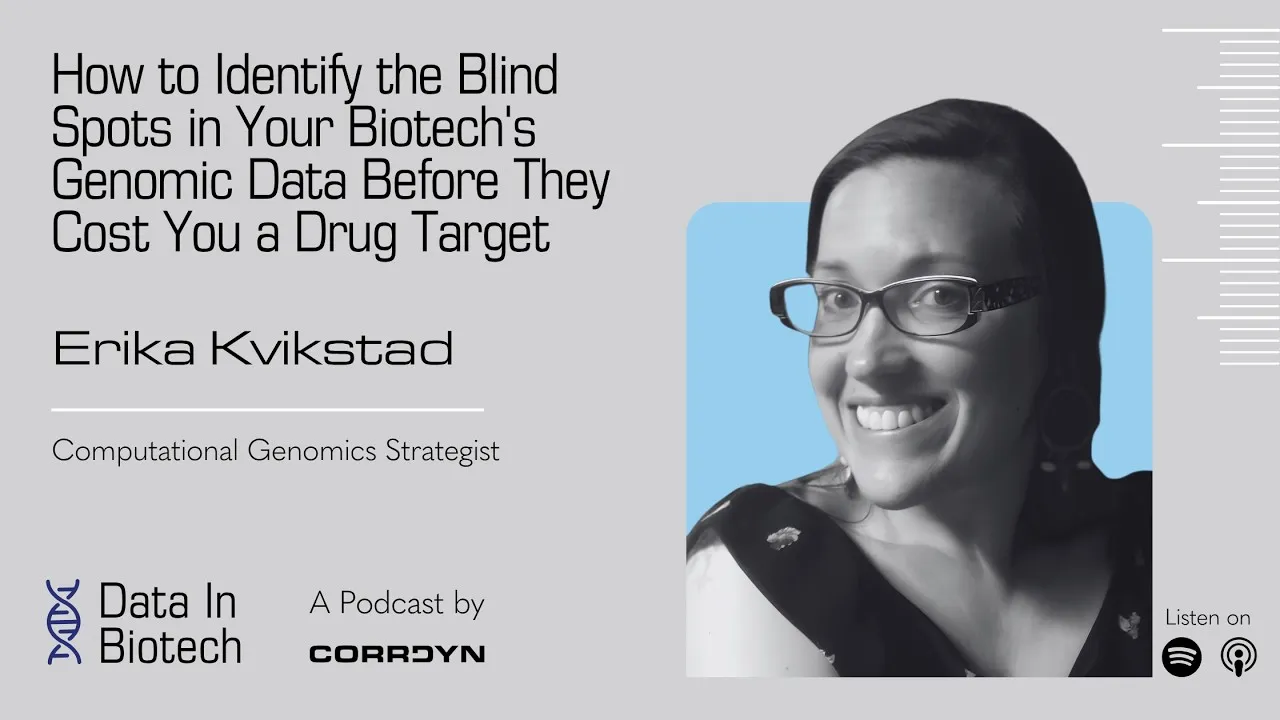
Erika Kvikstad is a computational biologist who led precision medicine for cardiovascular disease at Bristol Myers Squibb, where the team built on Camzyos, a first-in-class therapy for hypertrophic cardiomyopathy. Her career runs from academic genomics in France and the UK, including population-scale work with the UK Biobank, to pharma. She now works independently on genomic data equity, focused on how reference populations shape everything from target discovery to clinical trial recruitment.
Host Ross Katz and Kvikstad use cardiovascular disease as the working example because it stresses every weak point at once. Heart failure is a syndrome recorded through billing codes, the imaging that would settle a diagnosis is often unretrievable years later, and few patients with a genetically defined cardiomyopathy have ever had a whole genome sequenced. Kvikstad’s response is to sharpen the question first, pick the tool that fits it, and then check whether the data can support that tool.
Key Takeaways
Genomic bias starts at the reference genome and compounds at every step
Every variant call begins with a comparison against a reference, so the first question is whose genomes built it. Each later layer inherits the skew: AlphaFold for the coding portion of the genome, AlphaGenome for predicting functional impact in the rest, then clinical classification through ClinVar, ClinGen, and the Human Gene Mutation Database, all of which lean on frequencies from the populations that have been sequenced. When an association found in a mostly Northern European cohort is carried into another population, linkage disequilibrium and allele frequencies can differ, and the assumptions behind the association break. A variant of unknown significance there may be unknown only because too few people in that population have been sequenced. Better machine learning does not change the input, since the models still train on the same patient data.
A bigger sample will not rescue a fuzzy phenotype
A GWAS tests every variant it can scan, so the multiple-testing burden grows with genomic resolution and pushes toward larger N. Heart failure shows where that fix stops working. UK Biobank yields heart failure cases in the 20-some thousands, and a recent study built to find distinct HFpEF and HFrEF signals had about 35,000 diagnosed HFpEF patients, yet found one statistically significant signal, shared with HFrEF. Kvikstad reads that as a precision problem in the phenotype used as the response. HFpEF and HFrEF are two bins on a continuum, and when phenomapping tools carve finer subgroups, each subgroup falls back below the power a genome-wide test needs. Ross’s aside follows from it: tweaking subpopulations until something hits is p-hacking, and it voids the statistics the exercise depends on.
Billing codes drift, and a medication can rewrite a diagnosis
Most phenotyping runs on EHR billing codes, which are imprecise and sometimes wrong. Ejection fraction splits heart failure into reduced and preserved, and comorbidities such as hypertension, renal dysfunction, diabetes, and obesity split HFpEF into subgroups with distinct trajectories and drug responses. The codes also move over time. A patient diagnosed with reduced ejection fraction who responds to treatment can later carry HFpEF codes, and a clinician at intake for an unrelated admission can reclassify a patient as HFpEF because of a drug that treats both obesity and heart failure. Reconstructing the journey means lining up medications, diagnosis dates, imaging, and labs that were rarely recorded in sync, which is why Kvikstad wants models that take in all of that data at once.
Requiring complete records selects a younger, milder cohort
Imaging looks like the obvious check, since ejection fraction is measured from an image. The image that matters is often the early one confirming a diagnosis like DCM before the late heart failure event, and archives do not always keep it accessible even when a DICOM exists somewhere. In 2023 Kvikstad’s team built a language-model tool to pull ejection fraction and other diagnostic parameters from clinical notes, validated its sensitivity and specificity on patients with paired DICOMs, then applied it to patients who had only a chart. The effort was worth it because of selection. If you restrict the analysis to patients with every data point, you tend to keep recent diagnoses and younger patients without progression, and you lose the patients with critical disease who have since died.
Vendor evaluation needs a cross-functional team and a vendor honest about the gaps
Kvikstad’s evaluations put computational biologists, geneticists, clinicians, and an imaging expert in the same room, kept small enough to schedule. Each requirement shrinks the cohort. If you start with an HCM or DCM diagnosis and then require genetic data, imaging, and circulating biomarkers, the request soon describes a unicorn dataset. The vendors she valued treated the evaluation as an iterative collaboration: quick counts, more digging, cross-referencing against their other modalities, and a plain account of where the gaps were.
Germline genetics lets you sequence after the fact
In hypertrophic cardiomyopathy about 60% of patients have a known causal gene. In dilated cardiomyopathy the figure is 20 to 50%, spread across more than 50 genes that can go on a panel, and whole genome sequences for these patients are rare. Cardiovascular has an advantage over oncology here. Germline genomes are stable from birth for the vast majority of people, so a blood sample banked years ago can be sequenced asynchronously from disease progression, while cancer work needs tissue paired in time and location. That makes precompetitive sequencing consortia viable, such as the Alliance for Genomic Discovery, where NashBio works with the Vanderbilt hospital system. The sourcing differs too: oncology has Tempus and Flatiron, while cardiovascular data leans on NIH efforts, the DCM Foundation, and HCM resources such as SHaRe, run by groups with close patient relationships.
Pick the tool from the question, then check the data can support it
GWAS answers whether a variant associates with disease, and it needs power. Mendelian randomization asks what drives the phenotype, using intermediate traits measured in a broad population. UK Biobank’s imaging sub-study covers 100,000 participants, most of them people nobody would otherwise scan, so a variant linked to higher left ventricular end-systolic volume there can be tested against DCM in a separate, well-phenotyped cohort with matched controls. Kvikstad’s proteome-wide MR study applied the same logic to roughly 3,000 Olink-measured proteins in about 53,000 UK Biobank participants, testing them against 19 cardiovascular diseases in a some-by-all design, because resources like Open Targets already covered all-by-all. Single-cell expression data helped place candidate signals in cell populations such as cardiomyocytes, which bears on whether a mechanism is cardiac-intrinsic and what modality can reach it. BTN3A2 came out as a novel candidate for ischemic stroke with potential immune-modulatory biology, and integrating East Asian GWAS is how the team would test whether such signals are shared or population-specific.
Heart tissue is the scarcest sample, which limits what single-cell models learn
Transformer models trained on whole-body single-cell atlases, including early work from Patrick Ellinor’s group, learn the heart from a narrow set of donors: patients receiving device implants, people with severe disease, and organ donors after accidents. Technical replicates buy precision. Accuracy needs more distinct biological specimens, and those are hard to get when the organ is a heart. Kvikstad expects the technical hurdles to keep falling, which leaves representation as a people and design problem: working with communities whose genomes are not yet in any repository, and building those bridges now, before growing interest in rare disease makes them urgent.
Related: CorrDyn helps biotech and life sciences organizations evaluate real-world and genomic datasets before they license them, and builds the data quality checks that expose phenotype drift and missing modalities early. Also on real-world and genomic data: Lana Denysyk on real-world data for clinical trials and Jonathan Eads of Genomenon on genomics intelligence.
Full Transcript
Jason: Welcome to Data in Biotech, brought to you by CorrDyn. We explore the intersection of data and drug discovery. Let’s dive in.
Ross Katz: Welcome to Data in Biotech. I’m Ross Katz. Here’s a question that sounds simple: who are we designing drugs for? Most of the genomic data we use to find drug targets comes from a thin slice of the world. Mostly people of Northern European descent because that’s where the large biobanks were built first. My guest has spent her career chewing on that problem. Erika Kvikstad is a computational biologist who led precision medicine for cardiovascular disease at Bristol Myers Squibb and now works on it independently. She’s very good at showing how a bias that begins with whose genome we sequence follows the science all the way to who ends up with a drug that works. We get really concrete in this episode. Why heart failure is so slippery to define, that a patient can be reclassified by the medication they happen to be on, and things like why one study with 35,000 patients can produce a single genetic signal and not even one that’s worth following up on. I hope you enjoyed this one. I’ll say this up front. This is personal for me. I have one of the conditions that we talk about on this episode, and so I was really interested in learning more about the cardiovascular angle of the drug discovery space. So, Erika, welcome to the show. Erika Kvikstad, welcome to the Data in Biotech podcast.
Erika Kvikstad: Thank you for having me. Excited to be here.
Ross Katz: Awesome. Well, just to kick us off, your career has gone from academic genomics in France and the UK to precision medicine at BMS, and now independent work focused on health equity and genomic data. Can you walk us through the thread that connects all these chapters of your career?
Erika Kvikstad: Yeah, happy to. My background is a scientist in computational biology, and I’m really excited right now then obviously about how AI and machine learning are transforming our abilities in life sciences and healthcare. And throughout my career, I’ve used human data as it’s grown big data and computational approaches to translate complex biological signals into something we can act on. For example, that might be on the patient end, looking at whole genome sequences of patients with rare disease or cancer to understand what might be driving the phenotype in that individual. And then I’ve worked on the other spectrum, working with large consortia like the UK Biobank where we have population-scale data, and now the question is what are the drivers behind the risk for disease in a whole population of individuals compared to others. And throughout that, both ends of the spectrum when we’re talking about our genomic data, there are these questions that were lingering that were really nagging me in the background about what were we capturing and what were we missing? And that’s been what’s driven me to ask those deeper and deeper questions.
Ross Katz: Yeah, so asking the questions about who is most susceptible to the disease and what are the biomarkers, what are the targets that we can use to help from a therapeutic perspective. You helped build the precision medicine strategy for cardiovascular at BMS. Can you set the scene for what that team at BMS was mandated to do, and what role you played there?
Erika Kvikstad: Yeah, absolutely. We were really given the task or given the challenge to sustain and grow the pipeline of precision medicine for therapies for cardiovascular patients. And we did have a legacy to build upon, as you may know with Camzyos being the first in class and best in class for patients who have hypertrophic cardiomyopathy. And this really gave us a lot of room to double down on other individuals who are from these subpopulations of critical disease in cardiovascular. And it’s very heterogeneous when we think about cardiovascular in general. It’s a syndrome, it’s a collection of different symptomatologies and etiologies. By focusing on precision medicine and being precise in a very complex heterogeneous disease, it was really helpful to use an anchor on germline genetics. And hypertrophic cardiomyopathy, for example, about 60% of patients have a known causal gene. And that means that there’s 40% of patients who don’t, right? The flip side. And there are other diseases that are even more challenging like dilated cardiomyopathy where only about 20 to 50% of patients have a known causal mutation in a known gene. There are more than 50 of these genes that can be included on a panel. The genetic architecture is quite complex and it’s not always following this assumption of Mendelian inheritance. Even when we have precision medicine grounded in human genetics as an anchor to try to use that to determine causality, what is a variant and what is it associated to disease, and is it driving or is it just a passenger along the way? It was still very complicated in cardiovascular. This was clearly a challenge that required a lot of heads coming together and no one person could solve it.
Ross Katz: Yeah, that makes a lot of sense. And just a note of personal biography here, I have hypertrophic cardiomyopathy. I am taking Camzyos, so I am grateful to you and the previous team that helped to develop Camzyos. And although I do have family members in my history who have hypertrophic cardiomyopathy, I do not have the known genetic markers for hypertrophic cardiomyopathy. It required all of the regular annual imaging to determine that I had HCM in the first place. What you’re talking about hits very close to home for me.
Erika Kvikstad: Yeah, and thanks for sharing that and being vulnerable. Because I think when we see that we are part of a patient group ourselves or if we have a loved one who’s part of that, it takes the whole journey on a new perspective. We want to really get curious about what’s happening to our own biology, and then you start to think about all the complications and all of the other individuals who might not have the same access to be able to do the imaging on a routine basis. Yeah, there’s a lot of factors that really start to play when we have that kind of lens.
Ross Katz: For sure. Let’s take the different types of cardiovascular disease as our working example. You’ve described this as a heterogeneous disease where you’ve got these phenotyping challenges. Can you walk us through what it means to define a patient population, historically, since this is a disease that develops over a long period of time, from billing codes and the other ways that you can identify that patient population, when the nature of the diagnostic codes has changed over time and the way that they’re applied has changed over time? So I’m interested in your perspective on what that problem looks like and what do you do when you have to reconstruct these patient journeys from data captured in a changing medical and biological landscape.
Erika Kvikstad: Yeah, and that’s a really rich question in cardiovascular, and I think this applies to a lot of other disease areas that maybe are also complex. Well, walking it through, you mentioned that a lot of the phenotyping efforts are based on electronic healthcare records. EHR data, whether that’s inpatient or outpatient admissions. But those are billing codes and they’re not always precise and sometimes there’s errors. And when we are looking at, okay, I mentioned that we’re doubling down on different subpopulations, trying to get as precise as we can. Even with something in cardiovascular like we take heart failure, for example. Heart failure, we use ejection fraction or the ability of your heart to pump out as a way of measuring or defining subgroups. Do you have reduced ejection fraction or do you have preserved? So that’s two binary groups, but it’s really a continuum or spectrum of disease. And then you can get into, say, preserved ejection fraction or HFpEF. Well, there are so many comorbidities. Do you have hypertension? Do you have renal dysfunction? Do you have diabetes, obesity, other complex disease vasculature? So when we’re taking all these other upstream important factors, really what we see is we have a whole group of subgroups of patients who have their own disease trajectory, their own patient journey, and then ultimately may respond or not to a given therapeutic. Really with precision medicine, we’re trying to not just treat the downstream symptom which is a heart failure, but really understanding the mechanism of getting there, and that means we need to go beyond just the ICD-10 codes. One sidebar to that, for example. Say you really want to recruit a population that’s HFpEF. Depending on where your patients are coming from, how routinely they’re coming back to the hospital and having the scans and having the diagnosis, they may be on a medication, and so they might have had an incident and a diagnosis of heart failure with reduced ejection fraction, but now they’re on a treatment that’s really helping their heart, and so now they might have other codes in their history that are classifying them as HFpEF. And that means when we look longitudinally across a patient’s journey, taking in the medications, taking in when and at what time point along that patient’s course they had these diagnoses and being able to match that up with the imaging and the labs, that’s often a real challenge because there’s not always this timing synchronicity. That’s one complexity of the problem.
Ross Katz: It strikes me that you’ve got to try to reconstruct as best you can all of the different causal factors and interaction points along the entire longitudinal life of each patient, and then there’s the grouping that you’re attempting to do with the patients in order to identify their susceptibility to a given treatment regime, or something along those lines. And phenotyping is this label that you’re applying to this subgroup, but as you just mentioned, in addition to the longitudinal changes and the interaction effects you have of all of the different things that happen in a patient’s journey, you also have the challenge that everything that’s happening biologically is continuous, and so where…
Erika Kvikstad: Yeah, exactly.
Ross Katz: Where you draw the lines and how you do the groupings, and at the level of patient populations that you’re working with and the complexity of interactions and the number of variables that you’re talking about, getting to a place of being able to draw any conclusions from a given interaction has to be really hard. Am I thinking about that right?
Erika Kvikstad: Exactly. Absolutely. And I find it really fascinating and an exciting challenge. That means we need to work with people who have different expertise. For example, I mentioned the errors that can happen in billing codes, and a lot of people who work with real-world data are really familiar with that, but if you take a step back, you shared your vulnerability of your own diagnosis. My father actually has a number of complications and cardiovascular problems, but including that was a diagnosis of HFrEF and he’s had that for some time, and he’s never been diagnosed as diabetic. And he’s been medicated and you enter a hospital system for maybe an unrelated event and if you have, say, someone who sees on intake that they’re on a medication, for example, that treats obesity but also might be used as a heart failure drug, then he was reclassified as HFpEF simply because of that medication that he was on. And that was a very difficult challenge to then be able to be close to the data and try to advocate. In addition, whether you have a diagnosis of diabetes or not, then if you take that step back and we’re looking at the data, how specific is that to any one phenogroup that we are identifying? This is where machine learning is really exciting and having models that are able to take all the data, like have one model that rules them all. As opposed to looking at compartmentalized data.
Ross Katz: Yeah, and another aspect of excavating the data that you need to draw the conclusions that you want that you’ve talked about previously is that, obviously, as the patient goes through their journey, there are notes that are being taken, there are codes that are being applied, there’s labels that are happening inside of the hospital. And you might find out that imaging has been done. And okay, great. Well, a picture is worth a thousand words. And the conclusions that are drawn in the moment from that picture, from an echocardiogram or a cardiac MRI, the conclusions are useful, but it’s fundamentally collapsing a lot of that information that you’re there. That nuance of the continuousness of biology can have the potential to get lost. Can you share a little bit about your experience of how imaging can support the type of conclusions you’re trying to draw in cardiovascular, but then also the difficulties you have gathering this data for analysis.
Erika Kvikstad: Yeah, that’s a really good point and that brings to bear, right, both ends of are you deep in the data or are you really understanding the patient journey and the complex disease. Coming from the background I have in genetics and computational biology, imaging is an important biomarker, like I mentioned earlier, just the classification even on a HFrEF, HFpEF. How do we determine this? We need the image to be able to take that calculation or that measurement based on the heart function. Sounds straightforward and I would presume, okay, great, let’s just get my hands on some of this data and we can use that orthogonally to the ICD codes or together in a single model to see how well we’re doing at matching up these different classifications. Turns out, obviously, everything is harder than you think it’s going to be naively. And some of the simple questions that we didn’t realize that turn out to be really fundamental are, well, what’s the time of the image that the patient is taken with respect to their diagnosis? And along the course of their journey, if they’ve had a cardiomyopathy designation and perhaps a more refined model like DCM either wasn’t a code that was utilized or that refinement hadn’t been added on to what layer within the coding structure. That means that an image could be really important to have to validate that they’ve been on this journey of, say, that diagnosis for some time. And that’s prior to them then having the heart failure, that late-phase event. Gathering that information and those images, well, if we’re looking for that earlier history, data isn’t always maintained accessible. we face this as individuals all the time: how long are our banking records, can we pop them up, going back in all of our data on the cloud regardless of where it’s stored. We have these questions of how long and when we have archived. Hospital systems that are partnering with these data centers that are working with real-world data to provide this resource to teams then have that complication of the data might exist, the image might be there, there might be a DICOM, but can we actually access it? And this is where having those clinical notes alongside can be really powerful. And having a clinical note accompanied with a DICOM, you’re able to learn how carefully the match is between the variables that you can extract and every feature that you might be interested in from the image versus those that are captured by the clinician who’s seeing the patient. And often their notes will include their diagnosis and their observations that might be more precise based on their own experience and journey in that field. Then you can match those together and if you’re lucky and have paired data, you can do a lot of cross-validation to see how well you can develop a model. In fact, what we ended up being challenged with, and one of our earliest applications of GPT-5, I think it was 3 at the time, and Claude was just coming out. This was in 2023. We built a tool, in fact, to be able to extract not only ejection fraction but other parameters, features that are really important for diagnosis, match them up when we had the DICOM, and then be able to have that external validation of the sensitivity and specificity of our model and then apply it to those where we had just the chart and we didn’t have the image available, to validate the population data that we had, we thought was DCM is indeed DCM, to find nuances in disease progression. And if you restrict yourself to just patients who have all the data points for which you really want, you might be creating biases you don’t even realize. In that case, we might have been recruiting only patients with a more recent diagnosis, we might only have visibility to younger patients who haven’t had progression, or they might not have severity. Those unfortunately who had passed are on the death registry, who had critical disease, for example, wouldn’t be able to be included holistically in a data population to really gain insights not only for designing new treatments but for validation of existing, and so forth, as you can imagine.
Ross Katz: Yeah, and I can also imagine, as we’re going to try to touch on later, there’s selection effects in the data availability as well. Obviously, within the country, a major hospital system in a major urban area maybe has the resources to store imaging for decades upon decades and also has the relationships with real-world data vendors where the financial incentive is there for them to store that imaging data for use. But when you go to your rural hospitals or your hospitals that are located in developing countries, the infrastructure, the resources, and the incentives don’t necessarily exist as much.
Erika Kvikstad: Yeah, 100%. And that’s a real challenge in cardiovascular in particular. If we look at heart failure, the number of patients, I’m not going to get the number right, so anyone can Google it, but it’s something like six or seven million Americans annually are faced with a diagnosis of heart failure and are living with it. But globally, it’s more like 55 million. We represent just a fraction in North America, a small fraction of the overall patient population, and in fact, the largest percentage of individuals are in Asia, and we don’t have a lot of the resources from clinical trials and from a biobank perspective that are matching up with that patient population. And that’s just going on one end of the data consumption and not even touching all the other points and factors like you raised.
Ross Katz: Yeah, for sure. Obviously in order to do this kind of analysis and understand potential targets for cardiovascular disease and how different populations might respond to therapeutic approaches, you have to work with real-world data vendors. You’ve got a lot of vendors out there who are licensing real-world data with different coverage and quality. Can you share a little bit about how you think about evaluating a vendor and what you try to validate before you acquire data from a given vendor?
Erika Kvikstad: Yeah, so my experience might be different than others because, like I said, I’m not in epidemiology, I came into this from a different background. But what I really valued was working with a team to evaluate a vendor and really having a rich team. For example, my first experience where we were really doing this was a group of computational biologists, geneticists, deep clinical expertise, imaging expert, and trying to get all those people in a room. You can’t have too many because then you just can’t get any time on a calendar. But if you have enough of that knowledge together assembled and you’re working with a vendor who sees it as a collaboration truly and not just a sale and an endpoint, you’re able to not only get that quick estimate of what the numbers are of individuals who have a diagnosis, let’s take HCM or DCM as an example. But we already spoke about how the majority do not have a known genetic causal gene. Perhaps recruiting patients who also have their genetic information available is really important. And then that might now narrow down the data availability. You layer on imaging and that might layer it down. And you layer on another factor, say, for example, circulating biomarkers, and now you are looking at a unicorn dataset that’s going to have every single one of these features, including the deep phenotyping to really be able to say, we’re in this population of cardiomyopathy, we’re in this patient population of preserved ejection fraction and not overall heart failure with reduced. From my experience then for the evaluation, it was important to me to see that there was that cooperative, that real team endeavor to have that iterative back and forth to be able to evaluate, get some quick numbers, do some more digging, being able to cross-reference with the other modalities that they had, and being straightforward about where the gaps are and not trying to provide that unicorn if it doesn’t exist but actually giving a really good sense of what the possibilities and opportunities are. And I think I had really great exposure and really great experiences working on teams that were like that.
Ross Katz: Can you give us some examples of some of the gaps that you would look for when you were given an opportunity to acquire a new dataset?
Erika Kvikstad: Yeah, so we spoke about imaging and that being a challenge there in terms of are the images accessible, can we have the DICOM, can we have the report paired together, are they not going to be paired, what’s available? But in addition, for precision medicine, we were really taking the approach that’s been used in oncology and other areas of anchoring on the genetics as being the architecture for which we can have some foundation of causality. In germline genetics, we have our genome before we have our phenotype or manifestation, so we also have a pretty good understanding that the possibility of confounding and reversal is rather low. We really wanted to make sure that we had that genetic information. And for a genetically defined disease like HCM or DCM, it is really rare to have individuals who have their whole genome sequence, for example. What we can then work with in filling that gap are having consortia in a pre-competitive fashion coming together to pay for and provide the whole genome sequencing from a rich hospital system. One of the examples of that is the Alliance for Genomic Discovery. NashBio has been working closely with the Vanderbilt hospital system for some time now. They’ve had really great examples of that success. And that effort then is, knowing that there’s enrichment for particular diseases, so these patients could be really valuable. They don’t have that genetic data readily available. Now can we have it and be able to then match that with the other data to be able to say, can we find those mutations, new mutations that haven’t been identified that might be enriched in the population, but more importantly are there new targets that we need to be focusing on and what is the disease mechanism.
Ross Katz: Right, so you can’t go back and capture point-in-time records from patients who’ve already gone through the hospital system, but there is the opportunity, if you have samples available, to do that full genetic screen, but that’s relatively expensive, and so the consortia of pharma partners come together to pool resources in order to flesh that out. Am I thinking about that right?
Erika Kvikstad: Yeah, absolutely. And here’s where in a non-oncology therapeutic area, you have an advantage. If you have a banked biospecimen at a hospital system, someone’s come in and they’ve had a blood draw, and then there’s going to be technical differences in how those are preserved, but regardless of that, with indications that are not like cancer, where you have tumor cell growth, you have turnover, you have different populations growing, there you really need the right paired data at the time, and timing is important and longitudinal and making sure you’re getting it from the right subpart of the tissue. There’s a lot of factors that are really important in data capture there. Timing of those specimens is super critical. But fortunately, our genomes do change with aging over time, but for the vast majority, it’s stable from birth. If you have that blood draw and you have that ability to have that specimen on file, those germline genetics, you can have that sequencing performed, and that can be asynchronous to the actual disease progression.
Ross Katz: Yeah, that makes a lot of sense. Since you mentioned it, a lot of the real-world data infrastructure has been built for oncology because of the challenges you just outlined and also because of the number of people whose lives cancer touches. Can you talk a little bit about what are some of the other differences you see between the real-world data landscape for cardiovascular and that of oncology?
Erika Kvikstad: It’s interesting. There are a lot of resources: Tempus, Flatiron, a lot of these data sources where we do have really rich data in oncology. And in non-onc like cardiovascular, interestingly it seems like a lot of the data is being sourced by institutions who have close access to the patients and who have that trust. You have NIH efforts, you have the DCM Foundation which is making an effort to get… I mentioned before, it’s very low, the proportion of individuals that actually do have sequencing. Right there, having that connection to the patient and being able to not only have their sequencing but inform them as we’re being able to update on the tools and our ability to infer what is a driving mutation. And the HCM, as well, has a number of faculty who’ve been working really closely with these patient groups. They have resources like SHaRe, which is a resource, again, that is driven by having the trials, having the recruitment, the close relationship with the patients. You see that there’s a difference in terms of the communities that are involved. And that’s one of the observations that I’ve had working in that space.
Ross Katz: Yeah. You’re going through this data gathering process in order to lay the foundation for you to be able to draw meaningful conclusions about what the biomarkers are, what the targets are, who the subpopulations are that you want to target and who ultimately is going to benefit from whatever therapeutic program you’re bringing to market. But the thing that you’re trying to get to is statistical power in the methods that you’re using so that you can feel really confident about the conclusions that you’re drawing and move a drug or target through the pipeline. I’m interested in hearing from you, what are the situations that you run into where statistical power in cardiovascular is not what you need it to be, and what are some of the assumptions that you make in advance that can break down as you’re actually working with the data?
Erika Kvikstad: Yeah, that’s a great question. Again, in my career I was disease-agnostic, so I spent a lot of my time looking holistically at the genome. When we think about GWAS associations, for example, a genome-wide association study, being able to test a phenotype of individuals, say, with a disease versus healthy individuals, every single mutation that we can scan along in their genome and test whether or not it’s significantly associated with that risk. What’s interesting is then for those statistics, we need to have statistical power to say there is a difference and to say that with some confidence. And one of the first things we think about is increasing the sample size. Do you have large enough N enabled to be detecting that across the number of tests that you are computing? So when we’re starting to look at how fine precision we have with genome sequencing, that’s a lot of tests that you’re able to perform. Things can just lose their significance because of the sheer number of data points you’re testing. And what’s a really good example of how that breaks down in cardiovascular, I alluded to the heterogeneity of the phenotyping. The definition. Some of the early all-comers heart failure GWAS studies that are available have large numbers of individuals, populations. UK Biobank, and you can refine heart failure and you still have in the 20-some thousand individual cases. And most recently, there was a really great study trying to look for distinct signals in HFpEF and HFrEF patients. Again, this statistical association test, and using a platform like the Million Veteran Program for patients and there having the right data to be able to say clinically are they falling into these categories. And even with something like 35,000 patients of diagnosed HFpEF, still, there was only one signal that reached statistical significance. And it was not unique to HFpEF, it was also shared with the HFrEF population. Sometimes you can just keep adding the number of individuals and it’s not solving the problem. When you have theoretically enough power and you increase that sample N, it indicates that you have not just the precision on the genome that you need to refine, but you have precision in that phenotype that you’re using as your response. And that’s where HFpEF, HFrEF are, again, on a spectrum of disease; that’s not really true to all the variability underneath that grouping. Then if you try to get further and further, using phenomapping, and there’s a number of really cool tools to get even further refined subpopulations within those categories, you still find that often you still don’t have sufficient power to find signals that are meeting the statistics, that are not just by chance and also that are unique to that individual group.
Ross Katz: Yeah, and so one approach to that would be to just p-hack your way and tweak your subpopulations until you find something that is a hit, but obviously that renders all of the concepts of statistical power irrelevant, and so any conclusions that you would want to draw at that point can’t be achieved. It sounds like the data that is available is not quite sufficient to extrapolate the level of conclusions that you would like to draw. Having worked with the UK Biobank previously in the depth that you have, I’m interested in how you think about UK Biobank and what similar resources were designed to do. Where do you think that they deliver genuine value and where do you think the gaps start to emerge when you try to apply them to a specific indication, like DCM?
Erika Kvikstad: Yeah. UK Biobank and other biobanks of this nature are incredible resources. Half a million, it’s a retrospective study, so there was no enrollment, recruitment for any one particular indication or disease, and there’s rich data resources. The sources that are available include the EHR from hospitalization, but also GP records, so seeing your primary care physician, as we call it over here sometimes. And you have then lab procedures that are taken, you have their omics, whether it’s genetics, proteomics, metabolomics, for example, and it’s growing. And you also have registries: cancer, clinical, death registries. You have their medications, and you have questionnaires that are filled in by the participants. You have all these different data sources for which you are trying to harmonize a phenotype, and it’s not necessarily provided for you. It’s not an epidemiologist going through and saying, this is the right tool. But because it’s a community project, those who have taken the time to explore all the different mapping ontologies, who have developed the tools to integrate these different data sources, provide back, and that’s part of the participation with something like that, and then you can learn from others. I can’t even tell you how many papers there are published on that resource. It’s probably well into magnitudes more than what I remember, and that was even in the thousands. The point being is for discovery purposes, that is extraordinary. Whether or not it’s a population where unfortunately you have rare disease and there aren’t many individuals represented. Because you have all of that integrated data. In the case with something like DCM, where it might be that you have less than 1,000 participants, do you have the power to do a statistical association test? Perhaps not. But there are other publicly available GWAS across recruited populations that do have signals. You can look at those loci in these individuals for validation and look at all the other data that they have available that might not be in that collection. There is still a lot of fruit that you can get from this resource even if you’re looking at these indications that are very rare or ultra-rare.
Ross Katz: Yes, the way I understand it is that you’ve got the biobank-style datasets that are broad and to a certain extent deep, like the UK Biobank, as you just described, has very rich longitudinal information about each patient, but then as you’re trying to get closer and closer to the answer to the question that you care about in any given point in time, you’re trying to bolt on these other more focused datasets that give you the exact richness of information that you need within a given disease category. I’m interested in hearing you talk about how you work with the two types of datasets in tandem. How do you take the genomic signal that you do or do not see inside of UK Biobank and end up getting to a clinically meaningful outcome and bridge the gaps between these two different types of datasets?
Erika Kvikstad: Yeah, I’m really glad you bring that up now because we were talking about maybe having a resource, like UK Biobank or some of these other biobanks, where you didn’t have a recruitment strategy for a specific disease. And in the case of UK Biobank, where you have these sub-studies that are providing information, you have, say, for example, the imaging sub-study which is 100,000 individuals having their whole body imaging, DEXA, and this is such a rich resource in the sense that you can now map up healthy individuals, even if they’re not the patient population you’re looking for, to find associations between an imaging trait and an outcome that you might not have the power to do in a bespoke clinical case study where you’ve recruited individuals who have that disease. What you can use are other tools that are really fit for the question. If your question is, is a variant interesting and is it associated with this group? We really need a lot of power in order to say that with some statistical significance. If your question is, what is really driving disease for this phenotype? Then you can use other tools like Mendelian randomization, where you have a natural population and you have this rich data resource and you can look and say, in this population, individuals with this particular variant have an increased left ventricular end-systolic volume, as an example in the case of cardiovascular. And perhaps we never had a natural population. Because let’s be clear, people walking around outside aren’t just wandering into a hospital saying, please take my CMR, right? So we don’t always have an opportunity to gather that data. Now if you have a hypothesis that people who have an increased end-systolic volume are more likely to have DCM, then you can test that by having those signals in a different population for whom you don’t have the imaging trait, but you do have a really rich refined disease and you have those matching controls to say statistically, yes it is associated. That’s how you can make bridges between those different bespoke, really important cohorts versus these larger, broader biobanks that might have depth in different areas.
Ross Katz: Right, but even after you do that, we still have the problem with the UK Biobank that it is exclusively from the UK. There’s the representation problem that I know is very important to you. You’ve got these genomic databases from primarily Northern European countries where you have public health systems available, where the genomic databases skew heavily toward Northern European populations. I’m interested in what it means for the computational biology and the pharma community at large when the biggest and most important data sources that you can use for this kind of discovery work that you just described are biased in that way.
Erika Kvikstad: Yeah, that’s a really good point. And if you take a step back, it all starts with genetics and it’s really propagated throughout the whole process. We need samples of genomes in order to make a comparison between individuals to say, is this an error or are we seeing something that’s truly a variant that represents a mutation that occurred in this germline? And so what do you do to make that observation? You compare against a reference. Okay, so what do you use as that reference? So it starts there. Then you can say, well, is this variant interesting, so what does it affect? So maybe we’re using really cool tools like AlphaFold to infer the prediction of what it’s doing on a molecular scale. This is great and it really helps us in that 5% of the genome that is coding to understand if it’s having a direct impact on a molecule. Now we’re saying it’s interesting, but still, where’s the data that we’re accumulating here? Maybe we don’t have all the proteins covered, we only have 5% of the genome. Now we’re layering in, like with AlphaGenome, the ability to predict functional impact from the rest of the genome. But it’s still just saying is it interesting from a molecular perspective. Now we’re going to say, well, is it having a consequence and is that consequence important to disease? So there are a lot of algorithms now that are predicting what is the impact on clinical data. And we have resources like ClinVar, we have ClinGen and the process of having the clinician involved through that vetting stage. And we have some guidelines that we use to say that this is statistically associated and likely to be pathogenic, likely pathogenic, other categories. And that includes variants of unknown significance. These underlying models, regardless of how sophisticated they are with improved machine learning and AI, they’re still based on, again, patient data, and from whom is that coming from? And are those patients primarily… Human Gene Mutation Database, for example, to say that there is an association? What’s the frequency in the population? So what populations are sequenced in order to infer that? So there’s this cascading effect of always where’s the data coming from, so who are we able to infer there is a consequence. And now if you take an association that you see in a primarily Northern European population and you say, okay, this variant seems not only important because it has a consequence, so it’s likely impacting a mechanism, and it leads to disease because we see that we have some strong predictor that it is associated with this disease group. Okay. Now if we look in another population, a lot of our assumptions break down. Linkage disequilibrium might be different, so the inheritance pattern, we might have different consequences for the segregation of alleles, we might have different impact on what is the frequency of the mutation in that population. A variant of unknown significance in that population might be just simply from the fact that we haven’t sequenced enough individuals in that population in the first place to see that it is in fact associated to disease. There is this propagation of effects that really is circular in the fact that it all starts with where we’re having our data come from.
Ross Katz: Yeah, I’m interested in where you think that the skew in terms of the population that’s available causes the most issues. Is it that this causes the most problems in trying to predict which subpopulations are going to be most at risk, or is it understanding the underlying mechanism of a potential pathway that you could knock out, or is it targeting for clinical trials? Or some other aspect of the work that you do, where this bias shows up most strongly?
Erika Kvikstad: I think it really comes up at all levels. And like you just said, in terms of target discovery, if our true aim or mission is to be able to treat individuals globally who have this disease, then it’s important if we know whether or not the same mutation in the same gene is going to be associated with disease in that geographic area. But also it comes down to what diseases are we looking to treat? Because if it’s a rare disease where we don’t have a lot of cases reported, and they’re primarily reported in parts of the globe that we haven’t had a lot of population sequenced yet, how do we make that association so that we are hopefully treating the root cause of disease and not just a biomarker that’s changed but has actually been driven by the disease continuation itself. And in terms of the trial recruitment, that’s huge. Because if we are going to be, say, focusing on the best drug for the right patient, it gets down to at the right time in their course of disease. If we can’t actually get it to them because they are not in a part of the world maybe that has the recruitment site, they don’t have the relationship already established so that they’re part of the trial design, or a lot of other factors can come into play. That impacts the ability to then test your hypothesis, have that treatment available with clinical success and then actually get it to market, right?
Ross Katz: Yeah, that makes a lot of sense. What I’m hearing is that the bias is pervasive and that it impacts all levels equally and you can’t escape it, and there’s the working assumption, at least in data science and AI circles, that you can model your way out of these problems, but when you’re training on only a subpopulation of the universe of possible patients, then your ability to extrapolate to patients whose genomes you haven’t seen seems questionable, to say the least.
Erika Kvikstad: Exactly. I was going to say, you mentioned, with AI and with the computational tools we have now, what’s really exciting is we see technical traction. We’re using it successfully in a lot of ways, and we have genomic foundation models, and we can do comparisons across multiple species in order to see the robustness of the prediction of just learning, like Evo 2, from the genome itself, not providing it a language, and the DNA language is going to be different than English or another spoken language. We see the technology is there and there’s a capacity and it’s exciting. It’s capturing that excitement and at the same time using that lens of what’s the question we have and what’s the data to answer that question? Keeping that in mind.
Ross Katz: Yeah, that makes a lot of sense. I want to jump into an example of your work to illustrate the type of work that you do with the datasets that we’ve been discussing. You and your co-authors used Mendelian randomization across 3,000 circulating proteins to identify these candidate causal proteins for 19 cardiovascular diseases and flagged a novel candidate for ischemic stroke risk. Can you walk us through what that study set out to do and why proteome-wide MR is a useful lens for this type of discovery specifically, and if you’re willing to talk a little bit about how using the UK Biobank leads to some of the underlying assumptions that you have to make, then I would love to hear about that too.
Erika Kvikstad: Yeah, that’s great. I think that’s a really nice segue from what we were just discussing. The UK Biobank, as part of the pre-competitive consortium, was releasing the proteome sequence on a panel provided by Olink for approximately 3,000 proteins or analytes. And that was performed on a subpopulation and now it’s being scaled. And the idea there is what are the genetic signals as well as other phenotypes that we can underlyingly associate with circulating proteins that are widely used as biomarkers of disease. And that’s one out of many tools that we can use it for. But specifically what we were asking is, okay, in cardiovascular disease, we do have this power issue. We have some really bespoke GWAS studies that have been performed on collected individuals, but we might not have other molecular signals to actually tie that variant that looks interesting in that population to a mechanism. And we want the variant to mechanism to understand disease and where to target and to ultimately get to a treatment. To complete that chain, what we were using was Mendelian randomization to test these hypotheses across all the analytes that we had in the UK Biobank and the variants that we have in those participants, of those 53,000 individuals, to see and test that if there is an increase in a protein in that population, does that also lead to increased risk for disease? And it could also be the opposite, that that protein is increased in its absolute value in circulating blood because of the disease progression itself. Really you’re able to make those tests, and that’s getting us closer to a useful grounding point for starting to develop a therapy. This kind of target identification and exploration, if we’re grounded in the germline genetics, is really a helpful anchor, because we want to look for drivers. What was really cool about working with Chen Li, the first author on this paper, and it was a whole team effort, was to be able to perform this some-by-all approach, because we knew that the overall consortium and resources like Open Targets were going to provide an all-by-all resource, meaning testing all proteins against all phenotypes. We took a different strategy and said, well, how can we quickly aid the cardiovascular therapeutic area by testing hypotheses that could lead to these new targets or refining which biomarkers are used in which populations. That’s why we focused on this some-by-all approach rather than an all-by-all, and by taking those really powerful GWAS that were publicly available, being able to intersect the data in different data types, so linking it with available expression data from single cell, and to see whether there was an intrinsic cell population like cardiomyocytes that were really enriched or associated with those variants in that disease, that really gives you an anchor then to now say, like I was describing, now you’re closer to identifying what that mechanism is. And then that can really guide you on the right modality to get to that mechanism. Is it cardiac intrinsic, is it outside of the heart? these are really important questions along that path to treatment.
Ross Katz: Yeah, that makes a lot of sense and it highlights how the availability of this data and the increasing intersections of data that you’re able to use open up pathways for researchers like you and for people across organizations to take these different methodological approaches and discover potential candidates that can be targeted and assess them on their merits when thinking about the biological mechanisms.
Erika Kvikstad: Absolutely. And one of the signals that came out that was really interesting was a gene that is involved in inflammation modulation. There’s this often well-known and obvious link between inflammation and cardiovascular disease and a lot of other diseases that are maybe driven by some of the other comorbidities we mentioned earlier: hypertension, atrial fibrillation, ischemia. And in particular, one of the associations that came out, BTN3A2, was really interesting in that it was indicated in inflammation in the enriched in cardiomyocytes within the heart. In an intrinsic inflammation pathway. That then opens up other possible ways of treating cardiovascular disease in ischemic stroke. And if we see a signal like that in another population, by combining and integrating the data with the East Asian GWAS, we might see a signal that’s unique in that population or shared, and then we can go back and test those hypotheses by having more datasets to validate.
Ross Katz: Yeah, that makes a lot of sense. I love that example, but I’m also just interested in zooming out a little bit on the computational tools that are available. It’s a wonderful time to be alive when you’re in the computational space because there’s just new tools that are coming out all the time, and new datasets that are being released and expanded. You’ve got GWAS, you’ve got MR, multiomics that you can integrate, machine learning phenotyping. I’m interested, in particular in the cardiovascular space, cardiovascular precision medicine, how do you think about choosing the right tool for the job and stringing together the way that you’re going to make inferences along the way that lead you to a conclusion that allows you to move a target to the next phase of its development?
Erika Kvikstad: Yeah. We can ground ourselves in cardiovascular, but I think a lot of it is more broad than that and is therapeutic-agnostic in the sense of what is ultimately the clinical question, and then what is the right tool and the data to answer that question? So if our question is, do we see an association to disease? We have GWAS, and we know that we have a lot of GWAS available from these large biobanks for not only disease phenotypes but also for quantitative traits. The imaging in cardiovascular, we have really rich data for circulating proteins, because we think a lot about cardiovascular disease and a lot of times our mind goes to, uh-oh, I gotta check my cholesterol soon. We have this intuition that we know that our cholesterol, maybe our levels of LDL, are leading to atherosclerosis, which leads to a form of cardiovascular disease. We have a lot of that circulating data that we can use, and that again can be used in an association. Mendelian randomization you would use if the question is really not just is there association, but is this particular variant in this gene or regulating this gene, because mostly they’re not located in that 5% that’s coding, unfortunately, that would make life a lot easier. Then you can say, well, is there a regulatory transcription factor binding site, enhancer element that can allow us to say that modulation of this gene is what’s leading to this phenotype? And so in order to do that, maybe we need these intermediate traits. And circulating proteome for some cardiovascular diseases that are not cardiac intrinsic is a really rich resource. If we’re talking about cardiac intrinsic features, imaging is really an important characteristic. And more recently multiomic data is becoming widely used. We have a single-cell atlas of the whole body, we have rich resources where we can say now and test, is this modulation, this variant, enriched in this cell lineage, in this particular population? And does that population then guide us on what modality and mechanism might be the best to try to restore what healthy patients look like? And you can do this then at scale. Then it comes back to what is your question? So I think that keeping that in the forefront for understanding the data is really important. Because that last piece about integrating with single-cell data, we have transformer and deep learning models where we can make predictions then about knocking out a gene and what is its impact. We can use that in a cascading effect then to see what that has the ability to tell us about disease on a spectrum. And yet, if we don’t have all tissues, all organs sequenced and sampled to the same rate, we’re going to have again that question about power. And in terms of cardiovascular, we’re talking about hearts from patients. We are going to have a data limitation there. It’s always knowing, okay, do we have the right tool, but also does the data support use of that tool or do we have to be creative about how we integrate different types of data?
Ross Katz: Yeah. And when we talk about AI-accelerated computational biology, that creativity about data availability and tool selection, and understanding what’s going on underneath the hood and the assumptions that are underlying those tools, and how these things fit together to allow you to draw that correct inference, there’s a lot of discussion about judgment, like will AI ever have judgment about what a written piece of work looks like or what the right next experiment is? This is one of the areas of computational biology that I’m interested to see whether AI is able to accelerate that kind of work.
Erika Kvikstad: Yeah, and it’s exciting! There’s a lot of… it’s a really fun time because there’s so many more questions that pop up, more answers that we have. And I was talking about the foundation models, the genomic foundation models, and in particular one of the first transformer models in single-cell was from a group led by Patrick Ellinor in cardiovascular, a legend. We have a whole body atlas to use as that training data, but if you look under the hood, you can see that for cardiovascular, in particular for the heart, you’re having samples coming from patients who have had a device implant, maybe they’ve had real severe disease, maybe because they’re healthy donors and they have been in a motorcycle accident and have organ donation. You have more limited data. There’s always this question about technical versus biological replicates. And here we can see that the technical replicates will get you that precision, but if you don’t have enough different biological specimens, you’re not getting to that accuracy. What’s fun about then applying that, as you were saying, is AI going to be able to make those rational decisions for us? Maybe part of the process is being able to have the AI-informed to be looking at the data and interacting with the scientists earlier on to say that this isn’t going to be effective, but maybe provide those questions that we as people aren’t thinking of yet. That’s the idea. If it’s truly artificial intelligence, thinking differently than how we are, and so maybe they see potential questions that we haven’t thought of yet. Getting to that stage will take time and iteration, but it’s really exciting.
Ross Katz: For sure. Well, as we come to the end of our conversation, I’m interested in hearing from you, are there any parting thoughts that you want to leave the audience with, either about globally representative genomic infrastructure or what the future of computational biology looks like in your domain or building teams, anything like that?
Erika Kvikstad: Yeah, I think it’s an exciting time. And I think what we’re seeing are the technical hurdles we’re able to overcome with a lot of the representation, and this is a conversation then that becomes more of a people complexity than even a data or technical complexity. That comes down to just having people together from different communities to be able to solve that problem and join their expertise, whether that’s different scientific domains or whether that’s working with the communities who haven’t had their genome sequenced or haven’t been part of a repository yet and how you facilitate that. The more that we have these tools to help free up our time, the more that we can engage as people to be able to solve the problems, and so it’s very tractable and it becomes a design problem. That’s another exciting opportunity we have. And last I’d say, with the growth in interest in rare disease, it’ll just become even more important now more than ever to be having that forward-thinking lens. To build those bridges now before we need them.
Ross Katz: Yeah. We have to acquire the data now that we need to answer the questions we need to answer in the future.
Erika Kvikstad: Exactly.
Ross Katz: Well, Erika, it’s been great to have you on. I really appreciate the time.
Erika Kvikstad: Me too, likewise. It’s been great.
Ross Katz: Alright, so I have two big takeaways from that conversation. The first is that bias starts further upstream than many people think. It begins with the reference genome and whose DNA is in it. And then once it starts there, it’s with us every step of the way. Whether we call a variant real, whether we believe it causes disease, which targets we chase, who gets into a clinical trial. A variant labeled unknown significance in one population is sometimes unknown only because no one sequenced enough of those people to know better. And that’s not attributable to a bad dataset; it’s right there in the foundation of all of the drug discovery exercises that are going on right now. And there’s no modeling your way out of it. The second takeaway was that a bigger sample size of patients won’t save a fuzzy definition of the phenotype that you’re going after. Erika described a heart failure study with 35,000 patients that produced a single significant signal and it wasn’t specific to the group that they cared about. When the phenotype is blurry, adding people can’t save the question that you’re trying to ask. What you need is a sharper definition. In searching for a sharper definition, you might be inclined to sample a smaller and smaller group of people, but then you’re running into the representation issues and you’re also running into the statistical power issues. I felt like this episode really highlighted the tradeoffs in the analytical exercises and the data acquisition exercises that computational biologists go through. This one was really exciting for me. I loved learning more about how BMS has approached cardiovascular precision medicine and was very excited to have Erika on the podcast. Thank you, Erika. I’m Ross Katz. This has been Data in Biotech.
Jason: And that’s it for this episode of Data in Biotech. If you enjoyed the episode, please subscribe, rate, or leave a review in your podcast platform of choice. See you next time.