Listen on
Overview
Antibiotic resistance is leaving patients with untreatable infections, forcing a search for alternatives where standard treatments have failed. One such alternative, phage therapy, offers a highly personalized approach using viruses that specifically kill bacteria. This isn’t a one-size-fits-all drug; it’s a precisely matched biological intervention, tailored to both the specific bacterial strain and the patient’s condition. The complexity lies in scaling this “personalized squared” therapy from desperate, individual cases to a repeatable process within critical, often weeks-long windows.
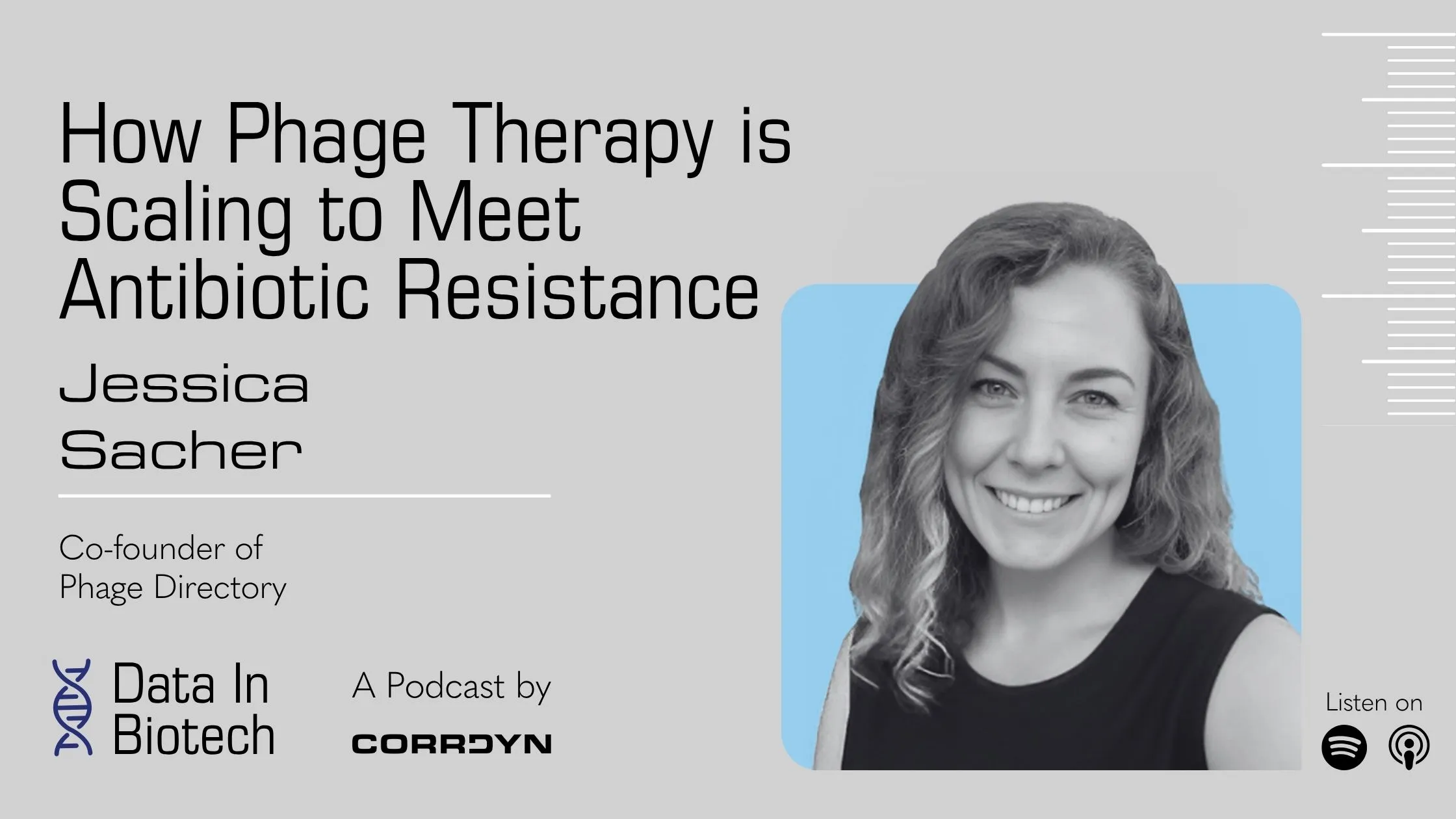
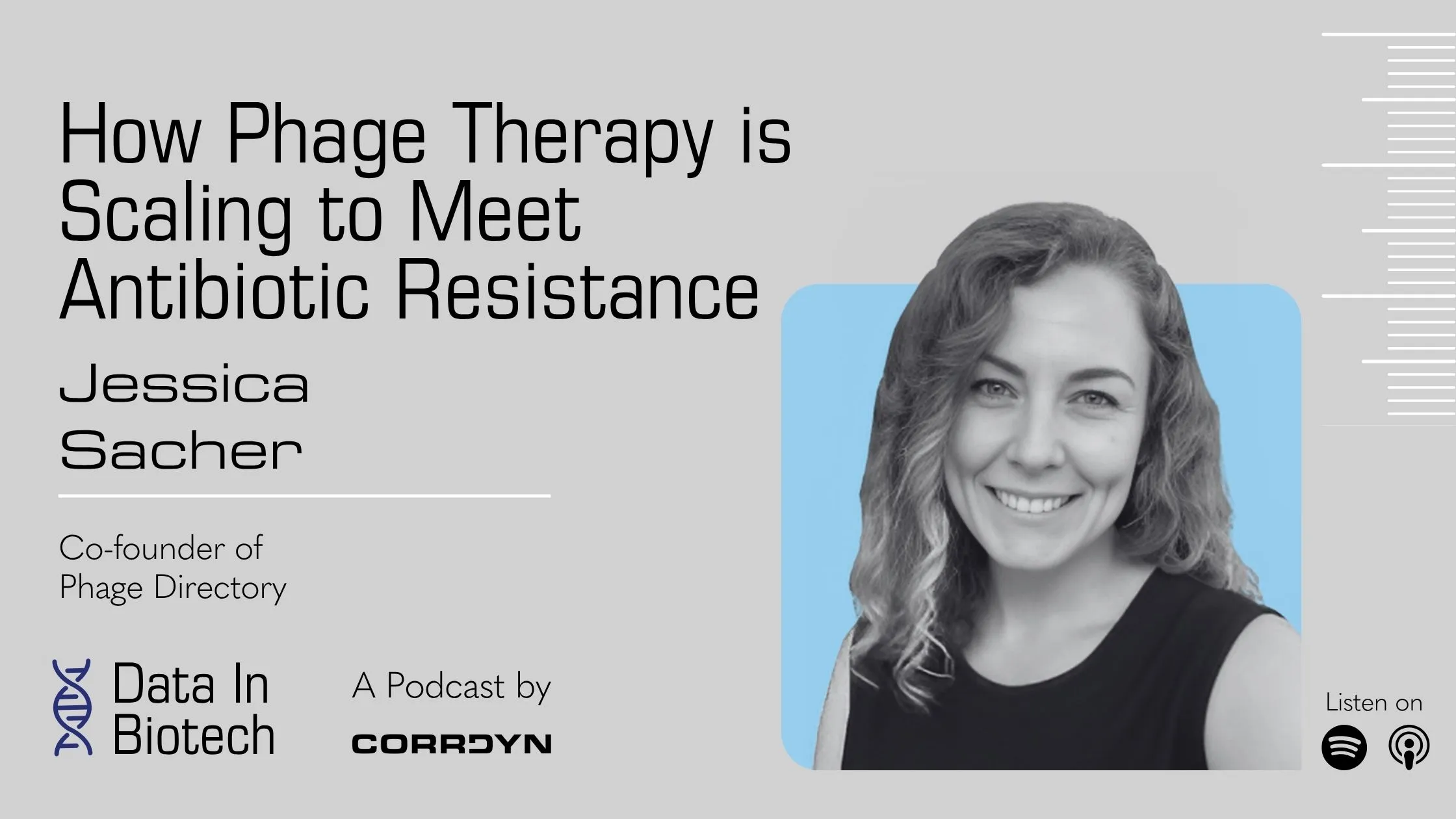
Host Ross Katz speaks with Jessica Sacher, co-founder of Phage Directory and staff scientist at Stanford, who brings unique insight into this challenge. She discusses how Phage Directory acts as a global “air traffic control,” connecting physicians with the decentralized network of university labs holding specific phages. Sacher shares her hands-on experience operationalizing lab-scale phage manufacturing in Australia, detailing the diagnostic and quality control processes required to deliver effective treatments. This conversation uncovers the data and process challenges involved in bringing a historically informal, compassionate-use treatment into a systematic, scalable framework.
Key Takeaways
Scaling Personalized Treatments Requires Decentralized Networks and Centralized Coordination
Phage therapy is effective because it’s highly specific to the bacterial strain. Delivering this “personalized squared” treatment at speed requires connecting a vast, distributed network of phage-holding academic labs with urgent patient needs. Phage Directory demonstrates how a centralized coordination layer can manage this complexity, acting as a crucial intermediary to match specific bacterial infections with the right phages from around the globe within tight, life-saving deadlines.
Operationalizing Compassionate Use Demands Rigorous Lab Processes and Data Tracking
While often used as a last resort, scaling phage therapy requires moving beyond ad-hoc efforts. Sacher’s experience in Phage Australia shows that establishing a systematic lab workflow—from tracking patient isolates to screening phage banks, performing serial dilutions, and testing phage combinations—is critical. This structured approach, including documenting results for clinicians, transforms informal scientific efforts into a reliable, repeatable, and scalable operational process.
Collecting Actionable Data in a Decentralized, Academic Context is Challenging but Essential
Phage research occurs across hundreds of university labs, each focusing on specific aspects of phage biology and using different characterization methods. While building a complete database of phage attributes would be valuable, demanding too much data from academics often leads to no data at all. The lesson here is to prioritize minimal, critical data points (e.g., bacterial species, country, hits) to enable connections, while recognizing the inherent difficulty in standardizing deeper characterization across a diverse research community.
Transforming Biological Discovery into Timely Patient Intervention Hinges on Strong Logistics
The journey from a lab-discovered phage to a patient’s intravenous treatment involves rapid sourcing, purification, and international shipping, often within six weeks. This requires more than scientific expertise; it demands reliable logistics, clear regulatory coordination, and effective communication among physicians, labs, and patients. The success of phage therapy’s resurgence highlights the need for integrated systems that can handle both the scientific and operational complexity of just-in-time biological manufacturing.
Related: CorrDyn supports biotech and life sciences organizations with complex data challenges, from building reliable data engineering systems to delivering insightful operations analytics. Our work in data reliability helps ensure critical information is always accurate and available.
Full Transcript
Jason: Before we dive in, if you’re in the business of building biotech tools or using AI to push science forward, check out our latest article from Ross: Why language itself might be holding back AI. It explores whether the very vocabulary that we use could be limiting breakthroughs in biology and beyond. You can find the link in the show notes. Welcome to Data in Biotech, a podcast from CorrDyn where we explore how companies leverage data to drive innovation in life sciences. Every two weeks, we sit down with an expert from the world of biotechnology to understand how they’re using data science to solve technical challenges, streamline operations, and further innovation in their business. Today we sit down with Jessica Sacher, co-founder of the Phage Directory and researcher at Stanford, to explore how data is powering the rise of phage therapy, a personalized approach to treating antibiotic resistant infections. We get into how phages are sourced, matched, manufactured for individual patients, the global network behind the Phage Directory, and what it takes to operationalize compassionate use therapies at scale. From wet-lab workflows to computational models that predict phage-bacteria interactions, this episode is a deep dive into the future of precision antimicrobials. Here we go.
Ross Katz: Jessica Sacher, welcome to the Data in Biotech podcast.
Jessica Sacher: Hello, thanks for having me.
Ross Katz: Awesome. Well, just to kick us off, would you give us a brief introduction to your background and what brought you here today?
Jessica Sacher: Yes. So I am Canadian and I grew up in Alberta, Canada, and I found my way into a PhD in microbiology, where I studied bacteriophages, and that led me even when I started in the biology of it, led me to using them for therapy in patients and helping make that possible and helping find ways of getting a personalized antimicrobial actually accessible to patients. So that’s what I’m still doing today.
Ross Katz: Wonderful. Well, for those who aren’t familiar with phages or phage therapy, can you just give an introduction to what phage therapy is and the types of infections that it’s used for, etc.?
Jessica Sacher: Yeah. So phages are the viruses that kill bacteria. They’re a massive class of viruses that no one talks about and they’re considered these safe viruses for us because they’re extremely targeted to bacteria. And they’re being used — 100 years ago they were discovered and immediately used in humans because people found out that they actually sometimes worked. What it is is basically getting a sample of a virus, figuring out which one to use, showing that it actually kills bacteria in a petri dish, taking that bacteria from the person who has an infection, actually growing that in the dish, and checking the virus works and then purifying some of it, giving it to that patient almost like an antibiotic.
Ross Katz: Okay. Interesting. And how have you seen the field evolve over the course of your work?
Jessica Sacher: Yeah, it’s been super interesting because this is one of those very ancient technologies that’s also new and it’s had a couple of Renaissances over the course of history. But when I came into it, it was roughly 2017 when I started, or was almost finished my PhD, started thinking about actually using phages for phage therapy. So this is phage therapy’s third Renaissance that we were already on by then, and some people had started using them in patients in the US, which is where I was studying. There had only just been one patient in recent history there. And fast forward to now, there’s thousands that have been treated with phages. So just in the last seven, eight years, it’s gone from one to hundreds or maybe even thousands even in this part of the world. So big things are changing.
Ross Katz: Yeah, interesting. So it sounds like, if I understand correctly, phage therapy is highly personalized, both to the patient that’s receiving the therapy and also to the phage that’s being developed to customize to both the bacteria and to the patient. Am I thinking about that right?
Jessica Sacher: Yeah, yeah. There’s those two levels. And yeah, you have to think about — well, I think about the bacteria and the phage first because I’m just used to that as a microbiologist. I’m thinking about it on that scale. If you choose the wrong phage, you’re just gonna get no response. Nothing’s gonna happen. You have a Pseudomonas-specific phage and an E. coli strain, nothing will happen. But then even when you have the right phage that kills the bacteria in the petri dish, it should work but once you put it in the body, that person has an immune system and they have a certain clinical condition and who knows where you’re putting it, maybe you’re putting it in the lung and now you have a lung environment to worry about. Does the phage work in that setting on that bug? Can it even access the bug? So yeah, it’s personalized squared, I would say.
Ross Katz: Right. And obviously you’ve got lots of different bacteria that you could be target- that you could be targeting with these phages and then you’ve got lots of different phages that you could be app- being applied for that to those bacteria. Can you just give us a sense of what are the orders of magnitude of the different sides of this equation?
Jessica Sacher: Yeah. So, well, first there’s the number of phages that there are out there and there’s apparently 10 to the 31. So one and 31 zeros. Every time you go looking for a phage, you seem to find a new one that hasn’t been discovered, although that’s started to plateau a little bit. But we see massive orders of magnitude of diversity of phages out there. And that is reflective of how diverse bacteria are out there. And people usually think of bacteria in a- in an infection, they think, oh well is it resistant to vancomycin or not? They don’t think about how every single bug has — there’s all the species like Pseudomonas, E. coli, staph, but there’s also below species there’s strain. And so staph is not going to be the same according to a phage. The phage sees so much more detail and so I don’t even know how many different strains of bacteria there would be, but I think it’s the same order of magnitude as how many phages there are because they only evolve to combat their predator, prey basically.
Ross Katz: Yeah. Interesting. And so you’ve got this broad range of phages that could be used to target this broad range of bacteria. Can you give me a sense of why interest has grown, or the number of patients receiving this treatment has grown, over the past decade?
Jessica Sacher: Yeah. So the reason basically is that our antibiotics have stopped working. And so we are seeing infectious disease doctors — they’re the specialists that your GP has to refer you to because your infection’s not treatable — reaching out to find phage therapy. And that’s why we’re seeing a change. It used to be a patient maybe they read about phages online and their antibiotics they don’t want to take them. But their doctor would be the gatekeeper and would say, well no we’re not using this. We’re going to use penicillin or whatever version of it we have now. But now the problem is becoming so dire where we have just rampant antibiotic resistance and people generally know about that now and they know about superbugs, they know we shouldn’t have antibiotics in our livestock because we’re putting them in the water supply, etc. But that just translates to more infections that your GP has to refer you to the specialist and the specialist is actually trying all the antibiotics they have. None of them are working and they’re saying, okay, nothing left and maybe amputation or unfortunately we’ll just have to keep you on IV antibiotics and hope for the best.
Ross Katz: Yeah. Interesting. And so what are the cont- what are the contexts where patients are receiving phage therapy today? It’s where standard of care antibiotics have been tried or not working or there’s reason to believe that antibiotics might have a negative impact on some other disease or comorbidity that’s going on with the patient. Am I thinking about that right, or what are the contexts?
Jessica Sacher: Exactly, yeah. So right now, the one thing to make clear is phages are not on the market as a drug anywhere. They are only given compassionately or in clinical trials. To qualify for compassionate use, you have to have had everything else fail. The standard of care has to have failed and the physician has to say that we think that this will help you, and we can document to the FDA that we have tried all the antibiotics that we would try, we have done surgery if we would have, and it’s still here. So the only people getting phage therapy are in that bucket where their infection has just failed standard of care. But unfortunately that’s becoming so much more numerous that it’s starting to feel common — most developed countries are doing it now.
Ross Katz: Yeah. Interesting. And so you’ve got this problem where patients are potentially failing standard of care. Eventually a patient reaches a point where the doctor believe- believes that the patient both qualifies for compassionate care and phage therapy and believes that phages could be useful for the infectious disease that the patient is dealing with. Can you just talk about the projects that you’ve undergone to try to meet that problem where it is?
Jessica Sacher: Yeah. It’s a challenging window because you have to be dire enough but not so dire that you can’t wait for phages that need to be made just in time for each person. And so in 2017 that’s when I met my friend at the time, now partner, Jan Zheng, and he convinced me to start Phage Directory, and this was to actually address helping people find phages fast enough in that window, which is roughly a month, maybe three. But how do we find the people that have the phages in labs around the world — it’s university labs basically — and how do we connect the doctors that have the patient who have no idea where to get a phage? You cannot buy them. So you have to know someone who you’re going to email. You have to look up a research paper and find the corresponding author and email them and maybe this paper you published in 2011 — do you still have a phage? And would you help with a clinical case? That was just not happening in four weeks. Not to mention the production of the phage has to happen in that time. So Phage Directory is the main project that I’ve been working on since, doing the sourcing of the phages for that. And that’s project one, I guess we’ll talk about.
Ross Katz: Yeah. Well, tell me about Phage Directory. What does Phage Directory do to try to shorten that timespan and meet the doctors and the patients where they are?
Jessica Sacher: So Phage Directory, we act as air traffic control. We receive requests from physicians, sometimes patients, and we tell them to go to their physician. And once they come back — which they do, sometimes a week later, sometimes two years later — they’ll say, I got my doctor, he’s on board, she’s on board. We will talk to that physician just via email and we’ll try to reasonably gauge if they know what they’re getting into. Do they know about phage therapy? And are they willing to — the most important thing is — be the point person to call the FDA and get permission, or the equivalent in other countries, because we do this for any country that asks us. But generally if they’re reaching out to us, they know to that degree. And we will help them understand what we can do for them, which is get the message out to the labs that we have in our network. So we have about 300 labs that are subscribed to an emergency phage alert. It’s a newsletter and it goes out to these labs when we’ve pre-qualified a case — yep, legit, a patient, a physician. They’re gonna do this properly. They just need phages and if we do the work to find them phages, they will reasonably use those phages. Then we send out to the labs. We’ll get emails back. The email we send out — we realized we don’t have to give a lot of information. We just have to give the species and the country. And so we’ll say we’re looking for Burkholderia phages in the US. If you can help, email back, tell us if you want to help by receiving the patient isolate or by sending your phages to some other lab for them to test. In the beginning we didn’t know that this would be the best way either. But this is what we’ve landed on. It keeps it simple. It doesn’t put any liability on the labs because we’re very clear that this is just the first phase that you’re helping with to find phages. And then they email us and we make the connection via email again with the physician and we’ll say, hey, these are the 12 labs that have responded. We’ll literally make 12 email connections. They’ll get their email inbox spammed and they’ll be like delighted because they never think anyone’s going to help them.
Ross Katz: Right. Yeah. So at that point, the doctor has introductions to labs that are willing to — would you say run through the po- potential phages that might be ve- that might be useful for the particular infectious disease that the patient has and then go through a screening process? Can you just walk us through what that matching process between patient and phage looks like after the connection has been made?
Jessica Sacher: Yes. They’ll sign up. They’ll say, here’s my address, send me the strain. They’ll get the strain in the mail and each lab will have maybe five phages against that bug. They’ll have five Burkholderia phages or maybe they’ll have 200. No one has 200 Burkholderia phages. Email me if you know about that. But sometimes for some bugs they have lots of phages. They will make the decision on their own how many to screen, but usually all the ones they have because they really want to find one. And so they will grow the bacteria on a set of petri dishes, depending on how many phages they have. They need enough space to grow a lawn of bacteria and then spot with a pipette just one droplet of each phage they have and then incubate that overnight. And then the next day the bacteria will grow and then there will be plaques wherever the phage was actively killing that bug and is not able to grow. And then they’ll say, okay this plaque corresponds to phage A1, which phage is that? Then they email me and say, hey, we have a phage or we have three phages. And that’s the screening process.
Ross Katz: Interesting. And then as part of the directory, are you keeping track of which phages are impacting which bacterial strains and how do you think about building up that repository, that directory of knowledge?
Jessica Sacher: I wish that we were collecting that level of data. We tried in the beginning and we do collect all the who. So which physician asked, what bug it was and roughly what clinical indication, like pneumonia or a wound. But we also collect which labs respond and how many — we used to collect how many phages they actually actively found. But in terms of collecting information about those phages, we ran into troubles doing that and so we don’t systematically collect that. We try to keep it light so that they’ll just at least help instead of putting anything in front of them — oh you have to have a sequenced phage or you have to submit the data — because we found they just won’t. They’ll say yeah I want to and then it’ll just get buried because they’re academics, they have a million commitments, and their priority list just drowns anything. And so we keep it light and we have not been able to capture as much as we want to. Although we have started — this is something we can dive into — but there was a couple of years where we went and collected from each lab what they care about about their phages, what are they characterizing them as. We realized that was even super diverse. We interviewed a few labs, maybe four, eight. We had 400 different attributes on a list and we’re like oh this could be a massive dataset because each person cares about their specific corner of phage biology. They’re like we study receptor-binding proteins. We know everything about the receptors of these phages. But we don’t have a sequencer. We don’t genome sequence them. No we don’t need that. And another lab will be more computational and they’ll know about certain genes that it has. Someone will be a formulation chemistry group and they know the stability and the structure. So we don’t collect that systematically for these cases, but we do at least know roughly how often we get hits and we can roughly say what likelihood we’ll find a phage for a given species at this point.
Ross Katz: Now’s maybe a good time to talk about Phage Australia. Can you just talk a little bit about the project that you underwent with Phage Australia and how that fits into the work that you’ve done with Phage Directory?
Jessica Sacher: Yeah. So Phage Australia came about as a result of one of these cases that none of us thought would go anywhere because the request came from Australia. And they were like we know we’re far away, no one’s going to help us, but do you have any Pseudomonas phages for this little girl who’s seven, whose leg is getting amputated — I don’t know what the time frame was but it was imminent. She was in a car accident and her bone infection just won’t heal. And so we did an alert and then 12 labs answered and this was our biggest response yet and we ended up finding a phage for her. Six weeks from the day they put out their alert she was getting phages intravenously. And so that was extremely rapid fire especially for a group that had never really done this in this way before. They’d done phage therapy as part of a clinical trial years back. But to do the sourcing and get the paperwork to do the compassionate use and everything — all that had happened in that window. The phage that they found came from Israel, got purified in the US, got sent to Australia for use. So it was crazy. That was fall of 2019. We were so excited that that worked so well — they were like yeah, we actually have a grant probably that we’re going to be able to get to build out something bigger, basically scale this up to more patients. The Australian government was really excited about that and they got that grant. They offered to bring Jan and I out there to join their team hands-on, actually be facilitating them building out their phage therapy ecosystem around the country. That was extremely cool and we were like well we’ve just been working on this remotely from our couches — this was before the pandemic, we were on Zoom every day, it was weird — but we were so excited about that. Pandemic hits, froze the grant. Unfortunately two years passed where we had to roughly work on this remotely with them, but we finally got to Australia in early 2022. And then we were there and I thought when we got there that we knew. Jan is the data guy, data engineer and software and user experience, so he was going to build everything for them — what are we collecting, how are we going to make sure it’s usable and learn from it. And for me, I thought I was going to be doing external work, trying to get us more sources of phages, make sure that everything’s working, but I quickly realized I was going to be in the lab because there needed to be somebody to actually make the phages and they wanted to scale that part out — they didn’t want to keep having to hope that they would find someone in the nick of time. So that was really cool because after what I think was four years out of the lab, I was back in. And probably my first month on the job, the physician I was working for, John Iredell — he’s a physician and he’s running the lab — he says, okay we have a patient next door, my patient. He needs phages, could we make him some, do you think? And I was like, well yeah of course, yes that’s the goal. And he’s like, so this week — when? Can you just start? And so that was the big eye-opening moment where I was like oh my gosh, I’m now going to make the phages and be the boots on the ground version of what I’ve been helping orchestrate, which was really cool.
Ross Katz: Yeah, so you were in the heart of it, making the phage development process operate more efficiently. Can you talk a little bit about what you learned about the operationalization of phage therapy from that experience?
Jessica Sacher: I cherry picked my favorite protocols from the different labs that I had been seeing and working with and then strung that together in a circle — literally drew it. And I had another postdoc in the lab, Stephanie Lynch, who was hired at the same time and had actually been a Phage Directory volunteer, and I got her out with us. And so we were like okay we can build this from scratch and everybody’s going to listen to us and we’re going to try to check all the boxes on the regulatory side but we’re going to do what we want to do in the lab. And so what it ended up looking like is there’s a diagnostic phase where we would bring in the strain from the clinic. We had to work out how are we going to do that from a communications side, but how are we going to make sure we are keeping track — the Pseudomonas that comes in today is not the Pseudomonas that comes in tomorrow? Very critical point but very overlooked. And then screen our phages. We had to find which phages we even have. We found a bunch in the lab from decades of academics prior and we brought them in together and started to gradually go through them and see — are they all unique, are they sequenced, are they mixed — and started to create a bank. Then in our process we would select three to five that showed a hit and do a subsequent set of experiments to feel better about them probably working in the patient. So instead of just a spot assay — where you pipette the droplet — you would serially dilute the phage down because it’s always orders of magnitude that the brain does not process, but 10 to the 11 phages per mil are in your tube. So you have to dilute it down 10 to the 11 times so that you can actually see one plaque. And once you can see one it’s really a phage and it’s not just the cells dying from the impact of a lot of stuff hitting them. If you see single countable plaques that go up in number as you dilute, that gives you the sense that that’s really replication and that’s really happening. And then we would also pit them against each other. We had a step where if we had three phages that looked good at that stage, we would combine them in each combination and do a growth curve so we could see if the bacteria — they have their growth curve — are inhibited from growth with all those combinations, or maybe two phages cancel each other out. We didn’t see that a lot but sometimes. So things like that, and then that was the diagnostic phase. We would put together a report — came up with what the report should have — that would be for the clinician to say, okay, this is why we think you should use these three phages. Here are the growth curves with them. Here’s how they work in combination. Pretty minimal information but they really needed it then. And then the production phase was after that. Stephanie and I eventually bifurcated roles — she was the diagnostic person, I was the production person. She would give me the three phages and say, okay, make these. So I would produce a larger batch of each of them and filter out the bacterial debris, because they lyse the bacteria and that’s the most toxic part of the process — that’s definitely something that would harm somebody if you didn’t clean it out, because the innate immune system is very primed to find bits of bacterial cell wall and get really mad about it. And so you filter all that out and then we figured out putting the phage through a purification column — the same machine you’d use when you purify any protein, FPLC, AKTA pure, whatever you have — you can do that with phages and so we would do that to purify it more and remove all the debris. And then we would have the phage produced, but we would have to do quality control and formulation. These were the last two steps. Quality control happens all through, but we have to decide what is good enough, what is safe enough for it to move forward to the patient. So there will be a sterility test — make sure there’s nothing growing in there, if you plate out and grow in a blood culture bottle you’re not going to have any bacteria in your solution. Then an endotoxin test which is the measure of that cell wall, and things like that. We put together a set of five safety checks that we would do. And then we formulate it — we wanted the pharmacists to do this but they were not quite ready. So we would have to actually source glass vials with the little needle plug, the rubber stopper, and we would dilute the phage to the concentration that we’re going to treat at and then distribute it with a pipette, one mil into each vial, and put those in a little box and print off a label from Microsoft Word and tape it on and be like here is the product. And we would walk it in a little organ — what are they called — cooler through the hospital and give it to the nurses station. So that was the process we put together.
Ross Katz: It’s just an entire pharmaceutical pipeline in a box, compressed. Obviously this podcast is called Data in Biotech. You’ve outlined this process that you created from the best protocols you could find from labs around the world, and you’ve got an established process that’s working for you. But obviously your goal is to treat more patients, or treat the same number of patients at lower cost, or treat the same number of patients with fewer diverse things that need to be created — just less effort. So how did you think about that in the context of Phage Australia and how do you think about that in the context of where phage therapy goes from here?
Jessica Sacher: Yeah. It’s interesting because I just went really heads down at the beginning — okay we just have to do this for one patient because there’s one guy across the hall. And there really was. And so we put all of our effort on that one person and it took us three months and we treated him and he had a great outcome. And as soon as that happened we were like okay how do we do this faster. What would be the best way to speed it up? We’re always getting these questions from the bosses and the funders. And we’re like, well, we’re just two microbiology PhDs — you could give us more people but that wouldn’t really speed us up. We could make a bigger batch, they would always ask us that, but that doesn’t help either because our small batch already makes 4,000 doses and we wouldn’t find 4,000 patients who need this phage. So there’s no point in scaling up the batch. And we organically fell into all these ways — instead of just asking how do we scale this, we started realizing what would actually save us steps and then working from there. One thing that happened was the second patient that came in that needed the same phage we’d already made the whole workup for — we’d done the phage safety screening assessment and we had it already made. We were like, oh my gosh, we can treat this person next week. We only have to do the final QC again. That’s obvious to someone who’s used to thinking about data, scaling, and process, but we were just microbiologists. So we were like, whoa, that’s what they mean by scaling. One thing that would be useful is if we had a vastly larger bank of phages. We only had about 300 phages. We were able to find phages against each patient that came in, but it still took us that week of screening for each. We pretty much allowed a week for each diagnostic. Obviously if you had a larger set of phages you would more likely be able to find one. So either you have to have a lot of phages on the shelf — a lot — or you have to get really fast at making them. I don’t think you can compress that too much. And one big blocker is the in silico part of it — can you predict a phage without even doing any testing? In theory yes, if we had enough genome sequences of the bacterial strain and enough genome sequences of the phage, pit them all together and collect that dataset. That’s something that could shrink that diagnostic window down. You could get it from a week of work to a click, and that would save a week per patient. So you can start there — there’s a lot of low-hanging fruit. It’s just a matter of who is motivated enough to decide they’re going to tackle it — how do we get 10 patients treated in a week instead of one. And the other huge thing is this is such a local enterprise. The patient kind of needs to be next door. And even if we had the phage on the shelf, how many patients are we going to have next door? You kind of have to have this set up in multiple places to scale it to all the patients in all the next doors. So I think about this a lot, but I quickly realized there are just chunks of things you could do here, there, and everywhere. Ultimately you could scale it in a way that’s similar to CAR-T cell therapy — you can have an autologous one or you can have donors and 10 people can get that. I think that’s the way it goes. Or fecal transplants — you start getting awesome star donors and they just donate all of it and you have the safety down and okay you can help 80 percent of people, not 100 percent, but that’s fine. I think that’s the way to think about phage. The other piece is the communication piece — how you even make this something that’s an option for all the clinicians around the world. Even if you have this system where yeah, if people find us we can help them even if they’re not next door, it’s not part of the system. The hospital pharmacy does not think that’s one of the options in their arsenal. And I try to find a place for the communication piece because I think that’s a huge way to scale it too — once there’s awareness and it’s not this mountain of work that one physician is responsible for, getting that more at their fingertips could actually really move the wheel.
Ross Katz: I’m really excited to have you on here because I feel like all of the problems that you’re facing are a microcosm of the biotech landscape at large. And this is just a really fun example of the places that data intersects biotech. With that as an intro, can we talk about the two papers you shared and the data science methods that are being used for phage therapy?
Jessica Sacher: Yeah. So I’ve gone down a rabbit hole recently looking at whether people are getting close to this whole in silico prediction thing. People used to consider it — and I still do — the holy grail of phage therapy: being able to predict from genome alone what phage to use. And people have tried to do this over the course of time. Since I’ve been in this seat of Phage Directory, there’s been lots of little efforts to do machine learning with phages — people will go and collect public data, phage genomes, and then do an experiment where they pit them against a panel of strains and come up with some matrix of did it kill or not, or a one, two, three score, and then try to use whatever model is available at the time. And that’s shifting now with all the new LLMs and way more activity in the space, so my sense is they have a lot more options on the tool side. But there’s been these efforts and I went down this rabbit hole last summer to figure out where are we at, because you hear about it and yet we’re not using it at all. None of the clinical efforts that I’m working with are actually saying, let me just predict — we can get the sequence of the bacterial cell and feed it into something. Nobody is doing that. And yet I get the sense that they’re doing it in research labs. So why is that? I found these two papers — they’re both similar and it’s a cool comparison because they’re doing strain-level phage prediction, but each chose a different species: one is E. coli and one is Klebsiella. And they’re using different ways of doing it on the machine learning side, which is the part where I’m not going to be able to assess — XG-Boost is better than this one. I get that there’s a lot of ways they can check what is going to be predictive of what your lab results say. But what’s interesting for me is the data collection side. First of all, I thought it was interesting — I would have thought you needed thousands and tens of thousands of each interaction to ever make a model, because that’s what I had in my head as the case for machine learning. Oh well you’ll never do it, it’s all about the data, and of course it is. But they’re doing it with 100 phages and 100 strains, or 400 strains and 100 phages. So you get 10,000 or 40,000 interactions and that is enough for them to be reasonably predictive — over 80 percent, I think each of them are — of choosing a phage cocktail that’s going to work reasonably well, or ranking the phages that you should test in order of what will likely give you a hit, and having that ranked list contain real hits in the lab. So that’s cool. Number one, people are doing strain-level phage prediction and doing it with on the order of hundreds of phages and strains — low hundreds on each side. That’s really cool, we’re getting closer to something actually feasible. I bet a lot of these phage therapy centers that I work with now, they all have that amount of phage and strain — it’s within the order of magnitude that most labs would have. So they could all be training their own model and following the exact same methods in these two papers. And I think it probably is very important that it’s not generalizable — obviously they can only to some degree test that — but it’s probably specific to this set of phages or this set of strains. We need to figure out how far that goes. But it’s tangible enough that one lab’s worth of information could actually meaningfully do that. So that’s what I’m really excited about for those papers.
Ross Katz: Yeah, so my takeaway from these papers was similar to yours — what we’ve validated is that it is knowable to a certain degree from the genetic code of the phages and the genetic code of the receptor binding proteins that you can characterize the host range for a given phage within a given set of bacteria. You can have a reasonable degree of accuracy that even if it doesn’t tell you in silico this is the phage you need to use for this particular patient, it could at least get you much closer to — these are the phages that you should be testing — so that you can close the loop between patient and phage much faster.
Jessica Sacher: And just to take you back on that — figuring out should we send the strain to all these 12 labs or should we just work with that one in Israel because they have three of the 10 hits basically, or put their library in and just know yes or no to even that entire effort. I think that, yeah.
Ross Katz: Yeah. The other thing that really jumped out at me — I think it was the Boeckaerts et al paper, and we’ll post the two papers in the show notes here so that everybody can go and look at the papers — I believe they used ESM2, the embeddings from ESM2. Even though they’re only testing thousands of interactions between phages and bacteria, they’re able to get much richer information about the nature of the phages and the bacteria because these large protein foundation models have been trained and incorporate all of these different types of data that, even beyond the genome of the phage or the genome of the bacteria, can give you a lot more signal about how these proteins are likely to interact with each other. So to me, in addition to XG-Boost having been around for decades, the nature of the methods being applied to the problem are relatively simple, but the amount of information that can be brought into the equation from these trained foundation models is really improving the ability of these models to pick up on where a phage-host match is likely to occur. Am I thinking about that right?
Jessica Sacher: Yeah, yeah. And I think it’s cool how it almost goes backwards to the biology. Based on what factors ended up driving what was chosen as the phages — what they reported made the model work — it’s like, we didn’t need the whole genome, we only needed this set of genes from the phage and this set of genes from the host. I think that’s a limit but it’s also an opportunity. If you have this information showing you those are the drivers of phage-host interactions in this species — we kind of thought they were, that’s why they chose to extract those — it was an informed phage bioinformatician who decided that. A regular person wouldn’t; you’d have to know something about the phage-host interactions to even choose which parts to pull out. But it also helps you validate: if the model works in the end, yeah, you were right about choosing receptor-binding protein and capsule genes for the host. Was that the thing driving it? Yes. And the E. coli paper — that group, I haven’t talked to them though I know some of them — I imagine it was surprising for them because I know they are a group that came from phage defense genes, looking at CRISPRs and all the different versions of that that are coming out, and that’s a hot area in phage. But what they showed is that that part didn’t actually drive anything. Not nothing, but they reported that defense isn’t what’s driving phage-host interactions. And they have to report that — but I imagine that’s what they’ve been studying and obviously they think that’s important. So you get this information about the biology just by trying to build these models. I love that, and it can get a lot of other phage people excited on that side because sometimes they’re like, we don’t need the machines — but it’s like oh, the machines are going to give us lots of rich things to test.
Ross Katz: What’s unique or what have you learned from sitting at the intersection of wet lab and computational opportunity and what are sort of the challenges that you see in being in that position?
Jessica Sacher: Yeah. That has been very interesting. My beginnings were not in a computational lab. I was very much wet lab. And I met Jan, he was like, hey computers can help your field. And I’m like, well, the computer people can just make websites. But now we can actually get our phages to people. And slowly I’ve been dragged forward toward what the computational side can do, but there’s never been enough time for me to go and learn bioinformatics and learn it all myself and figure out what databases are. I’m constantly trying to catch up. My biology knowledge is always feeling relevant, but I always have to interface with the computational people and there’s not time for me to become that. And so it becomes really interesting. At Phage Australia there was a bioinformatician on our team — there was Jan who was the data engineer — and I before that would have thought, oh you just bioinformatics, you take your phage genome and see is it safe, does it have any red flag genes, are we going to use it, which phage is it. And I realized, every time she gets a new phage, she has to develop a new pipeline for that and a new set of steps because they’re each so different from each other — it’s not just computer click, done — which I think a lot of us come at this thinking. All these black boxes but we always have this weird amount of trust that the computer can do it, but also no trust because how? I’ve gotten way more of a grip on the extent to which it’s a massive world of complexity even for the computer people. You’re not just going to replace something with it. You actually now have to be the one choosing which tool when — if it’s an E. coli phage I have to use the tools that are working for E. coli phages, and if it’s got a lot of repeats in its genome you can’t use this tool because it will be sensitive to that. I realized it’s not that different from my biology training because there’s all these rules and all these contexts and each bug is different and the growth phase will impact things. But interacting with the actual computational people — I live with one — and the questions are like, why does your field do it this way? Or why do you guys not even have this data collected? Well, when you’re in the lab and your gloves are on you’re not able to type on a computer and so you’re not capturing data. As you start working with the computational people you realize the problems are not how to compute the thing at all. They’re how to make computers see what we see in the lab in time, and it’s more about people logistics and physics on the level of I physically can’t capture that data in real time very well. And I don’t even have the habit of thinking in frameworks, doing things the same way every time. Biologists — I think just anyone in the lab, anyone cooking — to document exactly what you’re going to do and to do that one thing the same way every time, it’s so hard and it doesn’t really give you anything. So the problem just shifts way more toward me the biologist, and I think we have to have a seat at the conversation when, say, a database is going to be designed to collect all the phage data. In Australia, we wanted to do that, we tried to do that. Jan’s like, okay I’m going to make the database, what data is important and when do you get it, and we’re like, we can’t answer it. It depends, I don’t know. And so he has to follow us around and he’s like, your bug is shifting every time you grow it, so what do we put in the database as its identity? It’s like, well, it doesn’t really have an identity. It has attributes. And how do we know that it hasn’t drifted genetically? Well we sequence it. Let’s store the sequence data. But when do we need that? And how often do we sequence? Technically it should be every time we use it, but we can’t do that. So in a long-winded way, it’s been interesting to realize what the computer people need and how much I can contribute just by explaining the day to day. But even with seven years of doing this, even living with the person who is building the data infrastructure while I’m doing the lab work — we both have complete freedom to decide what we’re going to do — it’s still extremely challenging. Anyone who wants to think about how do we capture information from a lab, that is very much still where the problems are.
Ross Katz: Yeah, you touched on a lot of themes that we’ve had in this podcast before — there are lots of people building software for biology to try to capture data more effectively, to take advantage of lab automation, which makes it so that biologists no longer have to hand-code the data that’s com- that’s coming off the line. And in the machine learning world there’s the bitter lesson that everyone cites — you shouldn’t be making rules about your data about which data’s valid in which circumstances and which methods need to be applied in what contexts. You should just be generating as much data as you can and relying on the data to tell you the story. When you’re talking about human-generated data at internet scale, I think that makes a lot of sense. But in the context of biological data at biological scale, where the numbers of what we can measure and the quality of the measurements that we can get can’t quite get as large or with as high a degree of resolution, we’re in this interesting place at the intersection of wet lab and dry lab — where within sandboxed environments of newly automated biotech organizations all of that data can get generated and you can rely on the data to tell you the story. But in the context of therapies like phage therapy that are still under development, where the processes aren’t automated or very well defined and where the business model hasn’t been created yet, it’s unclear how these data science principles necessarily apply.
Jessica Sacher: Yeah, totally. I think you just have to see it as the whole set of steps, your whole pipeline, and some things are going to be great for automation. Any time you can stick in a tool — okay the phage genome is assembled, put it through this thing to find toxin genes, for sure use that and move on. But you have to allow that not your entire process has to be perfectly automated or that the data collection is just going to be there. You’re going to have wide swaths of the pathway that are just, you know what, this is not standardized as much. That’s okay — draw a circle around that. But this tiny little part is actually just an algorithm — like which of these three phages, what I described of the growth curves — we could take that and quickly pick which one to use. Modularizing it I think we can get a long way.
Ross Katz: Yeah, that’s interesting. And I think the problems you’ve described are the problems of startup biotechs across the ecosystem — figuring out which aspects we can standardize that we should be standardizing in order to capture the data that we need, versus which aspects need to be by their nature flexible until we’ve determined what the ther- what the therapeutic model is that actually solves the problem we’re trying to solve. Well this has been a really fascinating conversation and as we look toward the end I’d love for you to share what are the different directions that you see phage therapy going in the future, the next five years, 10 years?
Jessica Sacher: Yeah, one thing we’ve seen emerge is these phage therapy centers — we used to call them pre-phage therapy centers because they weren’t really a center, they weren’t calling themselves that. But they were a place that was repeatedly doing compassionate use case production. Even if it’s just a research lab with one person who does this on the side, you start to see them as — okay, they’ve got a little process, they’re now a center. These have grown up in the last five years and now there are different ones everywhere. I think that’s going to be here to stay, and these academic medical centers are going to keep having to deal with all the infections — but eventually the long tail, even if we have phage cocktails that actually make it to market, which is happening gradually. So I think the future is a combination of — a phage pill that has three phages in it for Pseudomonas, you use it for this reason because you have a Pseudomonas infection. We’ll have species-level cocktails that will come on the market as a biologic. It’s just taken a long time, but we just had a successful Phase 2 trial announced last week from BiomX, so that’s now the second positive Phase 2 phage therapy trial ever. That’s a really exciting thing and I think it’ll get better there. But the money in antibiotics is so scarce — it’s just the worst choice for a business. Max regulatory barrier and pretty much no sales volume because it cures the thing in a week and it’s considered cheap. So you’re not going to command a high price for it. I don’t really think that the phage cocktails on the market are going to be the thing that saves us because it’s just so expensive to get there. And that’s why I think these phage therapy centers are just going to keep getting a little more scaled up. They’re going to do their local region. While we were in Australia, in those two years, people were like okay we’re starting this in Canada, Singapore, Nepal. We had contingents of researchers and physicians visit us physically in Sydney and they were like, okay, we need to know what we need to do. I think that’s going to keep expanding. There’s one in the UK, multiple in the US, and I think that’ll support people in the next 10 years and it’s just going to keep going. As long as the problem is the way it is — superbugs, the whole crisis — unless we fix the economics of antimicrobial development, which I hope we do. I hope we carve out something that puts them in their own category and says, for these, they do not have the same economics as a drug, they will not be developed if we make them cost the exact same amount to make. If we did change that, that would help. Maybe phages wouldn’t be as needed.
Ross Katz: Yeah, for listeners out there — if you’re interested in phage therapy you should absolutely follow the Potavirus podcast that Jessica hosts. I remember one of the episodes talked about I think it’s the Pasteur Act and the idea that the government would be paying on a subscription basis for access to phage therapies rather than having the economic model be based on the same method that’s being used to reimburse for antibiotics. And so there are these creative ways that we can come up with within the context of healthcare systems to make sure that these therapies that do have real benefits are being economically supported.
Jessica Sacher: Yeah, yeah. I think beyond antimicrobials and phage, as I come to think about this, we should want a diversity of types of ways drugs are made because otherwise the only drugs we get are the ones that happen to fit this volume-based reimbursement model. I used to be like, what are all these jarg- — as a biologist I didn’t care about that — but it makes sense. If you can only make drugs that meet a certain criteria — say we could only have businesses if you sold 10 of them, you get the money, but you can’t have insurance businesses where you get money anyway but help them if they need it — we need to diversify the models and then we’ll diversify the types of treatments that fit. Something like phage just really doesn’t fit the current model, and even an antibiotic doesn’t fit it. So we can’t have nice things because we haven’t been creative about creating the structure. I think there’s tons of exciting stuff to do on that side of things.
Ross Katz: Awesome. So as we head toward the end, what’s your work at Stan- at Stanford looking like building on the stuff that you did in Australia?
Jessica Sacher: Yeah, exciting. I came here middle of last year and we’re working on developing — as I mentioned — on the phage engineering side, what can we do with using phages to deliver genes and deliver peptides. Phages have been used as phage display in the drug development world forever. But what about therapeutic phage display in a sense. We know they’re very engineerable and we can get them into eukaryotic cells. This is a new-ish frontier for phages — thinking about their use beyond just bacterial acute infection. It makes sense with the times because no one wants to fund infectious acute infection treatment, but also you legitimately have this very engineerable entity that is pretty innocuous in the body from an immune perspective. And with all these foundation models — back to the Evo thing — I’m noticing the biosafety rules on them are: do not use human viruses because someone might design a bad virus and we’ll have COVID again. And so phages are allowed to be used in these models. These models are going to get good at making new phages way faster than they’re going to get good at making new AAVs or other human viruses. So I feel like we should push on that. That’s what I’m excited we’re going to try and build out — a phage delivery center in a sense, or pipeline — here at Stanford. Stanford’s very close to all these different groups that want to — lab A has a big CRISPR system they want to deliver and they can’t, lab B has CF genes they want to deliver and they can’t, or there’s a cancer lab that wants to deliver a peptide that will stop the cell cycle from being messed up. And so we’re going to try and position ourselves and see what it takes for each of these problems — can we use phages to get the thing where it needs to be. It’s a whole new frontier.
Ross Katz: Awesome. And where can people find out about your work and connect with you online?
Jessica Sacher: Yeah, I’m on Twitter mostly, Jessica Sacher, @JessicaSacher. And you can find me on LinkedIn. phage.directory is our Phage Directory website if you’re interested in that.
Ross Katz: Right. And people should definitely follow the Potavirus podcast that Jessica hosts and the Capsid and Tail newsletter as well if you’re interested in phage therapy. Jessica’s on so many platforms and sharing so much information about phage therapy that even she forgot some of her platforms. So Jessica it’s been a pleasure having you on the podcast. Really appreciate the time and look forward to connecting down the line.
Jessica Sacher: Yes, thanks Ross, so fun. So excited for this.
Jason: And that’s it for this episode of Data in Biotech. If you enjoyed the episode, please subscribe, rate, or leave a review in your podcast platform of choice. See you next time.