Listen on
Overview
Biotech is undergoing a scientific transformation with immense innovation, yet translating these discoveries into reliable, scalable products faces significant operational hurdles. This friction, combined with persistent misconceptions about data and artificial intelligence, delays speed to market and impacts competitive advantage. Many leaders struggle to realize the full potential of their data investments, often due to inadequate data quality, siloed systems, and an overreliance on generic compute power.
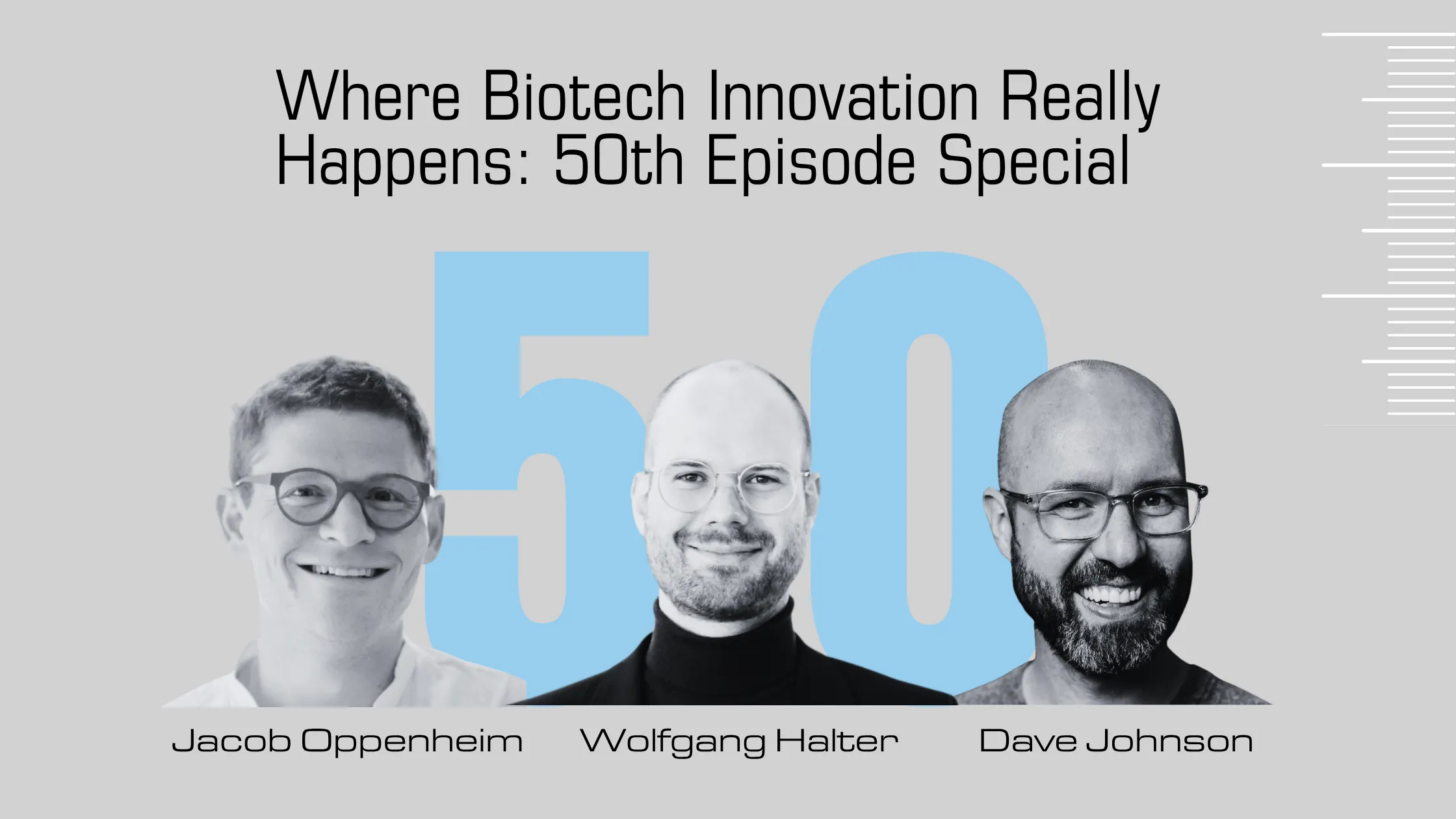
In this 50th episode special, host Ross Katz brings back three seasoned biotech leaders: Jacob Oppenheim, a venture partner at RA Ventures; Wolfgang Halter, Director of Data Science at Merck; and Dave Johnson, Founder and CEO of Dash Biosciences. They offer a wide-ranging perspective from across the industry—from early-stage venture insights to large-pharma data strategy and startup operational execution. Their collective experience provides a grounded view on where innovation truly originates, the crucial difference between scientific discovery and industrial application, and the real challenges in building trust around AI-driven solutions.
The conversation examines the tension between scientific progress and operational reality, unpacks common myths about data and AI, and outlines pragmatic steps for building the next era of biotech. This episode challenges conventional wisdom, emphasizing that effective data strategies and operational excellence are the bedrock for turning breakthrough science into tangible, reliable outcomes for patients and the market.
Key Takeaways
Biotech’s scientific breakthroughs are outpacing operational industrialization.
Innovation is abundant, with technologies like mRNA vaccines and CAR T-cell therapies reaching industrialization. However, the system struggles to integrate these discoveries efficiently. Operational challenges, such as inefficient in-vivo studies and slow CRO processes, create bottlenecks that prevent scientific advances from reaching their full market potential quickly. Focusing on streamlining development pipelines is critical for competitive speed.
High-quality, domain-specific data, not raw compute, drives AI success in biotech.
The belief that simply applying more compute power or generic ‘big data’ will solve biology’s problems is a misconception. Effective AI in biotech relies on small, highly annotated, and consistently generated datasets specific to the biological problem at hand. Companies that invest in creating these precise datasets through automated wet labs will achieve more meaningful AI-driven drug discovery.
Building trust in AI for biotech demands consistent performance and rigorous process controls.
Trust in AI applications, particularly in a regulated field like biotech, comes from consistent model behavior and adherence to rigorous operational standards akin to GxP regulations. Relying solely on ‘explainable AI’ is often insufficient; users and regulators prioritize reliable, predictable performance, even from models with known limitations, when backed by strong testing and change management protocols.
The US competitive edge in biotech R&D is under pressure from global shifts.
The US’s leadership position in biotech faces significant challenges, particularly from countries like China, which are increasing R&D investment and conducting more clinical studies. This shift signals a move up the value chain beyond manufacturing into full R&D. Maintaining global competitiveness requires greater efficiency through technology adoption and a critical look at academic and government funding in the US.
Related: CorrDyn helps clients in biotech and life sciences overcome data challenges. We focus on data quality and building reliable data engineering systems. Learn how biotech manufacturers realize data value.
Full Transcript
Jacob Oppenheim: We are living in a time of great scientific transformation.
Wolfgang Halter: The line between progress and risk is thinner than ever.
Dave Johnson: The one I constantly hear is that if we just had more compute, we could solve biology. If you just throw more GPUs at it, this thing will solve itself.
Wolfgang Halter: Trust goes far beyond technical reliability. Trust is a deeply emotional thing.
Jacob Oppenheim: This idea that AI comes in and suddenly AI’s the product, I think is faintly ludicrous.
Ross Katz: Hey everyone, welcome back to Data in Biotech. I’m Ross Katz, and today’s episode is a very special one. We’re celebrating our 50th episode anniversary. Over the past few years, we’ve had the chance to speak with some of the most thoughtful leaders in biotech: founders, operators, scientists, builders, people who work with data. The people who are watching this industry evolve and who are also helping to shape it. Today we’re bringing three of those voices back. You’re going to hear from Jacob Oppenheim, who’s a venture partner at RA Ventures, Wolfgang Halter, who’s the Director of Data Science at Merck, and Dave Johnson, who’s the founder and CEO of Dash BioSciences. All three joined us for deep-dive conversations in the past where we got to talk to them for the full hour, but in this special montage episode, we asked them to reflect on the state of the industry right now. Where is innovation really coming from? How do we manage the tension between hype and trust in AI? And what are some of the common myths that still slow biotech down? What you’ll hear is part retrospective, part roadmap of what’s changed, of what’s still broken, and of what might still be possible. So much of what we think about biotech is wrapped up in where the breakthroughs are coming from. Are startups at the edge? Is academia falling behind? Is big tech reshaping the rules or just dropping in a shiny new algorithm? To kick things off, we asked our guests where they see the pulse of biotech innovation coming from today. Let’s dive in first by hearing from Jacob Oppenheim, then Wolfgang, and finally Dave Johnson. Are you seeing a shift in where biotech innovation is coming from, whether that be academia, startups, big tech, or something else?
Jacob Oppenheim: I can’t say I’m necessarily seeing a shift there. I think we are living in a time of great scientific transformation. I think oftentimes the signals of that transformation are a little bit muted, even if we are living in that transformation. While everybody likes to talk about AI, I was just bouncing this idea around with a friend that when I grew up in the 90s, big pharma was an easy thing to hate on because what were the drugs coming out? What was going on? Vioxx was in the news, there were just slightly better versions of drugs with high prices. Today we’ve got Keytruda, which cures 20% of cancers, please check my numbers there, Ross. We’ve got Humira, which is life-changing for anybody with an autoimmune disease. We have mRNA vaccines, we have CAR-T. The scale of transformation that we are living through is enormous because we’re living off the fruits of a biotech-technological scientific revolution. To me, there’s an immense amount of innovation that’s just hitting that industrialization stage as people are able to use technologies to even see further and be better scientists on top of it. While I know I’m going to attract hate for this being on an AI or Data in Biotech podcast, honestly, I was joking with some people the other day that frankly, people use bad methods to analyze single-cell RNA sequencing data. But if I told you, ‘Hey, a lot of those analysis methods suck and many of them are just wrong,’ would you actually give up the results of everything we’ve learned from single-cell? Nobody would do that. Absolutely nobody would do that because we’ve learned to map the immune system with that. We’ve learned to map entire tissues and organs and we’re continuing to discover off of that. To my mind, we live in the fruits of high innovation despite the craziness and uncertainties in the outside world that create a fundamental tailwind behind everything that we’re trying to do.
Ross Katz: Wolfgang Halter, welcome back to Data in Biotech.
Wolfgang Halter: Thanks, Ross, for having me again.
Ross Katz: So the first question that we want to ask you is, are you seeing a shift in where biotech innovation is coming from? Whether that be academia or startups or big tech or some other class of organization that’s contributing or carrying more of the weight of innovation.
Wolfgang Halter: That’s a very good question and I think at the very heart of also what we do at MilliporeSigma. We are equipping academia, biotech companies, as well as the big pharma companies with not only materials but also services all around innovation. Traditionally, the classical approach is you start in academia, then there’s some startups forming and then those getting oftentimes acquired by big pharma. Now I would say big tech are certainly a new player on that playing field, providing new tools like AlphaFold or DeepMind, not by DeepMind, or DNA-BERT that allows very new approaches to some of that innovation piece.
Ross Katz: Dave Johnson, welcome back to Data in Biotech.
Dave Johnson: Thanks for having me back.
Ross Katz: Awesome. Well, we’re just going to do some quick questions today. The first question, are you seeing a shift in where innovation in biotech is coming from, whether it be academia, startups, big tech?
Dave Johnson: It’s certainly a tough market at the moment. That’s caused some shifts. I think we’re all seeing that investment dollars are moving to later-stage assets, clinically de-risked assets, and so that’s certainly having a hit on the biotech innovation in the market that we’re all optimistic that’ll come back. Certainly the NIH grant cuts and the challenges in academia are impacting the funding and the innovation in the academic market as well, so there’s both across there. We do see a lot of interest coming in from tech companies, so Isomorphic earlier this year with a $600 million raise showing that tech is making big bets in this space. It’s exciting and obviously the more super bright minds we have coming into the space the better, but I do think they come in with a little bit of a naive attitude of, ‘We built these big technical systems with billions of users, how hard can drug development be?’ Turns out it’s really hard. It’s really hard. A lot of them are learning that the hard way. I think they need to have the respect for the problem that’s here and have the humility for it. Then a lot of them run into operational issues, which is, fine, the science is solved, but now we need to do in-vivo studies. What does that look like? I gotta go find a CRO and then I gotta deal with change orders and inefficiencies and three-month delays and so on. Obviously that’s a big part of what we’re building at Dash is how we can transform that market of development to change the economics, change the pace of that to really realize the potential of a lot of this innovation that’s coming in.
Wolfgang Halter: I haven’t seen breakthrough insights in innovation directly coming from big tech, more on the tool and technology side, but they are certainly a new player in that field and that will change a big thing. The different company classes is one thing, but when we look at regions and areas in the world, that’s a whole other dimension here where we probably see a lot of movement in Asia happening where all those things like academia, startups, and industry are much more tightly integrated. So that’s also very interesting dynamics that we see.
Jacob Oppenheim: It’s funny about this and touching on the data piece is that the further we see, the more that we need computational approaches, the more that we need to think about data carefully. We can sequence all these things, we can measure all these things, and then suddenly what does it mean? Wait, we have a lot of information. Actually, this is a much more interesting problem than it used to be.
Ross Katz: Yeah, that’s really interesting. You can look at the ways that we can sequence immune cell receptors today, we can make personalized immunotherapies. These crazy things, and these are deep computational problems in a really exciting way. The integration with what we’re doing computationally with what’s going on biologically is only getting deeper. Yes, innovation is happening, but progress never arrives without friction. The next question we asked was simple: what are you most optimistic about and what’s keeping you up at night? The answers were honest, nuanced, and frankly revealed just how thin the line is between breakthrough and burnout. Moving on to the next question, what are you most optimistic about in biotech’s near future and what’s keeping you up at night?
Wolfgang Halter: Good question. I think it’s for both questions the same thing. That is the democratization of the biotech tools. The technology is getting easier to access, lower costs, and things like open source is also entering biology. Cloud labs are a completely new game. This new level of accessibility is certainly exciting as well as scary at the same time. It opens the door to misuse and there’s a certain level of governance and regulation needed for that, but on the other hand, it’s incredible how much you can do now and how much access that gives to other players also in the area. The line between progress and risk is thinner than ever.
Ross Katz: What are you most optimistic about in biotech’s near future and on the converse, what’s keeping you up at night?
Jacob Oppenheim: Let me answer those in reverse order. Go ahead. What’s keeping me up at night, the situation in the outside world is completely crazy all the time. As somebody who spent a lot of their time in graduate school and after graduate school in a slowly recovering economy but with a lot of stability, it feels definitely quite weird for there to be a lot of instability in the background. At the same time, what am I optimistic about? I’m optimistic about the pace of advance in science and I’m optimistic about our ability to digest all of the great new tools and discoveries that have been coming out over the past decade or two. I think there’s a huge gap between what is science and what is engineering. The point at which you can take something that’s a discovery in the lab, that’s chanced upon a principle that’s found by accident or through hard work and hard discovery, and trying to say instead of just discovering that principle to use it as a tool. To make it as a fundamental component of something that you’re trying to modify and to build something around. That’s going to take time. Because that takes time, that means there’s so many great innovations for us to work with and there’s going to be a great matter of things continuing to improve over time. If you showed the drugs we’re developing today to the drug developers of 10 years ago even, people would be shocked. There are so many premature obituaries for small molecule drug development, but every couple years it seems like somebody’s making molecules that nobody ever dreamed of before with tightly integrated computational approaches of an efficacy that nobody ever dreamed of before.
Ross Katz: What are you most optimistic about in biotech’s near future and what’s keeping you up at night?
Dave Johnson: I’ll start with optimism. I’m most optimistic that I think there’s more interest in being efficient in the space than there ever has been. Historically inefficiency’s not rewarded. Drug development is a really expensive lottery ticket system where you’re rewarded for how fast you de-risk things rather than how efficiently you do it. Partly it’s the capital markets being really tight right now, cash is harder. But partly I think there’s this realization as I talk to people that the current system is going to break if we don’t do something. It continuously costs more and more to develop drugs, and so I’m optimistic that this industrialization pitch, automation, technology are all much more accepted now than they were historically. More than ever. What keeps me up at night is the US’s presence and leadership in the world when it comes to biotech relative to China. That really concerns me a lot. For years, China has lagged far behind the US, but as of last year, they’re now running more clinical studies than the US is. It’s not just the rote manufacturing and in-vivo study work, they are only the full R&D supply chain. The number of folks that I talk to who are senior scientists, spent their career in pharma, and now they’re working for the small US outpost of a Chinese biotech. A number of those people. There was a great book recently from Patrick McGee, a journalist, called ‘Apple and China’ and talks through the whole co-relationship between Apple and the development of China and so on, but it also talks through how China has systematically moved up the value chain of many industries, think electronics and high-speed rail and solar panels and now EVs where they move from the manufacturing through actually being the developers of this and the world leaders of that. I worry that if we’re not careful, biotech’s next. This is the thing that keeps me up at night. The cuts in academia, government are not helping, shooting ourselves in the foot at the wrong time for that, but in a globally competitive market where we can’t compete with labor costs in China and the third world, we have to leverage technology. It’s the only way to do this: automation, technology to be competitive on that stage.
Ross Katz: If you hang out in biotech long enough, you’ll start to hear the same catchphrases over and over again. ‘We all have the data we need’, ‘AI is going to replace wet labs’, ‘More GPUs will fix everything’. But our guests have heard them too and they’re not buying it. In this next segment, we unpack some of the most persistent misconceptions floating around the industry and why they matter. What’s a common myth or misconception about data in biotech that you still hear today?
Wolfgang Halter: The biggest one that I hear repeatedly is that we have so much data that we need to leverage and it should be so easy. In reality, there’s a lot of data, but oftentimes, particularly in biology, it’s poorly annotated. It’s missing important metadata. It’s very siloed. It’s only applicable to a very niche use case. To be honest, in many cases where we’re looking at AI use cases with data in a bio setting, we’re looking at very small data and not big data.
Ross Katz: What’s a common myth or misconception about data in biotech that you still hear today?
Dave Johnson: The one I constantly hear is that if we just had more compute, we could solve biology. If you just throw more GPUs at it, this thing will solve itself. A lot of people are still looking for what is that ChatGPT moment of where with just enough compute, all of a sudden you get this big step change in value. The reality is actually in my career, it’s always been about the data, not enough good, high-quality consistent data. Because in this industry, a lot of data fits in a spreadsheet. If it fits in a spreadsheet, it’s not enough data. The data you have is often messy, it’s not homogeneous, it’s not on the right organism. Great tons of mouse data, where’s the human data that we care about? Then it costs just an inordinate amount to produce that data. ChatGPT only worked because you could put the entire internet into it. We just don’t have that kind of scale of data. That’s where a lot of the drug discovery companies are realizing this and they’re building out huge wet labs with lots of robotic automation with the explicit purpose to generate that kind of high-quality dataset that you need. Those are the ones I think will actually get somewhere, is the ones who actually build datasets that are representative of the ultimate system they’re trying to produce.
Ross Katz: As AI and biotech converge or come together, how do we build trust and manage expectations among regulators, clinicians, patients in the value of what’s being done, the efficacy of what’s being done, but also the extent to which you can trust what’s being applied.
Jacob Oppenheim: Look, I work in biotech, I work on drug discovery. At the end of the day, what you’re doing is you’re making drugs. The product has to work. Whether you got there with computational tools, with AI, or with just straight wet bench biology, it doesn’t really matter if at the end of the day it’s a drug. To me, I might punt on some of these questions. In the larger sense, I do think these are questions that people have to address with healthcare. But you have to ask what’s the product. This idea that AI comes in and suddenly AI’s the product, I think is faintly ludicrous. The internal combustion engine was not the product. The product was people built cars. But they also built trucks, and they also built airplanes, and they also built all sorts of factories with machinery that could run on its own. One has to think about what is the product and what is enabled by the product and too often I think there’s an overly large focus on taking something and replacing it with quote-unquote AI, whatever that means, instead of saying the vistas that are unlocked by novel machine learning, by novel AI tools, allow us to do completely different things than we had thought about before. Why, instead of saying let’s just try to do that more automated or faster, why don’t we go see what we can totally do now? Isn’t that a better way to think about the world? Perhaps it’s just because I’m an optimist at heart, but I see the potential to do things that we didn’t dream about and that’s what excites me.
Ross Katz: I’m imagining that interpretability is a big aspect of that as well. Being able to show your work and where the information comes from.
Wolfgang Halter: That’s a really good point. I was about to say explainable AI certainly plays its role. I think it’s a tad overrated, to be honest, because in the end, even for the expert sometimes the explainability of an AI model is hard to read. Let’s put it that way. For the end users, it’s going to be almost useless. The end users when you think of it, they want to rely on experience, what they personally experienced with that AI tool, as well as institutions. They have a certain brand that they trust. That’s what we have to play with. I don’t think explainable AI is the key to that trust topic, to be honest.
Ross Katz: Relatedly, one of the technologies that’s come about lately at which the US has been at the leading edge to date is AI, generative AI, and I’m just curious, as AI and biotech converge, number one, do you feel like there’s a problem in building trust in these technologies as it pertains to biotech? And if so, how do we build that trust among regulators, among clinicians, among patients in these model-driven innovations or model-driven decisions?
Dave Johnson: In general trust takes time to build and it’s easy to lose. You certainly have to be careful, it’s the right question to ask. When you think about building trust in models, it comes down to consistency. A model has to behave consistently in a way that’s useful for people to trust it. It doesn’t actually have to be super accurate, it just has to be consistently performant. Even a poor model that has known failings, known flaws, you can work with that because you can build systems and processes around it. But a model that’s 99% accurate most of the time but every once in a while it’s catastrophic, that’s the EV full-self-driving problem. That’s really hard to have trust in a system like that. It’s really about how you control things, how you test things, how you explore the design space around that, how you put processes and systems around your models to do that. To a great extent, that’s what the GXP regulations around software and technology within the clinical space are for. In GCPs, is around change control, change management, risk management. All those same principles apply. Just by following those, I think you get quite a bit of the way there. One of the things I’m very critical about is the push for explainability in models. It’s one of my soapboxes I stand up on. People often say, ‘Oh, we have to have explainable models and that solves the trust problem.’ The reality is it doesn’t. Because you could still have explainable models that are stochastic or have edge cases you didn’t think about, or you’re abusing them in ways or using them outside training data. Plenty of things you can do wrong with explainable models. By focusing purely on that as some sort of panacea, you’re leaving behind all the potential for much better models who could solve things better. I just don’t think it’s the right approach.
Ross Katz: Where do we go from here? In a world full of siloed data, inconsistent models and operational friction, how do we actually build the next era of biotech? Our guests had some powerful and surprisingly pragmatic ideas about what needs to happen next: from trust and testing to agent-based protocols and plain old execution. Here’s what it might take to make this transformation real. Is there anything that we haven’t talked today that you want to get out there, based on where you are now?
Jacob Oppenheim: If only to emphasize the message that more is different, and that the hardest part of bringing about new technology is operations. We always need more operators, is what I’m constantly telling people. Be great at doing what you’re doing. Work with a team to build the next great thing. Human creativity is incredibly important when we see these new technological advances. It’s not just the idea of, ‘Wouldn’t it be cool if?’. It’s actually making that happen in practice. It’s that level of applied creativity and innovation that really changes the game, and to me that’s the most exciting part.
Ross Katz: Yeah. It strikes me that that’s a message that often gets lost in this idea of AI automating everything away, is the human element that needs to get sprinkled in between in order to actually put these things into practice.
Jacob Oppenheim: What should we be using AI for? There’re going to be great uses out there. I can think of some. But there’s much more that we can do with these things than what I see in the typical conversation these days. We need to continue to expand and grow in that direction.
Ross Katz: Can you share a key moment in your career or in your company journey that’s happened since you appeared on the podcast, and if you have any lessons that came before or after about data and biotech that are applicable, we’d love to hear those as well.
Wolfgang Halter: One key moment was when I learned about the Model Context Protocols and MCPs in the framework of agentic AI, large language models. For me, that was an aha moment, because the more I learn about it and the more I realize that this might have the potential to really bridge some of those silos that we’re experiencing in those operational systems in those different data domains that we are dealing with. Much like RESTful APIs transformed how software systems communicate, I believe MCPs have the potential to bridge some of those persistent data silo gaps that we still face in biotech. That’s what I’m pretty excited about, and we are doing a lot of experimentation there already with, I would say, mixed success. Some of the things are really exciting. In some cases, we also learn there’s also a lot of marketing happening. But I’m pretty convinced that this is going to be a big change for all of us.
Ross Katz: Since you’re already experimenting with it, and it sounds like you’re excited about the potential applications of MCP and the framework, the protocol to the biotech ecosystem externally, and then I’m assuming the biotech ecosystem that you’re developing internally. Can you give us a vision for how MCP fits into that ecosystem, or maybe not how it does, but how you envision it could fit into the ecosystem?
Wolfgang Halter: We’re still talking about a communication standard. It’s crazy how this small piece—everybody’s talking about it, we’re focusing on such a small piece but everybody’s talking about it. For me, it’s going to be a game changer because it will allow us to start thinking of AI-first approaches more than human-centric approaches. When we’re building, when we’re integrating a certain data source into our data lake, in the past, we basically integrate something into our catalog. We then have a catalog that is searchable and then for people to go in and search for that data. With MCP, we are just creating a new interface and allowing that for AI agents to be found. So we don’t have to worry about those catalogs getting messier and messier over time. Because to be honest, all of the catalogs and data lakes and data warehouses eventually suffer from that complexity. For humans, it’s getting more and more hard to find what you’re looking for. For an AI agent that has a catalog of a thousand different MCPs, that’s going to be a different story. That’s what I believe is going to be the biggest shift, in the future, we will not define this biotech landscape only for humans but for AI that will help us navigate.
Ross Katz: Can you share a key moment in your career or in Dash’s journey that’s happened since you were on the podcast and any lessons you’ve learned?
Dave Johnson: You mentioned that when we first spoke when I first appeared on the podcast, was right after we really launched the company, we’re still in build mode, building this automated assay platform to do bioanalysis. The big point that I look back on is that first customer project we had. We’ve got a number of customers now, but the first one, not only was that very rewarding of building this thing and actually getting first revenue and all the months of engineering and stuff come to fruition with this one, that’s a big psychological moment. But the real significance of the time when we ran that first customer project was just how boring it was. You put the samples on, press ‘go’, and it did the assay. It did what it was programmed to do that we spent months building and training it to do, and it was not eventful at all. It was boring, there was no drama, no fire fighting, it just did the thing and everything looked great, the data looked good, and we were done. That’s what we’re trying to build here. There’s things like these assays that have been around for decades that at this point should be reduced to just boring. Reduced to rote automation. That’s what we built at Dash, we’re early in that journey, but the idea is to find all these things across development that we can remove the variability, remove the drama from, execute them in a way with much higher quality, much more consistent data, radically faster so that scientists can focus on science.
Ross Katz: What did we learn? That innovation in biotech is alive and well, but it’s still pretty messy. That trust isn’t something you build with white papers or catchphrases or even podcasts. It’s something you earn through reliability. And that the biggest breakthroughs might not come from replacing humans with machines, but from building better systems for humans and machines to work together. Big thanks to Jacob, Wolfgang, and Dave for coming back on the show and sharing their insights with honesty and nuance. If you like this format and want to hear more montage-style episodes in the future, just let us know. Drop us a line on LinkedIn or leave a review wherever you’re listening. If you want to dig deeper into any of the tools or frameworks mentioned today, like the MCP protocol or the open-source BEYOND package, you’ll find all those links in the show notes. On a final note, I just want to thank everyone who listens to this podcast for taking the time to learn more about all of the different ways that data is applied to biotech. We launched this podcast a couple years ago with the goal of learning more about all of the different places that data and data science touch biotech, and I know that we’re talking about the intersection of two very complex fields and two fields with very fast-growing bodies of knowledge, and I also recognize that the podcast format isn’t always the best way to go deep on a subject, especially when we’re trying to keep the episodes to under an hour and the conversations with our guests to under an hour. What’s on my mind after 50 episodes is number one, just gratitude that people are interested in listening to this and interested in exploring the different ways that data touches biotech, gratitude to our guests for being willing to come on the podcast and share their insights and really go deep on their areas of expertise for people who are still in the process of learning, as we all are, in this field that’s very fast-moving. Also, I’m trying to think more deeply about how we construct these episodes and this podcast to continue to go as deep as we possibly can in the podcast format, so that this is a place where we’re all coming to learn, where I get to learn as the host of the podcast and as the avatar for all of you, and where you get to learn by benefit of hopefully us asking really good questions, bringing in great guests, and formatting the podcast and the conversations in a way that makes it really easy to consume information about very complex subject matters. If you have feedback for me or for us on how we can do better or ways that we can deliver this content more effectively, or subjects that you’d like us to explore, I’d love to hear your feedback. I really enjoy doing this podcast because it’s an opportunity for me to learn and for me to meet really exciting people who do interesting work across the biotech space where it intersects with data science, which is really where my background lies. Please reach out on LinkedIn, or I’ll put my email in the show notes if you want to reach out by email. Please continue listening, give us a rating and review if you like what we’re doing. Excited to continue doing this for another 50 episodes, another 100 episodes, another 150 episodes. Thank you. That’s it for this one. I’m Ross Katz and we’ll see you next time on Data in Biotech.
Jason: And that’s it for this episode of Data in Biotech. If you enjoyed the episode, please subscribe, rate, or leave a review in your podcast platform of choice. See you next time.