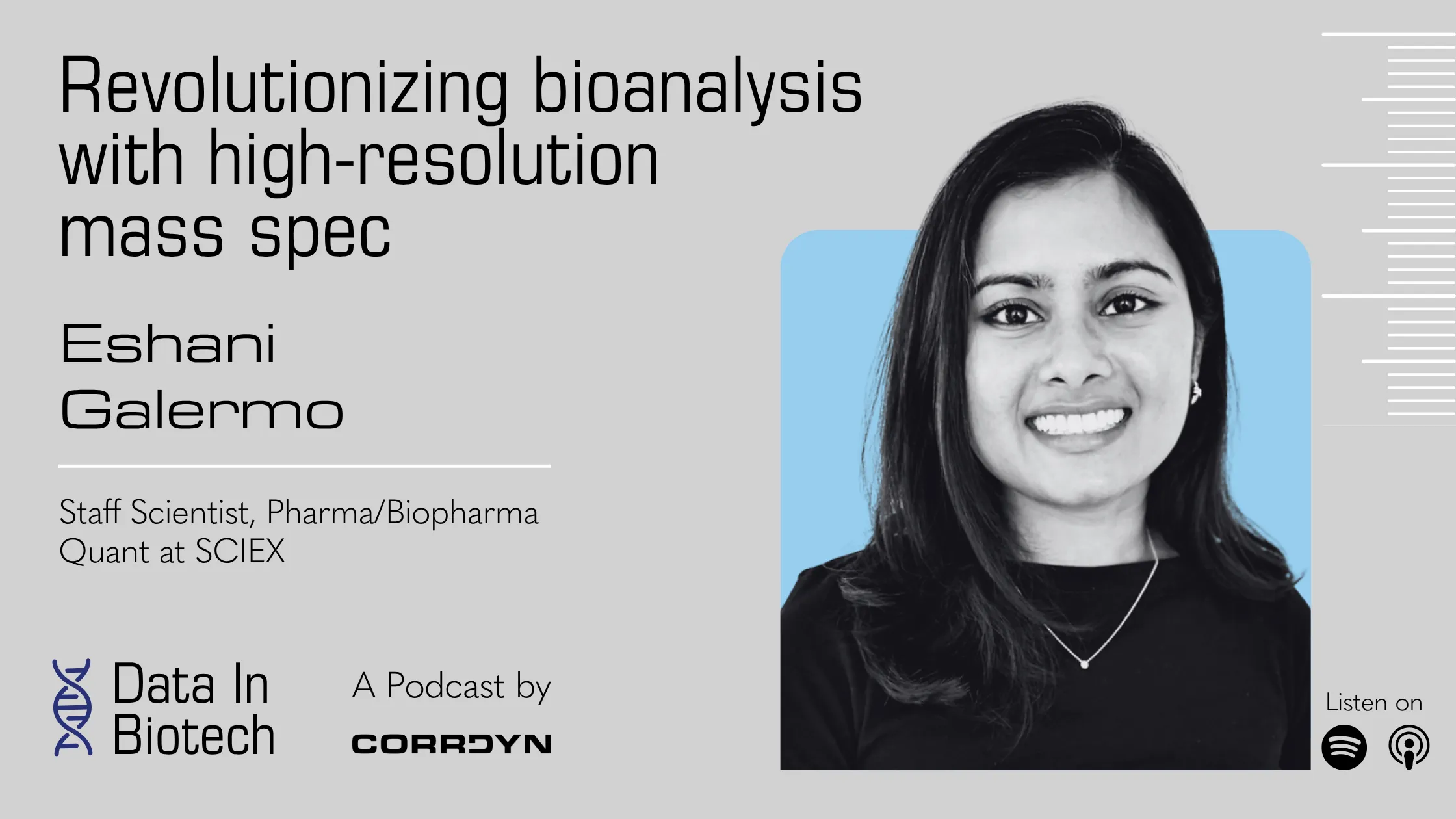
Listen on
Overview
Biotechnology and pharmaceutical companies face a critical challenge: accurately detecting and quantifying low-concentration, complex drug metabolites and biologics within intricate biological samples. Traditional mass spectrometry often falls short on sensitivity and selectivity for these advanced molecules, creating bottlenecks in drug development, prolonging clinical studies, and posing regulatory hurdles. This often leads to extensive manual data processing and difficulty in meeting stringent quantification limits.
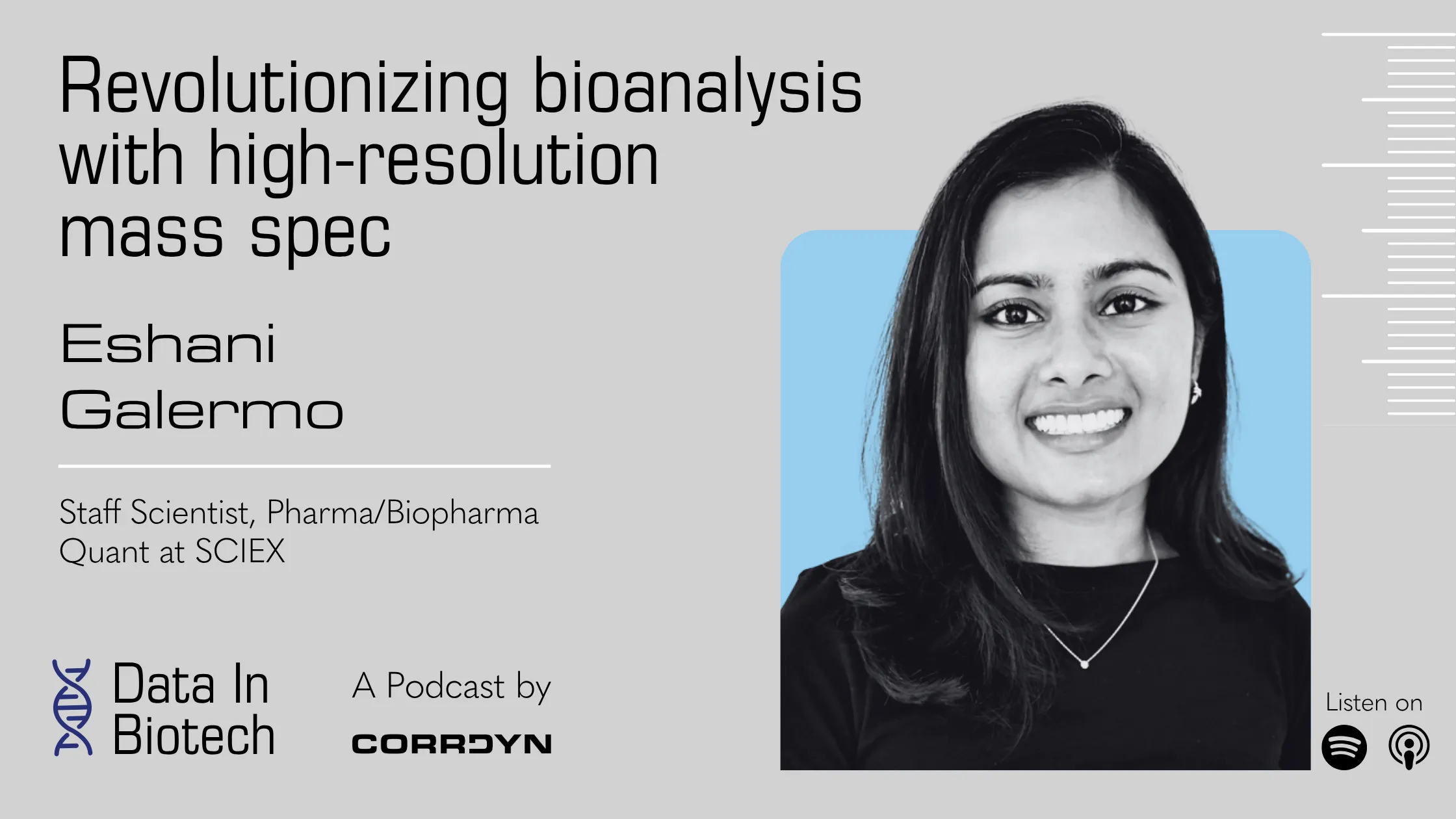
Host Ross Katz speaks with Eshani Galermo, Staff Scientist at SCIEX, who offers a direct look at how next-generation high-resolution mass spectrometry (HRMS) systems, like the SCIEX XenoTOF 8600, directly address these limitations. Her perspective from a leading instrument vendor highlights the innovations that enable bioanalytical scientists to overcome these technical and operational barriers. The discussion covers the evolution of HRMS from qualitative discovery to a powerful quantitative tool, the specific performance gains in sensitivity and dynamic range, and how integrated software and AI are transforming data processing workflows.
This episode provides data leaders and executives with a clear understanding of how advanced bioanalytical instrumentation can accelerate drug development, reduce sample waste, and ensure data integrity, ultimately impacting time-to-market and competitive advantage.
Key Takeaways
High-resolution mass spectrometry is now a quantitative powerhouse, not just a discovery tool.
Historically, high-resolution mass spectrometers primarily served qualitative discovery. However, innovations like the XenoTOF series now offer selectivity and sensitivity on par with, or exceeding, traditional nominal mass spectrometers for complex quantitative bioanalysis. This shift allows labs to consolidate workflows and achieve lower limits of quantitation for challenging analytes previously unmeasurable.
Superior sensitivity and dynamic range directly reduce drug development costs and risk.
The XenoTOF 8600’s 5x to 20x gain in sensitivity and ability to measure across 5 orders of magnitude mean researchers can use smaller sample volumes and detect low-level metabolites more reliably. This capability is critical for preclinical and clinical studies, ensuring regulatory compliance, accurately defining drug safety and efficacy, and avoiding costly re-runs due to insufficient data.
Integrated software and automation are essential for accelerating bioanalytical workflows and improving system reliability.
Beyond instrument hardware, features like automated fragment selection in SCIEX OS software significantly reduce manual data processing time, a common bottleneck. Tools like Metrics Tracker provide real-time system performance monitoring, alerting users to maintenance needs and improving instrument uptime. This automation directly translates to faster throughput and more consistent data quality.
AI integration is crucial for transforming raw mass spectrometry data into actionable conclusions.
With the increasing volume and complexity of data generated by advanced mass spectrometers, the primary bottleneck often becomes data reduction and interpretation. AI-driven quantitation software helps automate integration and analysis of large sample sets, applying user-defined criteria to quickly extract meaningful results. This reduces the burden on data analysts and accelerates decision-making in drug development.
Related: CorrDyn provides data engineering and process automation for biotech and pharma. We also offer data quality services and specialize in the biotech and life sciences industry.
Full Transcript
Eshani Galermo: I think greatly from the data processing side of things, AI would be really helpful because you get a lot of data. At the end of the day, that’s also another bottleneck is how do I reduce my data to meaningful results, conclusions at the end of the day.
Jason: Welcome to Data in Biotech, a podcast from CorrDyn where we explore how companies leverage data to drive innovation in life sciences. Every two weeks, we sit down with an expert from the world of biotechnology to understand how they’re using data science to solve technical challenges, streamline operations, and further innovation in their business. Here we go.
Ross Katz: Eshani Galermo, welcome to the Data in Biotech podcast.
Eshani Galermo: Oh, thank you for having me.
Ross Katz: Awesome. Well, just to kick us off, would you mind giving us an introduction to you and your background and what brings you to APS PharmSci 360?
Eshani Galermo: Hi, I’m Eshani Galermo. I hold a PhD in analytical chemistry from UC Davis. I studied mass spectrometry there, and then I worked for a CRO working on pharma and biopharma workflows. Then I shifted to SCIEX and I’ve been with SCIEX for five years now, and currently I’m the staff scientist there, still working on pharma and biopharma workflows.
Ross Katz: What drew you to work in bioanalysis and bioanalysis equipment?
Eshani Galermo: Yeah. I started off at a CRO out of grad school, and we were working on a lot of bioanalytical workflows there and that got me really excited. That was my first hands-on experience with a lot of different customers in biotech and pharma, biopharma. So it was very exciting. I come from a mass spec background, so eventually it drew me to a mass spec vendor and I ended up at SCIEX.
Ross Katz: Starting with the customer side. Can you give us some insight into what are the types of questions that biotech companies are trying to answer using quantitative bioanalysis that comes off of mass spec machines?
Eshani Galermo: Absolutely. One of the main things is how can I detect the compounds in my sample? And what levels? And can I reach the levels I’m trying to reach? That’s where sensitivity comes into play, and a lot of the instruments you’ll start to see there’s a lot of innovation, a lot of features going in to cater to that. As well, specifically for pharma and biopharma you have these samples in different types of matrices, biological matrices. They’re in tissues, they’re in liver samples, plasma, serum, all of that is very complex, and being able to pick out one particular target analyte from that matrix is very challenging. That’s one of the critical factors. Going into sensitivity is number one. Number two is they’re trying to see if they’re able to measure across a wide range of concentrations. You can have samples with lower abundant compounds and then you can have samples with higher abundant compounds. Can I measure across the wide range? That would be their second question. And then there’s characterization. Can I figure out what the structure looks like? Where is the modification happening? Can I figure out if those modifications are going to cause different types of effects down the road, as they’re going through drug development, that’s a big question as well. Those are all the types of questions we’re typically getting from customers as a mass spec vendor and trying to find solutions for them.
Ross Katz: I’m interested in what is it about traditional mass spec that doesn’t– where does it fall short or where does it not quite get bioanalysis companies or teams to the place of sensitivity that they really need?
Eshani Galermo: Yeah. We have different types of mass spectrometers out there. But if I had to categorize it, it’d be nominal mass spectrometers and high resolution mass spectrometers. Traditionally, speaking of bioanalysis since we’re at AAPS, a lot of quantitation workflows have been on nominal mass spectrometers. That has been the gold standard, but nowadays we’re starting to see a lot of analytes being more complicated, more complex in structure. Once again you have those types of analytes in very complex matrices, biological matrices. Being able to detect those types of structures as well as quantify them becomes a very big challenge. There’s been a huge push for high resolution mass spectrometers in the space of bioanalysis to cater to those challenges. Those specific unique workflows are now pushed on to the high resolution mass spectrometers.
Ross Katz: Yeah. And if I’m understanding correctly, some of the new molecules that are coming about like GLP-1s or peptides, these lend themselves better to high resolution, are those some of the complex molecules that you’re talking about?
Eshani Galermo: Yeah. GLP-1s, but also the oligo field. You have oligo nucleotides, you have siRNA’s, you have antibody oligo conjugates. You got an antibody part to it, a linker, and then an oligo. There’s a lot of these structures that are coming out with additional components that you’re needing to either verify or identify or quantify. All those aspects need to be catered to, and a lot of times you often face some kind of complex issue when it comes to the analytical side of things, whether it be sensitivity or selectivity, being able to pick up your target from a background. Or you are trying to quantify a specific structure that’s very hard to do on mass spec sometimes.
Ross Katz: That makes a lot of sense. My understanding is that the technology for high resolution accurate mass has evolved pretty dramatically and that these tools historically have been more qualitative discovery tools rather than quantitative discovery tools. Can you maybe characterize the difference between qualitative discovery and quantitative discovery on mass spec and then maybe explain how the technology is enabling high resolution accurate mass to do both as I understand it.
Eshani Galermo: Yeah. From the perspective of what we’ve been developing in-house, if you were to differentiate between qualitative and quantitative, qualitative is more looking at how can I structurally elucidate my compound? Can I figure out what are the components that are present or the modifications? What does my compound exactly look like? For quantitative workflows, it’s more looking at the actual amount or concentration levels of my sample, or my target compound in my sample. Traditionally, like you said, high resolution has been pushed for more qualitative workflows. But nowadays with high resolution mass spectrometer what you can do is differentiate your target analytes from your background analytes or ions better. One of the key advantages is that selectivity, based on the high resolution that you are getting from that system. Typically that’s advantageous in the quantitative field because that helps you reach a lower level of quantitation. You can get to those lower concentration levels better. Because of these advantages in the high resolution mass spectrometer people are looking at high resolution. It’s also flexible because you could do both qual and quant. Because of that, a lot of people are starting to look into high res and trying to incorporate it into their daily bioanalytical work.
Ross Katz: My understanding is there are a bunch of other– in addition to being more selective and more sensitive, there are some other benefits to using an instrument like the ZenoTOF 7600. For example, the idea that you can use less sample, that you don’t require as much sample to detect what’s happening with your compound, but also there’s this opportunity for your workflow to be speedier. Can you maybe verify if I’m understanding correctly that those are some of the benefits they bring to the table and if so, maybe explain how using a tool like the ZenoTOF 7600 allows you to use less sample and or get your workflow done faster.
Eshani Galermo: Yeah. The ZenoTOF system, we have the 76 as well as the 86. The ZenoTOF series in general, we have a specific area in the system where we introduce a trap. Basically what it does is your analytes are injected into the system, they turn into ions, and then the ions flow in and the user selects which particular ions they want to look at. Then it goes under a cell where it fragments into pieces. Then it goes into the time of flight, which is our mass analyzer. Typically when the fragment ions go into the time of flight, there is an ion transmission loss. Because of that we put in that trap to bundle it all together and then they send it into the mass analyzer and you detect it that way. From that you are able to get the best sensitivities when it comes to a Q-TOF mass spectrometer because traditional Q-TOFs don’t do that. That allows you to make sure that you’re not losing that sensitivity of what you injected initially because of just the intrinsic nature of Q-TOFs. Because of that Zeno trap, the ZenoTOF series has really pushed the boundaries for sensitivity. You’ll see that both with the 76 and 86 that really allows you to capture even the lower end as well as the higher end.
Ross Katz: That was really interesting to me. This idea that there’s this duty cycle that mass spectrometers essentially have where typically in a mass spectrometer, if I’m understanding correctly, the ions are being sent into the time of flight detector, but the time of flight detector’s only on for a very short period of time and so there’s this idea that the Zeno trap is holding the ions and only sending them when the detector’s ready to actually detect. So you’re able to get that signal much more strongly. Am I thinking about that right or understanding it right?
Eshani Galermo: No, it’s a pulsar essentially. You have to bundle it in order to send that packet of ions. Otherwise, you get a continuous flow, you’ll definitely be losing ion transmission.
Ross Katz: I find that aspect of this really interesting. Now that we have a little bit of background on mass spectrometers generally, can you outline typically, what is the data that comes off of a mass spec machine and how you analyze it in order to get some of the answers to some of the questions that you discussed earlier?
Eshani Galermo: Yeah, absolutely. Let’s say for a quant experiment. If you’re trying to calculate the concentration levels that you injected originally into the mass spec, what you would do is at the end of the analysis you will get a certain intensity as well as the m/z or the mass to charge ratio of your monitored fragment ion. In that case, you would take that– it would come in the shape of a peak. You would take that peak, you would integrate it, use the peak area, and then back calculate what that concentration would be.
Ross Katz: Right. So there was this calibration that happened prior to it where you understand the relationship, as I understand it, between the area of the peak and how that maps to what the concentration of the compound is.
Eshani Galermo: Yeah. Essentially you’ll get the retention time and then you would get the intensity and you’d get several different peaks according to whatever you were trying to measure. Each of those peaks also has information of what particular precursor ion or the original m/z of your analyte, as well as the fragment ion information.
Ross Katz: Yeah. You can distinguish all of the things that are present and then how much of each thing is present and the conclusions that you draw from that depend on the nature of the question that you’re asking. But the ability to detect small variations in the things that you’re detecting yet then also detect exactly how much is present, both of those things are elements of the high resolution accurate mass. Am I thinking about that right?
Eshani Galermo: Yeah. That’s awesome.
Ross Katz: If I understand correctly the 8600, this newer piece of equipment, offers this 5x to 20x gain in sensitivity. From a bioanalysis perspective, what does that get you in terms of your workflow or in terms of your ability to get answers faster, less expensively, or to questions that you wouldn’t have even been able to ask previously?
Eshani Galermo: During drug development, you have different levels of the drug development process. Typically you would have your particular therapeutic in different types of samples. It could be in mouse samples in your preclinical studies or clinical studies would be in human samples. A lot of times you would try to minimize the amount of the sample volume, just because of the invasive nature. In that case you would be having small sample volumes that then have a smaller concentration of your compound because you’re monitoring your drug over time. As well as metabolites, which is basically your body metabolizing the drug and turning it into other different types of structures. As the time goes on, the concentration drops. You can imagine small volume sample, less concentration of drug therapeutic, how can I detect that and to the lowest level so you can safely say, this is the tox level, this is the safety, this is efficacy and then I can push this drug out safely to the public. It’s really important to have an instrument or platform that can target those low level concentrations, especially in those preclinical and clinical stages.
Ross Katz: Right. I can imagine from a regulatory perspective, depending on the nature of the compound that you’re bringing to market or the therapeutic that you’re trying to bring to market, you might have obligations to reach these very low levels of quantitation that you might not be able to reach with your typical triple quad mass spec machine. Am I thinking about that right?
Eshani Galermo: Oh yeah, there can be cases in terms of the compounds that have, like I mentioned earlier, with the background issues or you need better selectivity, you’re able to do that easily on a high resolution mass spectrometer and safely push out the drug.
Ross Katz: We’ve talked about LLOQ, but I’m interested in– one of the things that you talked about in your presentation last night was this idea of a broad linear dynamic range. I’m wondering if you could define what a linear dynamic range is in the context of what we’re talking about and then maybe talk about why that’s critical for streamlining late-stage clinical studies and making sure that the data integrity is there.
Eshani Galermo: Yeah. As I was mentioning earlier, when you’re looking at the drug over time, if you’re dosing, it will go from high concentration to low concentrations and it’ll give you a range. Being able to measure across the lowest range and to the highest range is very critical. The ZenoTOF 8600 system has that new optical detector that allows you to capture that wide range of concentrations and you saw with different examples, we can reach up to five orders of magnitude in some cases. It’s really critical because you can have samples with very high levels of your analyte and there can be samples with very low levels. How can I have a full assay that can measure that?
Ross Katz: One of the things that came up as I was researching the 8600 was also this concept that by having this much greater sensitivity leveraging the full scope of the sample that you’re pushing through, you’re getting so much more data that allows you to ask more follow-up questions about the composition of what’s in your sample. First of all, is that understanding correct? And if so, are there examples of questions that people ask after doing mass spec that the ZenoTOF 8600 enables them to ask?
Eshani Galermo: Absolutely. There’s times when you can open up the instrument and just get the full profile. Basically, hey I’m injecting this sample that can have multiple analytes, what do I have? And then sometimes you’ll see peaks there that you don’t know any information about. Those are flagged and because the system also allows you to collect fragment ions, which is pieces of the initial ion, you can put the puzzle pieces together essentially and be able to elucidate what that structure would be like. There’s libraries available, and a lot of companies have in-house libraries as well and they can figure out what that structure would be like.
Ross Katz: Yeah, having that higher degree of sensitivity means that you’re going to be able to pick up on those things that wouldn’t otherwise be there if you had the 7600 for example. Okay, that’s really interesting. One of the things that I believe you were discussing in your presentation last night was this idea of finding the locality of biotransformation sites for drug metabolites and how that helps with drug metabolism and pharmacokinetic studies. Can you maybe share an example of how that works?
Eshani Galermo: Yeah. When anyone consumes a drug, your body metabolizes it. Basically, at the end of metabolism, you start to see different types of structures come off that are of the original parent structure but have certain modifications. Those certain modifications can be problematic, and that’s why you will have all these scientists really going in to figure out what those structures are, what those metabolites are. Are they going to cause some type of effect? Typically with a mass spec, you’re able to, like I said, you have those puzzle pieces. You can look at it and you can figure out, ‘Oh, hey, this is a new type of modification that’s happening at this site and that means X or Y or Z.’ It’s really important to figure out the structures of those metabolites, but also figure out the levels of those metabolites as well, which the ZenoTOF 8600 system can do with the better sensitivity.
Ross Katz: Another thing that I was noticing was that you have automation support for bioanalytical researchers to help them go through their workflows more effectively. One of these was this idea of an automated fragment selection feature and then another thing that came up was this metrics tracker tool. I’m interested in what are the additional components of the system around the outside of the mass spec itself that help to automate or improve the workflows of the bioanalytical scientist?
Eshani Galermo: Yeah. The software side, SCIEX OS software. Basically our system comes with SCIEX OS software. SCIEX OS software really tailors all the features that are needed for quant. Users can acquire the data, manage the data as well as do all your integration processing within that software. There’s always aspects where there’s a lot of manual upfront work like the automated fragment selection. That really helps a lot of folks that are doing quantitation because in a high resolution mass spectrometer setting, you typically get all the fragment ions coming through. Basically you can filter out and figure out which fragment ion gives me the best sensitivity, which fragment ion gives me the best selectivity. Or in the case of the dynamic range, which one gives me the best over the widest dynamic range. A lot of times you have also the capability of summing these fragment ions because you can leverage that level of sensitivity through summing. Because of that, there’s a lot of manual work where you would go in and try to figure out what works where and what would work for me. We have that feature in SCIEX OS software that can now automatically– you would define your criteria, you could say, ‘Yeah, this is the information from my peptides, this is the sequence, this is the concentration levels or the types. I want to target lower LOQ’s,’ and it will take the information from your fragment ions as well as the theoretical fragment ions, match it and figure out, ‘This is the final results that will cater to the lower LOQ,’ or ‘This is the final results that will cater to the broader LDR.’ That really minimizes that upfront work, so you don’t extensively have to go through your data as much, and it will give you a nice peak with integration that’s already summed with the different fragment ions that you selected. That’s really exciting for bioanalysis because it allows you to minimize that data processing stage. Then you mentioned metrics tracker, and that’s another feature that we have in SCIEX OS software that allows you to track the performance of your system. Sometimes things come up, obviously, any system things can come up and it’s a little bit harder to track the performance. Metrics tracker does that where it will allow you to measure or look at the performance of the system, look at the sensitivity of the system, if there’s any significant drops in sensitivity, hey I need to schedule a cleaning, I need to do X to get it up and running again.
Ross Katz: Awesome. So there’s a component that’s helping the researcher with their workflow and then there’s also helping the machine operations side to understand the status of the machine and make sure that they’re staying on top of their maintenance, making sure that the machine is operating to the highest degree of quality that it can. For a CRO or another biotech or pharma organization with a bioanalytical workflow, and they’re looking at the ZenoTOF 8600 relative to the other mass spec machines that they might get, how would you recommend they think about distinguishing the 8600 from other options that they might get? How would you encourage them to think about the ROI or the cost of ownership of a machine like this?
Eshani Galermo: The ZenoTOF 8600 system comes with a lot of great features that cater to bioanalysis. It is a box that can do both qualitative and quantitative work. We’ve added, as I spoke about, the Zeno trap and the duty cycle. We discussed that, so it really helps with making sure you have the most sensitive system there for bioanalysis work where you’re looking at some lower level abundance target analytes in your very complex matrix. As well as being able to do qualitative work on the system. The system also has two different types of fragmentation. It has both EAD, electron activated dissociation, and CID, collision induced dissociation. Both of which help with identification workflows as well. If there’s labs that are doing both qualitative and quantitative work, it’s a really useful platform to have that flexibility in your lab. For both sides of the spectrum, qualitative and quantitative workflows, the ZenoTOF is able to cater to that. The 8600 is very much on par in terms of quantitative performance with nominal mass spectrometers. If there are assays, like you saw last night, some of the examples that I’d shown last night had high background issues, some of them had closely eluting matrix peaks. All those assays can be easily moved on to a high resolution mass spectrometer and not having to do additional sample prep that you would traditionally do with a nominal mass spectrometer. All of those are very advantageous features of the ZenoTOF 8600 system.
Ross Katz: As we come to a close, just looking toward the future a little bit. Do you expect machines like the 8600 to eventually displace your triple quads like the 7600 or do you expect it to be used in a complementary fashion on a forward-looking basis?
Eshani Galermo: I would say complementary. Definitely the triple quad is your gold standard for a reason. It gives you very sensitive quant. There are cases where there’s complexity, let’s say you want to quantify a structure that’s very hard to break down, you want to use MS1 level quant, high resolution will give you very accurate MS1 level quant. Or if you have those background issues as I had mentioned earlier, you can have more selective and sensitive quant on high res. Or at least the latest gen high res. I think that they work hand in hand. There’s going to be areas where a high res will make sense and there’s going to be areas where a triple quad is going to make more sense. But both offer good advantages for bioanalysis.
Ross Katz: Any time we talk about data we end up talking about machine learning and AI. I’m interested in what are the intersections of machine learning and AI with either the method development that might go into how you utilize the machine or the consumption of the data that’s coming off of the machine that you think are the most interesting applications that can be complementary to a machine like the 8600?
Eshani Galermo: Yeah. I think greatly from the data processing side of things, AI would be really helpful because you get a lot of data. At the end of the day, that’s also another bottleneck is how do I reduce my data to meaningful results, conclusions at the end of the day. That’s really critical and I think in that area you would probably need AI integration in certain places where you can take a large sample set of data and get the conclusions that you need for your samples.
Ross Katz: Have you seen anything in existence that’s been moving in this direction or is it still a little ways out for the ability to do that?
Eshani Galermo: We have AI quantitation software. It’s a collaboration with Mass Analytica. We have some examples out there where we used it for a large sample set of data being able to reduce it down easily, integrate automatically. You will have your user define criteria for what you want to set it up as, what you would like to see in the final results, and then the software will do the magic for you. Yeah, it’s definitely out there and I think it’s going to continually evolve as well because more samples, you’re going to get more and more data and for sure that’s going to be a big area for AI.
Ross Katz: Even more generally, what excites you about the future of mass spectrometry? Are there other innovations coming down the line that you think are really exciting or might change things?
Eshani Galermo: Yeah, of course, there’s going to be a lot of innovation. Continually we’re innovating to become most sensitive, being able to measure across a wide range of concentrations, have these different types of capabilities, such as EAD, we have a different type of fragmentation mechanism. We have all these new modalities that are coming out and being able to target all of them is going to be critical for our customers. We’re continually getting information from our customers, talking to them, figuring out what are the main challenges currently in the market space so we can cater our next innovation to answer those questions.
Ross Katz: What are the most interesting types of feedback that you get from customers and potential customers that influence how you all think about R&D?
Eshani Galermo: Yeah. We get feedback for our software. We get feedback for our mass spec. How can it be more robust? Last year we had launched our SCIEX 7500+ system listening to customer feedback, understanding that robustness needs to be a critical player so they have more instrument uptime, they’re spending more time doing analysis. We listened and we delivered. We have this MassGuard technology in there to really push for more instrument uptime. We also implemented it on the 8600 system. Feedback like that really helps us innovate better for the next round of instruments.
Ross Katz: Yeah. Eshani, you’ve been a great guest today. I really appreciate the time. Before I let you go, would you mind telling people where they can learn more about your work and the work at SCIEX?
Eshani Galermo: Yeah. Absolutely. You can go to sciex.com. We have a lot of our applications there. I work for a global technical marketing team. We have different folks that take care of different market verticals, and we are continually driving applications with customers, innovative applications. You can read more about our technical notes there in the pharma, biopharma space as well as other spaces. And also you can learn more about our products as well. We have the product pages there too.
Ross Katz: Fantastic. Well, Eshani, thank you again. Really appreciate you coming down to talk.
Eshani Galermo: Thank you. Thank you for having me.
Jason: And that’s it for this episode of Data in Biotech. If you enjoyed the episode, please subscribe, rate, or leave a review in your podcast platform of choice. See you next time.