Listen on
Overview
Bringing life-saving drugs to market hinges on fast, accurate decisions, but the increasing complexity of molecules like therapeutic peptides (e.g., GLP-1 agonists) challenges traditional bioanalytical methods. These complex compounds often require extensive preparation, limiting detection sensitivity and delaying critical data points for drug efficacy and safety. This bottleneck directly impacts drug development timelines and patient access.
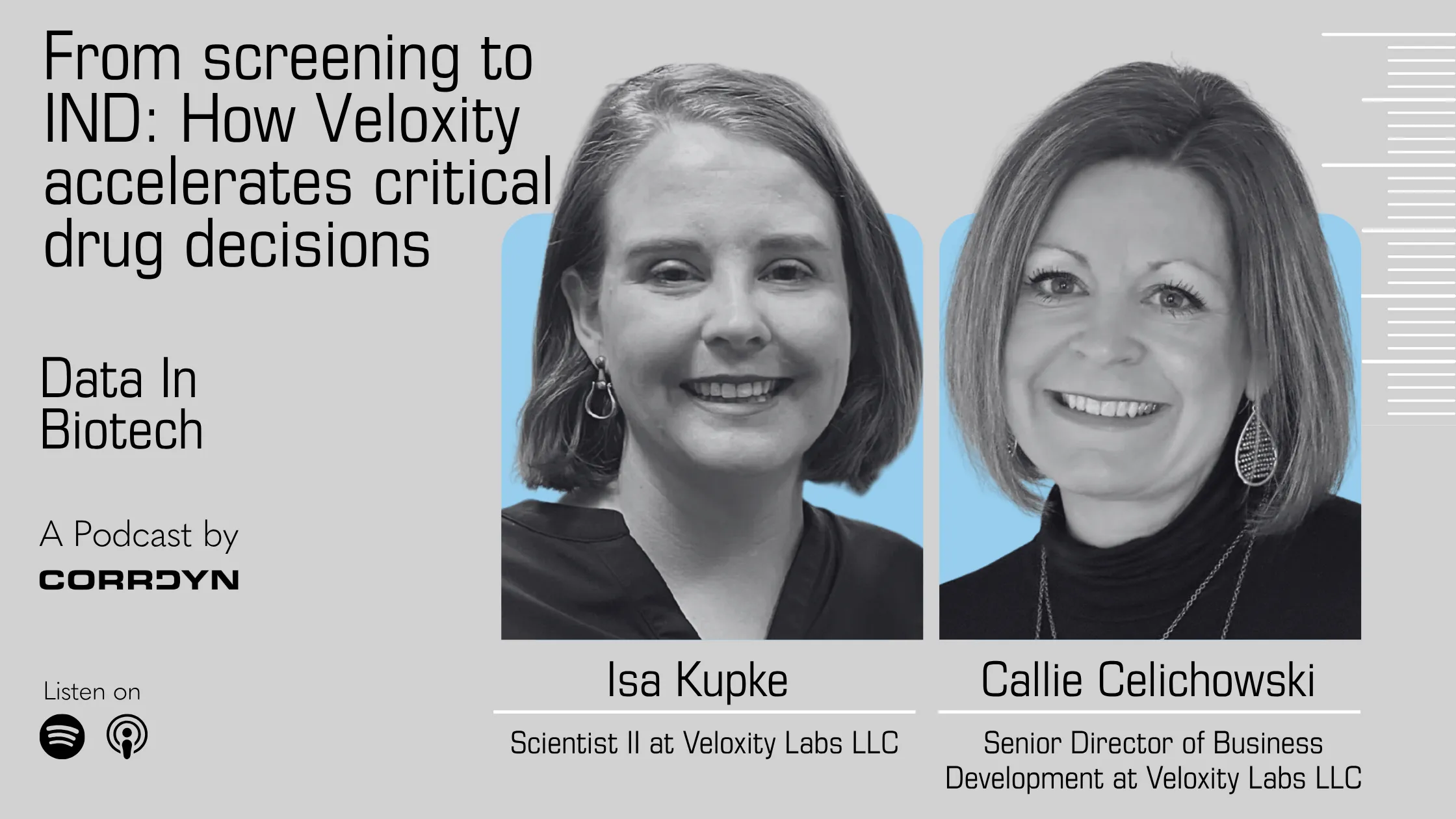
In this episode, host Ross Katz speaks with Callie Celichowski, who leads client relationships at Veloxity Labs, and Isa Kupke, Scientist II. Veloxity Labs is a contract research organization (CRO) at the forefront of bioanalytical mass spectrometry. They discuss the critical role of advanced technology—specifically the Thermo Scientific TSQ Altis 8600 High-Resolution Accurate Mass (HRAM) mass spectrometer—in overcoming these challenges. The conversation details how Veloxity, as the first CRO in the U.S. to adopt this instrument, delivers precise, low-level quantitation of complex analytes, accelerating decision-making for their clients and ultimately contributing to faster patient access to new therapies.
Key Takeaways
Advanced Bioanalytical Technology Directly Accelerates Drug Development Timelines
The adoption of instruments like the 8600 HRAM mass spectrometer is not just a technical upgrade; it’s a strategic investment that reduces a full day of sample preparation and enhances sensitivity. This allows for the rapid, accurate quantification of complex molecules like GLP-1s at extremely low concentrations, directly impacting how quickly drug sponsors can make critical decisions regarding drug safety and efficacy. For data leaders, this highlights the ROI of investing in leading-edge data acquisition infrastructure within life sciences.
Method Robustness Drives Regulatory Readiness and Reduces Project Risk
Scientists make thousands of ‘small decisions’ during method development to ensure data reliability. These decisions—from sample extraction techniques to instrument tuning—are critical for achieving accurate, repeatable results, especially with challenging analytes like peptides. Building well-tested methods from preclinical phases ensures that data holds up for regulatory submissions, minimizing surprises and rework later in the drug development lifecycle and safeguarding against costly delays.
Specialized CRO Partnerships Offer a Competitive Edge in Complex Bioanalysis
For drug sponsors, selecting a CRO that offers direct scientist contact and specializes in difficult analyses (like peptides) with advanced tools provides a significant advantage. This model contrasts with larger, more ‘machine-like’ CROs, ensuring consistent expertise and faster feedback. This relationship-focused approach, combined with advanced technology, translates to quicker data delivery and more informed decisions for clients, particularly when working through novel drug candidates.
High-Sensitivity Data Enables Micro-Sampling and Deeper Metabolic Insights
The enhanced sensitivity and lower limit of quantitation (LLOQ) provided by HRAM technology allows for the detection of drug concentrations at picomolar levels in micro-samples (e.g., dry blood spots). This not only reduces the sample burden on patients but also provides more granular data on drug metabolism, absorption, and distribution over longer time points. This detailed kinetic data is essential for optimizing dosing strategies and understanding drug behavior in the body.
Related: CorrDyn helps companies across biotech and life sciences manage complex data challenges. We specialize in data reliability and developing technology strategy to ensure data systems support critical business goals. Read our perspective on how biotech manufacturers realize data value.
Full Transcript
Isa Kupke: As scientists we make a thousand small decisions to make a robust method. Every decision that we are making is with the end goal in mind and that’s the patient and saving lives.
Jason: Welcome to Data in Biotech, a podcast from CorrDyn where we explore how companies leverage data to drive innovation in life sciences. Every two weeks, we sit down with an expert from the world of biotechnology to understand how they’re using data science to solve technical challenges, streamline operations, and further innovation in their business. Here we go.
Ross Katz: Callie Celichowski, welcome to the Data in Biotech podcast.
Callie Celichowski: Thanks Ross.
Ross Katz: Awesome. Well we’re here at the AAPS PharmSci 360 conference and excited to talk with you about your work and about Veloxity Labs. Can you just give us an introduction to you and your background and the work that you do?
Callie Celichowski: Yeah, sure. So Callie Celichowski, and my background is all business related. I started on a marketing team at a really large CRO where they did great training and introduced me to drug development, and then moved to smaller mid-size and small CROs, more on the sales side.
Ross Katz: Awesome. Would you introduce us to Veloxity Labs?
Callie Celichowski: Yeah, Veloxity is a bioanalytical mass spec based CRO. We are located in Peoria, Illinois, and really focused on very early screening, drug discovery, all the way through IND-enabling and clinical bioanalytical support. Really partnering with clients to do everything from start to finish mass spec based.
Ross Katz: As we were preparing for this podcast, I know that one of the catchphrases or taglines for Veloxity Labs is this idea of speed with purpose. Can you unpack what that means in the context of how you work with clients?
Callie Celichowski: Yeah, there are a lot of CROs that can provide a set of data. They can send it over and give you an Excel, they can give you a Word report that has what was found. But when you have questions or you want to really discuss and get into the nitty-gritty of what that data means, Veloxity really is always there for you. We’re doing not only the delivery very, very quickly, but if you have questions you call, you text, you ask the questions, and our people are going to be there start to finish to give you what you need.
Ross Katz: From the client perspective, or from the sponsor perspective, what do you think they’re looking for in a CRO? How do they evaluate which CRO they’re going to select and why do you think they end up with Veloxity Labs?
Callie Celichowski: A lot of our clients have a relationship with one of us from the past, and we’ve gotten to know one another. We don’t run before we walk. We smart start with a smaller project and then dive into more deeper, longer-term strategic partnerships. Clients are looking for a partner that they have one person to go to, a scientist. Our scientists work on things from the start to finish. We don’t do a handoff from method development to method validation to sample analysis to reporting. You have a PI that is working with you on every step of that process and they are your main contact versus we’re going to start with development, and then somebody’s going to do the validation, and then somebody else is going to do the sample analysis. That works well for larger institutions that have more of a machine type of philosophy whereas we are really focused on that relationship and getting you from start to finish.
Ross Katz: One of the things that interested me about Veloxity Labs is your work with peptides and especially the idea of working with GLP-1 receptor agonists, these drugs that are becoming really transformational for weight loss and diabetes treatment and a variety of other indications that are out there. I’m interested in number one, what kind of work you all have done or how you all are positioning yourself for the work that needs to be done with regard to these peptides.
Callie Celichowski: Yeah, it’s trending. There’s a lot of publicity and advertisements and all of that kind of stuff going on about different GLP-1s and other peptide-type work that’s in our wheelhouse. Trending, that’s one thing. There’s always the popularity and there are things that are going to go in ebbs and flows and this is a big one right now. They’re trying to put their best foot forward in making sure that they’re going about this in a regulated fashion. Being able to get additional products to the market that maybe are more efficacious but yet still safe is really, really important. The companies that are working on that are ideal for us.
Ross Katz: Is there anything that you see on the horizon for how the CRO model as a whole or how Veloxity Labs in particular needs to change or adapt as molecules become more complex, as the type of analysis that you’re doing or the nature of the assays that you need to apply needs to change in order to…
Callie Celichowski: Yeah, we always as an industry have to be adaptable. I think gene therapy, for example, that was all we were talking about maybe a year and a half, two years ago, and that particular segment of our industry has had a rough go of it lately. It doesn’t mean that it’s forgotten, it doesn’t mean that it needs to go away. We still need to find solutions, but we also have to be ready for what’s next. I feel like the GLP-1s and different peptide more complex analysis is necessary, and Veloxity has done a really nice job not going overboard but staying on top of some of the trends.
Ross Katz: As you look forward to 2026, is there anything in terms of how Veloxity Labs’s footprint or machinery or the way that you operate might change that you’re particularly excited about?
Callie Celichowski: Just continually growing is important, but growing with purpose, not growing just to grow. We don’t want to be the biggest CRO, we don’t want to be a one-stop shop for everyone. We want to be experts in bioanalysis from early screening all the way through whatever your endpoint is as a client.
Ross Katz: Callie, thank you so much for joining the podcast today. Isa Kupke, welcome to the Data in Biotech podcast.
Isa Kupke: Thank you so much for having me.
Ross Katz: Awesome. Just to kick us off, would you give us an introduction to your background and the work that you do at Veloxity?
Isa Kupke: I’m Isa Kupke. I’m originally from South Africa, that’s why I have the accent. I started in natural product research, and through that I got into mass spectrometry, LC-MS/MS, so I came to the US, I did some work on American plants and their traditional uses, and then I came to Veloxity and I’ve been loving it. I’m working as a scientist now at Veloxity, helping our PIs with doing work for our clients and helping them make the decisions that they need to make.
Ross Katz: Awesome. Working as a scientist at a CRO, I could imagine a lot of things about the different types of problems you get exposed to, but would love to hear from you about do you have any example projects that you’re willing to share or give us an overview of what your work looks like.
Isa Kupke: We work mostly currently on small molecules, but we are moving more into peptide work. Peptides are notorious to be a little bit more difficult to work with than small molecules. They need a lot of preparation during method development, tuning, they have multiple charge states that affects the sensitivity. We try our best to get the best robust method that we can for our clients so that even if they are in the preclinical phases where we’re dealing with just making decisions going into GLP work, and regulated work, we’re really trying to get those methods as robust as possible, really understanding the stability of an analyte of a peptide, so that once we go into the actual regulated work we don’t have any surprises and the data we are getting is as robust as possible, and that it is ready to be submitted to the FDA.
Ross Katz: For people who aren’t familiar with the work of CROs, connecting the dots between a drug that you might get in the pharmacy to the kinds of work that you’re doing in the lab in order to characterize these preliminary drug candidates to prepare them for bringing them to market. It’s hard to understand how these things connect to each other. But my understanding is that the kind of work that you’re doing with mass spec is to try to interrogate the nature of these preliminary drugs and quantify some of the aspects of it such as stability that you just mentioned so that you can help your clients to answer the most critical questions that they need to answer as they’re preparing the launch. Would be interested in hearing from you, what are some of the most important questions that your customers are asking about these preliminary drug candidates and then how do you attempt to answer those questions with the kinds of mass spec methods that you bring to bear?
Isa Kupke: A lot of the drugs that our clients do are mostly in the preclinical phase. They want to know does their samples have a toxicity at any certain level? What are we detecting in the samples that they are sending during different dosing stages? A lot of toxicology type of work that we are analyzing the drugs in. Also efficacy. Our clients also want these results and this data fast. That’s what Veloxity is all about. It’s so important for them to have a CRO partner that can provide data fast to them so that they can get the drugs to the patients as quickly as possible.
Ross Katz: That makes a lot of sense. My understanding is that you’re attempting to interrogate the toxicity or the efficacy but then you’re also developing methods for the detection of these properties. Am I thinking about that right?
Isa Kupke: Yes. Not in that sense. What we do is we want to quantify the levels of drugs or the level of the drug either in certain matrices that the client might send to us. We get blood samples, whole blood samples, plasma samples, tissue samples, and our extraction techniques vary based on the type of analyte just so that we make sure that we don’t get any interferences once we get to mass spec and looking at the concentrations of that specific analyte that they are interested in in that matrix that they are sending to us. That is what the mass spec is helping us with.
Ross Katz: My understanding is that you’re using mass spec to characterize all these different quantifiable traits of the drug candidate that’s coming in and then you’re providing that data back to the client. Are you providing any sort of narrative support or guidance with regard to the data that you’re providing back?
Isa Kupke: We mostly try to provide data that is easily interpretable for our clients. If they have more questions surrounding data and data trends, they can definitely approach us. But direct discussing the data or making very important decisions such as for the efficacy, that is not what we currently do, but we try to make sure that the data that they are receiving is interpretable and that they can use it for moving forward with their regulated studies.
Ross Katz: That makes a lot of sense. Obviously documentation of the methods that you’re applying in order to generate the data, I’m assuming is as well, right?
Isa Kupke: Yes. Even with non-GLP work, all our methods are documented. Every step, every decision that we are making, we document that so that it can be moved from one phase or one test or where the client currently is, it can move through and if there’s maybe a scientist that’s not there that day, that a scientist needs to take over, the work never stops and they can just continue with that.
Ross Katz: In our previous conversation with Callie, we discussed this idea of peptides and GLP-1s and what I’ve heard is that the nature of peptides makes—and you actually shared this a little bit earlier—that peptides are harder to understand or harder to interrogate using the tools that you have available. Would you mind just unpacking a little bit about what makes it harder and maybe that can lead into why there is this need for the 8600, for understanding mass at a higher degree of accuracy?
Isa Kupke: Yes. Currently peptides are super sticky, so they just stick to everything. We definitely adapt our methods to account for that. Peptides are also very large. With the current 6500, the mass is too large or the peptide is too large to really be effectively analyzed by the mass spec, and we have to do some digestion. That digestion normally takes a day. It also comes down to when you’re building the method, the peptide has multiple charges and that affects the sensitivity that we’re seeing. It’s difficult to go to really low LLOQ levels where our clients might need that in deciding what levels the drug is effective at or toxic at. What’s really great about the 8600 is that we can just pop that peptide right in there, and we can get data that we could have never seen in the 6500. We can go to concentrations that we couldn’t have before with the 6500. The 6500 is still great for small molecules, but saving time with just the method development, the tuning, because peptides require on-column tuning and it’s a lot more difficult than just a small molecule putting in on the instrument on the 6500, tuning it, and you have a pretty decent method in like 10 minutes. Peptides take much longer. The 8600 is definitely going to save us a lot of time in developing a method when we are extracting the peptide digestion, protein digestion. It’s going to be really fun. I’m so excited to get hands-on experience with it.
Ross Katz: I’ve never been exposed to the 8600 system before but my understanding is that it’s called HRAM or high resolution accurate mass. The idea here is you can measure the mass at a much higher resolution, to many more decimal places of accuracy in order to detect something like a GLP-1 that might be in a sample so you can then sample for much longer as the peptides are diminishing in concentration, and the idea here is that that helps to characterize how much remains in the body over the long term that you have the drug in your system. Am I understanding that correctly or how would you update that?
Isa Kupke: Exactly. That’s correct. Sometimes when we do testing for a client, their dosing would go for—we normally have a predose sample and then once they start dosing, it could be various time points where they are collecting a sample. Normally the concentration goes a little bit more down as you reach longer time points. Having the 8600 being able to detect analytes even at those low concentrations really helps the clients make better decisions and faster decisions for the drug and moving it forward because all those decisions add up to time and money and a patient’s life. That’s so important is to get the most accurate data and the most data that you can to make the correct decision.
Ross Katz: I think you all mentioned that you’re one of the only CROs in the United States that has access to one of these machines or is gaining access.
Isa Kupke: We are the first. I think there’s only two equipment currently that has been actually manufactured, and we are the first CRO in the US to have this piece of equipment, and we are so excited to test it and to run samples on it.
Ross Katz: Is the reason for that that it’s just so new it’s just been developed or that it’s relatively expensive or that you all are so excited about the capabilities of it that you’ve just gained access?
Isa Kupke: Oh yeah, having the capability to use it, I’m really excited about the Zeno part and learning more about that Zeno trap part of the mass spec. It’s a pretty expensive piece of equipment. That’s why not a lot of CROs currently have that. There is some training that goes into that but just being able to go down to such low LLOQ levels, and it being so sensitive and saving that much time with peptide work and being able to do some protein work on it as well is really going to be fun, and I think expand what Veloxity can do and really staying at the forefront of bioanalysis.
Ross Katz: One of the other benefits that as I was reading up about the 8600 was this idea that you could move into microsampling so not have to take such large blood or tissue samples from patients in order to be able to interrogate them. Am I understanding that correctly or is that something that you see on the horizon with the availability of this machine?
Isa Kupke: Currently we do have the capabilities of collecting samples or receiving samples from a client that does microsampling. We do work with Tasso and the dried blood spot. With the 6500, we can get pretty good data from that. But sometimes with more difficult analyte that is not as stable, getting really into those low, low, low LLOQ levels that goes into picomolar or things like that, that is really difficult with some analytes, and I think the 8600 is really going to give us so much more information that we couldn’t have.
Ross Katz: We’ve mentioned LLOQ multiple times, it’s a lower limit of quantitation, right? That’s a measure of the sensitivity of the instrument that you’re using, if I’m understanding correctly?
Isa Kupke: It’s going to that lowest concentration that a client wants. The LLOQ is a concentration, is the lowest concentration that a client wants to measure and sometimes it’s really difficult to hit that target, especially with a little bit more of a sensitive type of analyte or a drug that’s not as stable or there could be a lot of interference from a matrix especially that’s also a problem with peptides. There’s a lot of suppression and things like that, and it’s hard to then get to those lower levels of an analyte. I think the 8600 is going to be really great.
Ross Katz: You’ve got clients who want to be able to detect very small concentrations of drug in a sample and interference from the matrix is this idea that there are other chemical elements present in the sample that might introduce noise that interferes with your ability to detect those very low concentrations. If I’m understanding correctly, one of the reasons why they might want to detect those very low concentrations is understanding how quickly the body metabolizes the drug or understanding how much is left over so that they can think about dosing. Am I thinking about that right?
Isa Kupke: Exactly. That’s correct. Clients want to know at those lower level how the body is, like you say, metabolizing them and at what levels the drug is present during a specific time, and that will just help them make the decisions for absorption, distribution, so they’re looking at all that ADME.
Ross Katz: Is there anything that you feel like people don’t understand about the work of bioanalysis that you think they should understand or anything unexpected that you’ve encountered as you’ve grown up as a scientist in this field?
Isa Kupke: Yes. I do feel like a misconception is that, or that people don’t know, is that as scientists we make a thousand small decisions to make a robust method. Every decision that we are making is with the end goal in mind and that’s the patient and saving lives. That is why speed is so important for Veloxity. Our philosophy is treating a disease one sample at a time and we always keep the patient in mind, and that’s why we know speed is so important is to really help the patient and helping our clients make the decisions to save lives.
Ross Katz: What are some examples of some of those small decisions that you make when you’re going through your workflow?
Isa Kupke: We are making decisions for robustness, for data that would enable our clients to make the fast decision, to make accurate decisions, to make decisions that can be transformed into a viable product that saves lives.
Ross Katz: Thank you very much for joining. Where can listeners go to learn more about Veloxity Labs?
Isa Kupke: Yes. They can go to our website. It is veloxitylabs.com and they can reach out to either me or Callie and we’ll send them more information and…
Ross Katz: Great.
Jason: And that’s it for this episode of Data in Biotech. If you enjoyed the episode, please subscribe, rate, or leave a review in your podcast platform of choice. See you next time.