Listen on
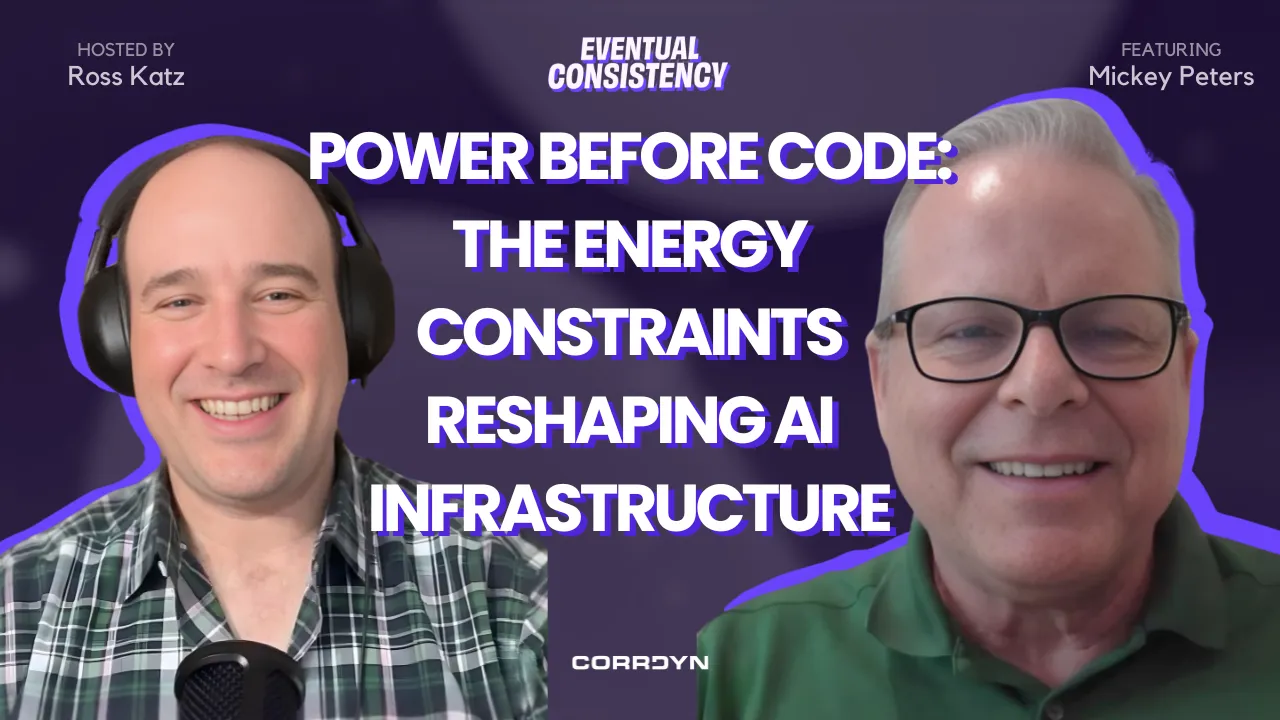
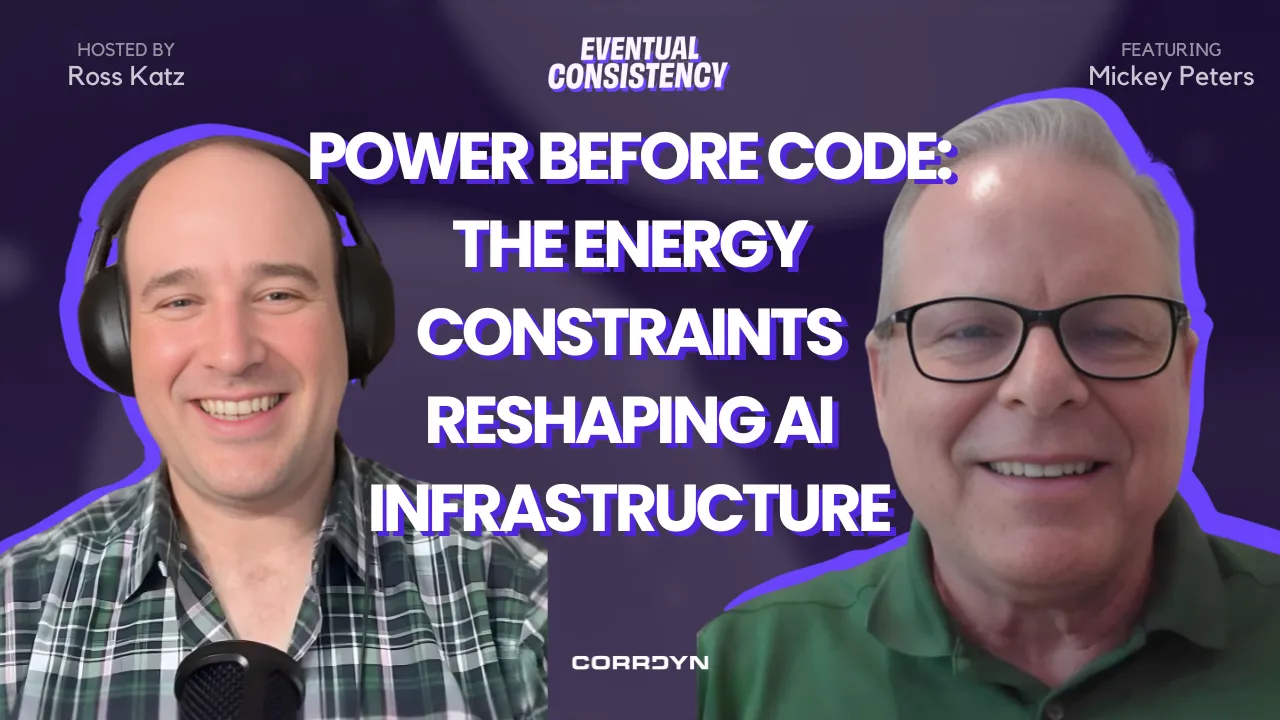
The relentless demand for compute power to fuel AI innovation is colliding head-on with a physical limitation: available electricity. Data centers are now consuming more power than entire major cities, leading to public grid capacity crises, city-imposed moratoriums, and hyperscalers building their own private energy infrastructure. For data leaders and executives, this means power, not capital or technology, is fast becoming the critical constraint limiting AI deployment and dictating cloud strategy.
This episode features Mickey Peters, a former energy executive who managed billion-dollar power operations across South America and now advises CEOs through Vistage. His experience navigating complex infrastructure buildouts and community relations offers a grounded perspective on the energy dynamics now reshaping the AI landscape.
The conversation dissects how the world’s largest tech companies are wrestling with energy procurement—from massive utility partnerships to vertical integration into power generation. It uncovers the overlooked role of community sentiment and regulatory hurdles in project success, and explores the profound trade-offs between speed, cost, and operational control as companies race to scale their AI capabilities.
Key Takeaways
Power is the new battleground for AI competitive advantage, not just compute.
The scale of AI models means energy requirements have surged past traditional infrastructure planning. Hyperscalers are making multi-billion dollar moves—like Google acquiring a solar developer or Meta securing 5 GW deals—to ensure consistent power. Future AI leadership hinges as much on reliable energy access as on cutting-edge silicon.
Community and regulatory engagement are non-technical bottlenecks for data center expansion.
Local communities, wary of noise, environmental impact, and job displacement, increasingly reject new data center projects. South Bend, Indiana, voted down a large center; Denver paused all new development. Neglecting ‘soft skills,’ transparent communication, and authentic community support can lead to significant sunk costs and project delays, irrespective of technical readiness.
Vertically integrating power generation offers control but adds non-core operational complexity.
Building ‘shadow power grids’ alongside data centers provides direct energy control and can bypass public grid limitations. However, it forces tech companies to manage power plant operations, maintenance, and regulatory compliance—tasks outside their core expertise. The preferred model for many remains outsourcing power delivery to utilities, despite their slower pace.
AI infrastructure planning requires accounting for energy availability, lead times, and social license.
Data leaders must broaden their infrastructure considerations beyond compute costs and latency. Future planning involves assessing power grid capacity in target geographies, navigating lengthy permit and equipment lead times, and proactively engaging local stakeholders. Ignoring these factors risks project failure and a critical loss of time in a fast-moving AI market.
Related: CorrDyn helps organizations navigate complex technology strategy challenges, including data cost optimization and data engineering for modern workloads. Learn more about how biotech manufacturers can unlock data value.
Full Transcript
Ross Katz: Welcome to Eventual Consistency. I’m Ross. My guest is Mickey Peters, former energy executive and Vistage chair. Every week, there’s another announcement about AI breakthroughs, another data center project, another promise about what’s possible with enough compute. We’re not here for that. We’re here to talk about what’s actually happening, honestly, the way you’d talk about it with your team. Today on the podcast, Silicon Valley is building shadow power grids because the public grid can’t keep up with AI’s appetite for electricity. Cities are imposing data center moratoriums. Power, not capital or technology, is becoming the constraint that limits what you can actually do. So let’s talk about what that means for anyone planning to build with AI. All right. So two stories are converging that most data leaders aren’t paying attention to yet. First, the Washington Post ran an investigation that found data center operators are building private on-site power generation to bypass grid constraints. One West Texas project is consuming more power than all of Chicago. Silicon Valley is essentially building its own power infrastructure rather than waiting for the grid to catch up. Second, cities like Denver are imposing data center moratoriums while regulators draft zoning frameworks. The bottleneck isn’t capital, it’s not technology, it’s whether power even exists where you need it, and whether communities will let you build there. This matters because if you’re planning data infrastructure, whether you’re a VP of data deciding where to run workloads or a CTO planning your cloud strategy, you’re probably thinking about compute costs and latency. You’re probably not thinking about whether the electricity exists to power what you’re planning to build, or whether electricity costs might drive your decision about whether or not to build it. Mickey ran major power operations for Duke Energy in Brazil and Peru, managing over a billion dollars in capital employed. He’s navigated power constraints, infrastructure build-outs, and regulatory environments. Now he advises CEOs through Vistage. On the subject of energy, we’ve got three things happening all at once. First, we’ve got the national grid reaching its capacity, and all of these new data centers being built that are demanding a lot of energy from that grid that’s reaching its capacity. As a result, you’ve got tech companies that are creating a shadow power grid, trying to generate their own energy in tandem with the data centers. And then you’ve also got communities pushing back on the development of data centers because of the energy dynamics around that. Mickey, excited to have you here given all of your experience in the energy industry. Just interested in, what do you think about when you see these dynamics at play, with the constraints on supply and the pushing of demand for energy?
Mickey Peters: Thank you, Ross. Most of my experience was in South America and I ran power companies all over South America and the projects we dealt with at that time were big mining projects. They were very similar. They took up big spaces in the mountains primarily in the Andes, really had a big impact on the communities. A lot of conversations with the community, and then how are we going to get the power there? Sometimes you had to build on-site generate… it was a very similar profile to what you’re seeing with the data centers, but the data centers obviously are at a much larger scale. It feels like there was always a lot of excitement, a lot of energy initially with the first few mining projects, but then over time the community gets burned out, they realize the cost associated with the projects, like a data center. You have a lot of employees when you’re building it, but then once it’s completed, there’s much fewer employees obviously once they have the data center in operation. The local impact is primarily property taxes and an influx of construction workers when you’re building the project. But also there’s an impact with the noise, with the fans, so they’re either saying no. I think near South Bend, Indiana, recently rejected a new one—they have an existing data center that is nearing completion and they had a new one, a bit bigger, that they said no to. They actually voted it down in the local government. And then Denver, I think Colorado, has hit pause. Said right now we’re going to hit pause. We’re going to step back and assess. Which again makes sense. You start to see how these things once you have them up and running, how they work and what the impacts are. But on the grid, you said there are different responses. I find it really interesting. Meta last year just announced in Louisiana, they acquired a very large tract of land, 1,700 football fields, just to keep—we can all get that dimension. They’re building a very large data center initially, two gigawatts, eventually five and down the road 10. Made a deal with the Louisiana government for the local utility to build out the power, mostly gas, some solar, and to give you an idea once the initial phase is up and running, it will consume two times the amount of energy of the city of New Orleans at the peak of their demand. The dimensions of these are just beyond what we’re familiar with. Then you have Google just in December acquired Intersect Power, which was a developer of solar, primarily solar but other renewables together with battery. So now they have their own in-house power developer basically for them to lean on for their projects. But behind the meter. As you said developing their own power grid, their own power source that will be interconnected to the grid but they have their own source local on-site for their data centers. Then Microsoft and Anthropic and their recent projects were saying okay we’ll bear the cost—telling the local utilities and the local communities, any negative cost impacts, we’ll pay for those, higher rates or whatever those are. Microsoft even going back a year and a half ago where they brought Three Mile Island out of the mothballs. That’s a little under 1,000 megawatts and they got a big loan from the Department of Energy and wow, who ever thought you’d bring Three Mile Island out of retirement? They’re all taking different approaches and it’d be interesting to see how it plays out over time because it’s not stopping, it’s going to keep going, keep growing.
Ross Katz: That makes a lot of sense. Given that you now advise executives with Vistage, I’m interested in from your perspective, how are the hyperscalers Amazon, Google, Meta, Microsoft, how are they all thinking about what the options are to procure energy for the data centers? When would it make sense to do your own generation on-site next to the data center? When would it make sense to partner with a local utility? How do they think about the trade-offs of these decisions?
Mickey Peters: I think it’s all basically cost based. There was a rush to find the perfect sites where the elements of power, land, infrastructure, employees—you start to find these hubs if you will where you had this rush to identify where are those sites where you have those elements at a reasonable cost. Obviously over time those sites run out. You hit the okay, we’ve pretty much milked all of those low-hanging fruit. Then it becomes a matter of okay, where do we have community support? Because if you’re going to spend millions of dollars like in South Bend where they spent probably tens of millions of dollars working that project and all of a sudden you get shut down, that’s just sunk cost. You’ve wasted money and so you really need that community support element. Finding where those pockets are. Ideally this isn’t their core, they want to outsource that. They don’t want to be in the power business but you see Google where they actually brought a power developer in-house. They’re thinking in their announcement they’re going to continue to run them as an independent, sort of on their own but part of Google now, and we’ll see how that plays out. Meta obviously did a little competition and Louisiana won. We’ll see over time how that goes. They actually had a very large piece of land that the state had already acquired for an auto plant that didn’t happen. So they had it sitting there and it was what Meta was looking for plus a lot of natural gas—they have the resource natural gas, natural gas power plants are relatively quick and easy to install. They’re also 24/7 365 type supply. Even Google has the environmental impact. Some say we don’t want gas, want renewables. Each company has their own different set of values and different set of priorities. Based on those they do their research and probably have a war room with a ranking of their options, live depending on what’s happening with the value of land, the price of electricity—as they monitor those start to move on the ones that have the highest score for the different parameters that they’re looking at. But there’s really no one-size-fits-all solution. Each company is finding their own what they’re comfortable with with their values and their strategies, and then moving forward with those options which are very different. What’s happening now, they’re very distinct ways to solve that problem.
Ross Katz: That makes a lot of sense. I also think one of the things that seems to be getting lost is, all of these companies feel the existential threat of AI and the overwhelming framework that they’re using to evaluate the quality of the AI that they can produce is the level of scale that they can get to from a data center perspective. It’s a gold rush dynamic where all of these companies are rushing to deploy as much data center capacity as quickly as they can so that they can support all of the emerging use cases for AI and also support the foundation model companies that train these bigger and bigger models. You’ve got this AI market that’s moving as quickly as you can possibly move. And then you’ve got the energy industry, as I understand it, and would love your understanding here—depending on the options that you choose it can take a long time to deploy this energy capacity. I’m interested in from your perspective, for the companies, how do they think about that trade-off between the scale that they want to get to, the way that they want to be integrated into the energy infrastructure and the speed with which they want to move in procuring the energy.
Mickey Peters: One of the biggest factors always was licensing and getting all the permits and licenses. I remember the NIMBY, Not In My Backyard, and some regions have that type of mindset. In that case of Meta in Louisiana, they were able to get—you have the state, which can control a lot of the regulatory bodies, and they’ll expedite the licensing process, make it quicker for them to get through that. The time to get it online is shorter. They have the natural gas literally there within the state parameters so it’s all in-house. That was always the big uncertainty—how long will it take to go through the community aspect and have the conversations, how long will it take—then you get comments and you have to respond to the comments. That’s many times what would take the time. Going through that if you can find a place where you can shorten that and get the support of the community already resolved, so you don’t have that uncertainty. Then you have the shortages of equipment, shortage of transformers, breakers, etc. Those are very long-lead items that are also impacting it. The thing you’ve seen is their willingness—the money is not the issue. Obviously they have plenty of financial resources. You really have to come at it from a creative perspective. The biggest challenge is really that community support—you really have to feel comfortable that you’re not going to get a no six or nine months or a year into the process and go, wow, we just wasted a year. Money but more importantly the time as you said if you’re not getting those data centers online. Maybe even doing multiple sites, which then if a local utility is going to build out the infrastructure and then the data center, oh sorry we didn’t choose your site, we chose another one. They’d committed to this infrastructure whether it’s transmission lines or switchyards or whatever. It’s really interesting to see the dynamics as people get more familiar with how this works. How does this work? Then you have as you said the companies are my god we got to get these data centers on as quickly as possible. But the communities, what they’re remembering is trade. Remember trade where that was going to lift everybody’s boats together, global trade and NAFTA and all of these agreements. A lot of communities did not see that. So here we are now with AI where the concerns from the people on the ground in those communities is what if AI takes my job or my kids’ jobs or my grandkids’ jobs? They’re wary of AI. That’s what happened in South Bend, from what I’ve heard—that concern of we’re basically contributing to our own demise was the thinking. Why are we doing this? You hear a lot of people asking that question, which again education, getting everybody aware. Right now in the AI world there’s not a party line let’s say. Depending on who you talk to and what day you’re going to get a different perspective.
Ross Katz: It’s a very fast-moving marketplace and these communities are seeing the hype, seeing the big headlines that AI is coming to take their jobs. But you mentioned in your experience in Latin America the long-term experience that people got with energy infrastructure being developed and the way that they learned the economic dynamics of how this energy infrastructure moves through their community. I’m interested in from your perspective, what do those conversations look like between a hyperscaler, a local utility, a state regulator, a local community? What does each group care about and what does the push and pull look like in those conversations?
Mickey Peters: Usually you have somebody, in this case the Google or the Meta coming in from California. All of a sudden, which many people consider a foreign country—it’s not, but especially in Louisiana or Texas or vice versa. They come in and they’ve got all the numbers and the data and they’re presenting their case. There’s always suspicion. You’re dealing with slick urban versus many times rural or small town. You have these different dynamics and so you really have to be well thought out, prepared and have their arguments understood and addressed. They can quickly devolve into an us versus them, outsider versus insider. That’s really what derails it. Basically people working with half information or no information, just gossip and rumors. You really have to take control of the narrative and be clear and sincere and not talk down to people, not be condescending—how you show up and how you present your case and how you interact with the locals and make them feel like they’re important to you, you want to consider their opinions. Even how you treat them at the meet. How you shake their hand, you show you care. If you come in in a bunch of black Suburbans, you’re all in—I remember going into a small community, everybody take off their suit and tie and their coat. Roll up your sleeves. We need to ditch this American executive thing. It’s really interesting how quickly—because if the local community isn’t supporting you there it’s not going to happen. That’s really important. The regulator is usually more of a peer-to-peer type of conversation. It is about the data and about the resource and about the case you’re making to support your project. But where it really makes or breaks the project is with the local community. How you show up in those conversations and how you convince them and show them—it has to be authentic. Everybody has a very keen detector up if they sense somebody just playing them or somebody’s really not being sincere or authentic. You really have to have a plan. Meta committed to 500 jobs in that project in northeast Louisiana. The question, okay, as AI starts to be able to run a lot of those data centers without people, what are you going to do with that 500? Are you going to keep it there? Are you going to get 400, 300—how do you deal with that? How do you answer that question? If they say we really only need 100 or maybe 50 people in the data center. AI does the rest. How are we going to compensate for that? As soon as you say one thing and do another or show any sense of insincerity or that you’re not being truthful, you’re trying to hide something, it takes that quick to lose your credibility. You see it all the time with corporations in their local communities. You really have to go in with a mindset of we’re going to shoot straight with these people and deal with the hard questions, speak truth and not try to spin it in any way.
Ross Katz: I agree it also seems like if you’re working for a business where you’re very used to making the cold clinical business case and not really concerning yourself with the emotional aspects of where people might be coming from or with the values that they bring to the table, their fears with regard to the development of this new infrastructure, being sensitive and positioning yourself and also understanding very deeply the different stakeholder groups that you’re dealing with and how they view a project like this differently. It seems like there’s a lot of soft skills entailed in trying to navigate this kind of project that’s sort of at odds with the billions and billions of dollars that need to be invested to make the economic case make sense.
Mickey Peters: The rub is you’re already out of your comfort zone being in a culture, in a conversation that you’re not accustomed to. People in Silicon Valley have their terminology and how they say things. I would practice when I would go into a local rural community—spend hours practicing, okay, what do I not say? What are the red flags? What are the words and phrases that I could use as an expat who lives in the big city—many haven’t even been to the big city. You have to really spend a lot of time anchoring yourself in the culture and what’s important to them and how can you speak in a way that resonates with them and be sincere about it. At the end of the day, is this somebody that’s just doing a fly-by and just going to come in and tell me what I want to hear and then I’ll never see him again? When what he said doesn’t happen, where do I find that guy? What did he leave me with, his card with his cell phone number? See ya. I’ll never forget we did a project up in the very high Andes mountains right on the equator. Very, very remote community. We were doing some dams up there at 16, 15, 14,000 feet and there was a lot of resistance initially to the project and they were concerned about their agricultural irrigation. We cut a deal with the community and we committed to doing some projects for them. Fix a bridge, put electricity in the school, fix the roof on the school—we had seven or eight projects and we did every single one of those projects. We did what we said we were going to do. Then we had this celebration afterward and the head of the local community, when I met him and talked to him, he said, I’m not sure who you are, but I hope more people like you come here. I said, well why do you say that? Said you’re the first people that actually did what you said you were going to do. You finished those projects and our bridge is fixed and our kids can go to school with electricity and they don’t have the elements coming in at them as they’re at school. Well, we said we’re gonna—that seems obvious to me, but for him that was—having that kind of a story of these people do what they say they’re going to do, they’re not BSing or trying to, is really what will be important and not something people focus on normally.
Ross Katz: One of the concerns that I can imagine a lot of communities are thinking about is that their energy costs are going to go up. To your point about property taxes, maybe the economy gets better but the economy pushes them out, it leaves them behind. How do you respond to objections like that from a community?
Mickey Peters: That’s right. Prices like in Microsoft and Anthropic said, hey we’ll foot that bill. It’s not so easy to calculate exactly how much is the impact of their project, complicated math there. But having that commitment—hey we’ll make sure that we pay any incremental difference from our project. Then on things like jobs, training. You have to sit down with the community, understand their fears. What are you afraid of? This trade thing years ago, they’re going to tell you what happened back in the 80s and 90s when they were promised that global trade would help make their factories bigger, better, more demand, and it didn’t happen. Many of them were left with empty buildings where their factories used to be. So they’re wary. This is not their first rodeo. They come into it with kind of a, yeah we’ve heard this before. You really have to sit down with them and understand their fears and let’s talk about—we’ll commit to training, committing X amount of profits to training you and setting up building a school that will help—that kind of thing where you hear what are you afraid of? What are your real fears? What makes you pause or even reject this type of project? Look at those as legitimate and try to walk in their shoes. I can understand that, that makes sense why you would be afraid of that. So here’s what we can—how does this sound? If we commit to this will this help you feel better about it—just really trying to address those fears. In the case at South Bend they didn’t. They were just talking about this generic future and generic positive things out there but they didn’t go, okay, in this community with these people here’s what we’re going to do—very specific and directed—their kids, their grandkids, their neighbors, people that they know. You really have to sit down and spend some time. Your people spend some time with them and really work that out.
Ross Katz: As I’m hearing you talk, one of the things that’s occurring to me is that you mentioned NIMBYism, not in my backyard—it’s an umbrella term that describes a bucket of fears that people might have. Some people are worried about the noise, some people are worried about the cost, some people are just angry about what happened with trade historically and they think this is just going to be a replay of it. Other people are just distrustful of anyone who comes from California to visit them. There’s a long list of objections that people in a given community might have. What the hyperscalers are doing is either trying to navigate that, or in the case of building their own energy infrastructure, they’re trying to avoid having to navigate that by co-locating the energy infrastructure with the data center. Can you help me understand, do you think that doing the shadow power grid thing of building your own generation capacity along with the data center, do you view this as a long-term solution or more of a short-term band-aid that these companies are doing in order to move more quickly and avoid having to have the hard conversations with the regulators that they might have to have otherwise?
Mickey Peters: You still have to have some conversation with regulators. It’s not the same because you’re not using the power from the existing grid, you’re building your own, but you still have permits and licenses and whatnot you have to get. But it changes the conversation. This has been happening for decades. They’re not the first industry that has come in and built inside the fence, they used to call it. It’s a very long-established way of dealing with this issue. I would say it’s going to be an option into the future. It’s not a band-aid I don’t think. The difference is the utility, that’s their expertise, not yours. When you build it inside the fence, you have to hire someone to manage that for you. It’s basically something you would normally outsource to the utility. I just want to have my power when I need it and I don’t want to worry about where it comes from or if it needs maintenance or whatever. But all of a sudden that’s your problem because that’s your power source. In Google’s case they have this—I forget the name of the company—that they acquired. They’re acquiring that expertise and so then it’s in-house. But it’s $5 billion. It wasn’t a small acquisition. Maybe for Google it is. You have that challenge of something you’ve always outsourced, all of a sudden now if you’re going to build it inside the fence, now it’s in-house. Now you have to hire people to manage that for you and deal with the issues of owning and operating a little power plant. If it goes down—they never want it to go down, they want backup to the backup to the backup to the backup, which in many cases at some point you’re going to have to have an outage. It’s a different model and I think they would much prefer, like in Meta’s case, Entergy is the local utility, they’re building and owning and operating the power plants. So it’s not Meta’s headache. You guys deliver us the power and that’s on you, not on us. That’s the preferred way if they can do that because nobody wants to have something in-house that isn’t their core strength, isn’t their core skill set. Then you have a whole new set of headaches and issues you’re not accustomed to and you don’t know how to deal with them. That’s the challenge of bringing it inside the fence or behind the meter. Some companies have done that very successfully, others have not. They end up selling it back to the utility and letting the utility take that asset or that plant. There are different success stories and stories that didn’t work out so well. At the end of the day for them, they don’t think the cost of the power is the big issue, it’s just they need that power 24/7 365 so that they can have their chatbot or the cloud or OpenAI or whatever running without any issue.
Ross Katz: It strikes me that because of the market dynamics that they find themselves in, you’ve got this fast-growing use case that’s energy intensive, and competitive advantage seems to be based on scale, the scale of compute that you can bring to bear. But it also seems to be a winner-take-all marketplace where people will migrate to the company that has the best AI capabilities. All of the incentives are to move as quickly as they can. The market dynamics are causing them to look a lot harder at vertical integration like Standard Oil, like the Ford Motor Company. It was whoever got to scale first won and so they were going to get to the highest degree of scale they possibly could. It’s a fascinating time also because the number of players who can bring these resources to bear is also very high, relatively speaking. From a consumer perspective and a business perspective, switching between any of these model companies is relatively easy. So the protections that you would normally hope to secure when making this scale of investment in energy infrastructure, in data centers—it’s hard to forecast what demand is going to look like for AI and it’s hard to forecast what energy infrastructure needs to look like. I think the utility companies, if they could forecast energy demand really well, they would build it themselves, but they don’t want to be stuck holding the bag for building out capacity that doesn’t end up being used.
Mickey Peters: It’s funny you mentioned that vertical integration and remember Ford actually had a rubber plantation in Brazil way back when—this is in the 20s and 30s—where they were trying to get rubber for the tires. This isn’t the first time we’ve had this type of challenge when we have these big new technologies that come on. At the end of the day the people who are clear-headed and really able to see it, being grounded in reality and really do their homework and adjust and pivot when it calls for that, not get stuck in a certain mindset. That’s what happened in South Bend is well of course this is going to happen. This has to happen. This is AI. It was voted down 4-1—it wasn’t even close. All those negative mindsets and fears and anxieties that weren’t addressed and just papered over with well this is the future, we can’t miss out on it, we have to be a part of it or it’s going to leave us behind—all probably has some truth to it, but everybody said, look we’re not signing up for this. It’s interesting and challenging and the companies that make the right choices and hire the right people to help them because this is way out of their normal skill set, way out beyond their typical what they’re focused on. It’s really hard to get up that learning curve and do it right. You’re going to make some mistakes, so you obviously got to learn from your mistakes quickly. They have that fail fast mentality—fail early, fail fast—that mantra is going to be put to the test, is being put to the test here.
Ross Katz: It seems like a difficult arena in which to fail fast. Mickey, I really appreciate you coming out today. As we head toward the end, we normally do a segment where we spend a minute stepping back and talking about, what’s one big idea that’s on your mind? If there’s something that comes to mind for you—it can be related to this conversation or unrelated to this conversation—happy to open the floor for you to share the big idea that’s been there for you.
Mickey Peters: I’m a Vistage chair as you said and so all this fear of AI—who needs humans anymore? The big idea is that the ability to work with people, to lead people, to be a good teammate, to add value, that’s never going to go away. There’s going to be a need for that. The idea is continue to grow, continue to learn, continue to challenge yourself, and you’re going to be okay. That fear of being replaced by AI—I’m not afraid. I’m not afraid. That’s the big idea—I’m not afraid. Whether it’s OpenAI or Claude or whatever, I’m not going to be replaced. Really make yourself irreplaceable in that sense of just how do I continue to add value and train and learn and evolve.
Ross Katz: I love that and that relates to the idea that I’ve been chewing a lot lately. This week one of the big news stories was that Jack, the former CEO of Twitter who is now the CEO of Block, laid off 40% of his workforce, almost all software engineers, and used AI as the reason for why the layoffs occurred. It caused a lot of conversation obviously, because if you’re a software engineer, you’re looking around and now a CEO has gone out and said publicly that he thinks that a lot of CEOs are going to be cutting a lot of staff because of the additional efficiencies that AI can drive. To your point about fear, that can cause a lot of fear and anxiety among people who see the potential for this automation to come through. Where I come down is, it’s easy to see the headlines of people who are cutting large quantities of staff, but what you don’t see is the hundreds of thousands of small companies across the country that have the opportunity to build capabilities using AI that they didn’t have the capacity to build yesterday. That have the ability to automate things that they didn’t have the capacity to automate yesterday. The new demand and the new capabilities, it’s a slow trickle and it doesn’t make as many headlines and it takes a long time to show up in the productivity statistics. But the big cuts that cause fear, they happen all at once where everybody can see it. I don’t think any of us knows what the long-term economic impacts of AI are going to be. But what I do think is that we need to try to have a more nuanced view of where this might shake out and acknowledge that to your point Mickey, everybody’s going to have to grow and change and adapt to the economy in the same way that we have historically as new technology has become available. But that doesn’t mean that we’re all out of a job. It just means that we have to keep learning, keep growing, and keep our eye on the ways that we can add value given our particular skills.
Mickey Peters: Right. It was funny because it was Jack Dorsey who is supposed to be the kindler gentler when he was at Twitter and Elon came in, and now he’s the bad guy—he’s kind of evolved I guess as well.
Ross Katz: Well, if you’re going to be a public figure now then you always have to be ready to turn heel. You’ve got to always be ready to rise and ready to fall. Well, Mickey, I want to be sensitive to your time. I really appreciate you coming on. Thank you so much.
Mickey Peters: You’re welcome.
Jason: That’s it for this episode of Eventual Consistency. If you want to talk about your data challenges or you think we got something wrong and want to tell us how, you can find us at corrdyn.com. That’s c o r r d y n .com. We’re doing this every two weeks, so we’ll see you next time where maybe we’ll be a touch more consistent. Thanks for listening.