Listen on
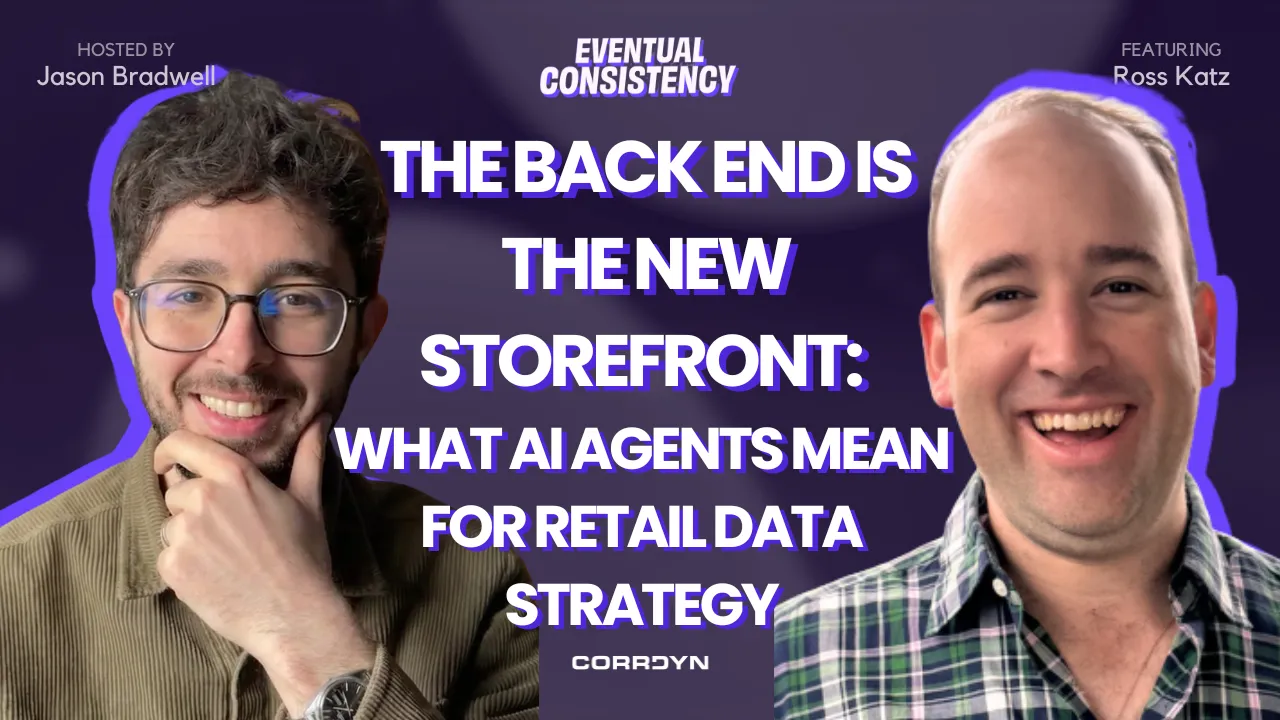
Retailers face a critical strategic inflection point: invest heavily in AI-driven agentic commerce or double down on physical store expansion for experience and data capture. Recent announcements from Best Buy and Target illustrate this divergence. While Best Buy reconfigures its entire product catalog for AI agents, Target commits billions to open more physical stores, emphasizing drive-up pickup and expanded in-store services.
This isn’t an either/or dilemma, but rather a reflection of the same underlying challenge: securing data advantage and customer loyalty in the next decade. For data leaders and executives, preparing for this future demands clean, actionable data assets and adaptable infrastructure. Failing to establish this foundational data hygiene risks surrendering customer relationships and critical profit margins to large tech platforms, reducing your business to a mere fulfillment operation.
CorrDyn’s Ross Katz, Principal and Data Science Lead, who guides data teams through such strategic shifts, explains how these seemingly opposite bets converge on similar outcomes. The conversation dissects the tactical data requirements for agentic commerce, including structured product data, real-time inventory, and programmatic pricing. It also explores the data-gathering potential of physical stores, examining the risks of product commoditization and outlining how companies can maintain brand loyalty and retain first-party data in an AI-driven future.
Key Takeaways
The Back End is the New Retail Storefront for AI Agents
Agentic commerce requires meticulously clean, organized, and real-time product data, not just a user-friendly website. Retailers with fragmented or inconsistent back-end data will face significant hurdles, as AI agents consume structured inputs via APIs, exposing technical debt quickly. Your ability to expose data securely and efficiently determines agent performance and reputation scores.
Physical Stores Evolve into Data Hubs and Experiential Destinations
Target’s strategy demonstrates physical stores are more than sales floors; they’re critical fulfillment centers and rich data capture points. These locations gather nuanced customer behavior insights, build brand loyalty through unique social experiences, and protect retailers from commoditization. This first-party data fuels advertising platforms and informs a deeper understanding of buying decisions.
Retailers Must Implement a Bifurcated Strategy to Retain Value
Success in the AI era requires simultaneously enabling agentic commerce for commoditized transactions and cultivating human-centric experiences for complex purchases. Businesses must protect strategically valuable first-party customer data and differentiate through personalized service. This approach prevents margins from being squeezed by AI agent platforms that prioritize price and availability over brand loyalty.
Foundational Data Hygiene Determines Competitive Advantage
Regardless of a retailer’s primary strategy, a unified, clean source of truth for core entities like product catalogs and customer identities is non-negotiable. Investing in robust data infrastructure ensures responsiveness, accuracy, and scalability across all consumer touchpoints. This organized data is the bedrock for both agentic and in-person retail success.
Related: CorrDyn provides data engineering and data assessment services to help retailers prepare for future commerce models. For broader strategic shifts, see our work on digital transformation, especially within e-commerce.
Full Transcript
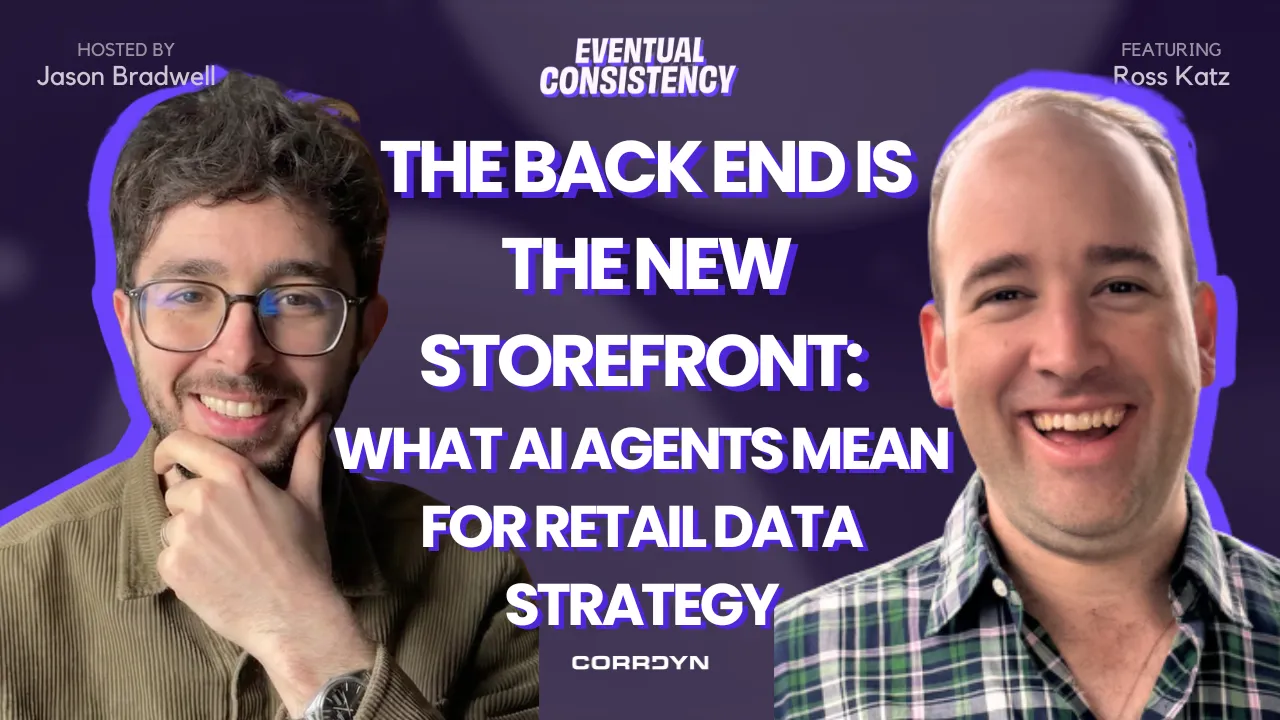
Jason: Welcome to Eventual Consistency, I’m Jason Bradwell, the producer on the show, and today, as always, I’m joined by Ross Katz from CorrDyn. Today we are talking about two very different bets on the future of retail. Best Buy is repositioning itself as an AI-native commerce platform, opening up its product catalog to ChatGPT and Google’s agent ecosystem. Target is doing something that looks almost old-fashioned by comparison: opening 30 new physical stores and betting $5 billion that proximity and experience still win. Ross and the team over at CorrDyn work with data teams navigating exactly these kinds of strategic inflection points, so let’s talk about what’s really going on here. Here we go.
Jason Bradwell: Okay, in the first week of March, two major retailers made headlines with strategies that look, on the surface, pointing in completely opposite directions. Best Buy CEO Corie Barry announced on the Q4 earnings call that the company is partnering with OpenAI to make its product catalog available through ChatGPT, supporting Google’s universal commerce protocol, a standard designed to make seamless agentic shopping across platforms. The goal, from their point of view, is to make bestbuy.com legible to AI agents, not just human browsers. This comes as comparable store sales have fallen 0.8% year over year. Revenue has dropped nearly 1% to $13.8 billion. Target, meanwhile, have announced plans to open more than 30 new stores in 2026, which will include its 2,000th location as part of a broader plan to add 300 stores by 2035. This is backed by a $5 billion capital investment plan for the year, with hundreds of millions going into store payroll and training. The new store format will include a 24-lane drive-up pickup, expanded food and beverage, and same-day delivery infrastructure baked in from the ground up. The surface-level narrative is that these are opposite strategies, but you could read both moves as a bet on the same underlying question: Where does data advantage live in the next decade of retail? Neither company is saying that explicitly, but the decisions they’re making might tell us more than the language they’re using to describe them. Ross, you and the team over at CorrDyn work with data teams all the time making infrastructure and technology decisions. When you’re looking at these two announcements side by side—Best Buy starting to open up business to AI agents, Target’s opening 30 new brick-and-mortar stores—what’s your honest reaction to all of this? Is one of them the right way to go, or can both strategies make sense at the same time?
Ross Katz: Yeah, my outlook on this is basically that both are right, and that all of the players in the market are positioning themselves to play all sides of where the emergence of AI agents takes you. From the Best Buy angle, what you’ve got is an idea that AI agents are going to be one of the main mechanisms through which people both research and make purchases in the future, especially for more commoditized products. Obviously you want to set yourself up so that if there are people, especially tech-forward people, who are making those kinds of purchases, and maybe they’re the kind of people who wouldn’t have gone to bestbuy.com to make their purchases previously, you’re opening yourself up to a new customer segment that you wouldn’t have had before. But from Target’s perspective, the stores aren’t just stores. Anyone who’s shopped at Target knows that, yes, there is the experience of going into the store. You’re normally going into the store to purchase things that you can only really evaluate when you’re in person in the store, and also, if you’re like me and you have a six-year-old who just loves Target, it’s a great weekend activity, and so you’re going in there for the experience of being in the store. And that’s true whether you have a small child or not. But basically the stores are serving the shoppers that walk into the stores, but they’re also fulfillment centers for the online orders that people are making online. If you’ve done drive up, Target, Walmart, Amazon, these are companies that are starting to make more and more of their margins from becoming advertising platforms. The stores are really valuable from the perspective of capturing customer data that can then be used to improve the ad targeting platforms that they’re then selling to the brands that they host in their online stores and in their brick-and-mortar stores. You can’t underestimate the extent to which that data, especially since that’s where the major margin improvements are coming from in retail, is part of the value of these new concept stores is setting them up in order to capture the experiences that customers are having, identify what people purchase, yes, but also what people look at, what they evaluate, what they put down, what their interactions with employees in the stores are, what causes someone to make a purchase decision, what are the evaluation criteria they’re using, what are they saying out loud to each other. I’m expecting these stores to be really great experiences for customers that make them want to come into the stores, but also to be places that are heavily monitored in order to capture this data that’s being used for advertising improvements. And then finally, Best Buy, Target, all retailers want to be legible to AI agents, and that means getting their data houses in order to serve up that data to AI agents in a way that makes them select your product when given a choice between seemingly an infinite number of possibilities online. It’s very early, and to the conversation we had earlier about ROI in the AI era, I think both Target and Best Buy are strategically positioning themselves in a way that allows them to win regardless of how transformative AI agents are to the retail industry. We know for sure that they will work with customers at the very beginning of their buying journeys, helping them research and understand products that maybe were more difficult to understand previously, but how much they will disintermediate the purchasing of new items is up in the air, number one, and then also is probably dependent on how complex the product or service is that’s being purchased, as well as how much the customer needs to be physically present in order to evaluate that purchase in order to make the purchase. They’re both right. They want to position themselves for whichever way things go.
Jason Bradwell: Yeah, that makes a lot of sense. The experience point you raised really resonates with me. Toys R Us comes to mind for me—and this is more of an anecdotal than an observational point on Best Buy and Target’s strategy—but I don’t know what it’s like in the States, but here in the UK all the Toys R Us that used to be prevalent in every single shopping center across the country have all shut down and the company’s gone into administration over here. So you don’t see them anymore. I think a large part of that came down to the store never really evolving to meet the expectations of the experience of what it was and what it could be. Toys R Us, talking about your daughter, Ross, going into a Target and just loving the experience—what better environment could there be than a toy store to create an amazing experience for families to come and not just browse and buy, but to actually make a day of it. I think it’s really interesting your point around getting people into the store as a way of capturing data that ultimately then feeds other parts of the organization’s strategy. I’d like to dig into that with you and how that could look. But I want to start with talking about how does Best Buy actually pull off this agentic play? And your thoughts on that. The CEO of Best Buy’s talking about how do we make the site more agentic-friendly, sounds simple, but what does it actually take in the back end to make a product catalog legible to AI agents? Talk me through that process.
Ross Katz: Yeah, Best Buy CEO Corie Barry, I think her viewpoint on this is basically, on the one hand, you want to make sure that all of your inventory is discoverable and available and competitive with AI agents, but also you want to make sure that you are drawing a boundary around the data that is strategically valuable to you and could be used to take away the customer experience in the future. But in terms of tactical implementation of this, the first thing is structured product data. You’ve got these standardized attributes that AI agents are going to use to compare across your different product categories. There’s an entire evaluation process of what are the evaluation criteria that these AI agents and by extension, the buyers going to use to compare and contrast items in a given product category? It needs to be really clean, well-organized. You need to have your taxonomy in place, and you need to have all of the content of that taxonomy filled out for each product in each category. It sounds really simple, but if you’ve ever worked with a retail organization, getting product catalogs into a place where they’re relatively clean, where they’re consistently named, where all of the specifications are present, where the descriptions are exactly what you would want, not just a human to read, but an AI agent to read, given that AI agents are much better at reading at this point than human beings are. That is an entire effort in and of itself, not to mention the infrastructure you need to host that product catalog behind your website in a way that exposes you to the massively higher volume of inbound requests you’re expecting to see as time goes on and setting yourself up for the scale-up and scale-down of that, because as we said just a moment ago, it’s likely that early adopters in Silicon Valley are going to be making purchases in this way, but it remains to be seen to what extent your average buyer at a Best Buy or a Target is going to be delegating any of their purchasing decisions to AI agents, let alone their most important ones. Structured product data is the first thing you need to set up. It needs to be well-organized and then it needs to be hosted in a way that it can be accessed. Best Buy is not picking a side in terms of what is the specification that’s going to be used by AI agents in consuming that structured product data. They’re working with both Google and OpenAI on both of their respective standards and going to basically allow the market to determine which standard is the best way to buy Best Buy products. The second thing that companies need to think about from a data perspective is real-time inventory APIs. We just mentioned that storefronts are not just stores, they’re fulfillment centers. We also mentioned that AI agents are going to be making a much higher volume of purchasing requests than you would have expected a human being to be making. If 12 AI agents all at once come to your website and attempt to purchase the same item at the same time, the first one successfully makes the purchase, the second one successfully makes the purchase. The third one needs to know: Do you have the third item on hand in order to make the purchase? I’ll give you an example from my recent life. There was recently some terrible weather here in the US, and I had flights canceled early last week. As a result, everybody was trying to get a rental car to go to a major hub to fly back to their home. Everybody in the city of Orlando was trapped there. I was rebooked on a flight two days later. I called up a car company, I’m not going to throw them under the bus, and I booked through the phone a car at a branch that was not at the airport because the airport was out of cars. I took an Uber with my family across town to the branch, showed up, and that branch—we’re talking about cars here. They’re not hard to count. There’s very few SKUs, and they did not have the car available because the branch inventory was not connected to the corporate inventory. A lot of retailers are in this same place, but you’re talking about not every person in the city of Orlando searching for a car, you’re talking about the entire internet searching for products simultaneously. Having that real-time inventory available in order to be honest with the agents about what you have and what you don’t have is going to be really important, because my expectation—and this is something that I’m certain the retailers are preparing themselves for—is that behind the scenes, the companies that are hosting the agents, that is the foundation model companies, are going to be building up reputation scores about who is successfully fulfilling the orders. If you’re consistently missing the mark in terms of saying you have items available that you do not actually have available, that’s going to be a problem for you. The third level of data that retailers need to have available is programmatic pricing and promotions. As a company, you’re going from a place where you’re setting pricing on a daily, maybe a weekly, maybe a monthly basis. If you’re really advanced, maybe you’re doing it sometimes intraday, but to a place where your pricing needs to be able to respond, and also your promotions need to be able to respond in nearer to real-time. We’re not talking about a web page that needs to be updated. We’re just talking about an API that needs to be updated. But having a human in the loop deciding, oh, I think we need to raise prices here when the agents that are making the purchases are no longer visible, is no longer an option. Obviously there’s the transactional APIs—can the agent actually make the transaction? Then there’s the reputation data. Are you capturing the positive experience that the buyer had with your product in a way that agents can then parse later on? Also I’m expecting that returns-level data is going to become more and more important. As agents interact with people’s sites, I’m expecting that especially bigger retailers like Best Buy and Target are going to be making predictions based on the customer profile, the customer’s likelihood to return the product, because both sides are going to have a vested interest in ensuring that the purchase that’s made is a purchase that the customer’s happy with. I think both the retailers and the foundation model companies would like to live in a world where trust is growing in a system where AI agents are making purchases on your behalf. If you’re constantly getting things purchased by your AI agent that you’re then having to return to the store, that’s going to very quickly erode trust in the system as a whole. Having data hooks that close that feedback loop between foundation model company and retailer is going to be important as well.
Jason Bradwell: Awesome. Breaking that down, we’ve got the operational hygiene data, the real-time stock APIs—as you’re talking, I’m thinking about the GTA 6 launch later this year, which is going to go absolutely gangbusters. I think they’re estimating it’s going to make more money in the first year than the entire movie industry will make. How many people are going to be looking for that? Then you’ve got the programmatic pricing and promotional data, the transactional APIs, the reputational data. This marries up, particularly that first point, with what the analysts are saying around the Best Buy coverage, right? Consistent naming, accurate pricing, real-time availability—all of that has to be in place before this agentic commerce stuff actually works. I’m curious just to follow up on this—is there a question around what happens when that data is then being served to multiple agent platforms simultaneously? Is there going to be any issues around OpenAI, Google, Anthropic, each of these things having different expectations, different update frequencies? Does that become an engineering problem?
Ross Katz: I think it could, but I doubt it. Honestly, at a fundamental level, the data is the same, the platform is the same, and the way that data needs to be exposed, I’m not expecting to be a massive engineering challenge because I think all of the players want the protocols that they’re putting out there—ACP by OpenAI and UCP by Google—they want them to become the de facto standard. Becoming the de facto standard is basically a product of: How much value does the standard provide? And how easy is it to implement? My expectation is that as they’re hammering out the standards, either they’ll consolidate on a single standard or they’ll both be interoperable, or it’ll be easy enough to host both simultaneously. I’m not expecting it to be a massive engineering challenge.
Jason Bradwell: Fair enough. The main takeaway here, from what you’re saying, is that most retailers have product data that’s in a bit of a messy state, right? This agentic stuff is going to start surfacing that technical debt pretty quickly if this is the direction of travel for the industry, is what I’m taking away, right?
Ross Katz: Yeah, that’s really the heart of the matter. It used to be that the front end, the storefront online, was the thing you needed to think the most about from an e-commerce perspective. People spent a lot of time on front-end development and integration with ERP systems, etc., to make sure that step-by-step flow of getting you to checkout made sense. All of us who have interacted with retailers see that sometimes the updates do exactly what they’re trying to get them to do and sometimes the updates are regressing away from allowing you to make purchases more quickly. But now it’s not about the front-end interface, it’s about: Do you have the data in order on the back end in a way that allows you to efficiently and effectively and accurately respond to the requests from these AI agents? My expectation is that the foundation model companies do not want to live in a world where AI agents are navigating your bespoke front-end website and making purchases in that way. The reason these protocols are coming about is so that they can interoperate with you via APIs where agents are already very capable. That requires you to have all of your data assets in a clean, user-friendly place. It requires you to be able to expose that data in a way that is secure and efficient and scalable. It requires you to be in a place where your marketing people, your merchandising people, the people who are maintaining that metadata about your product catalog can update things quickly and be responsive to the market and what they’re seeing in terms of the decision criteria that agents and humans are using to evaluate the different products. The volume and velocity at which this is going to occur means that responsiveness is going to be the most important aspect of what you’re doing. This is a new and emerging way of interacting, and companies are not used to interacting in this way. It’s a microcosm of what’s happening on generative engine optimization. Your website from a marketing perspective needs to look different in a world where agents are reading it than in a world where humans are reading it.
Jason Bradwell: Let’s shift gears a little bit to look at the Target angle here. They’re obviously aiming to open up 30 stores this year, aiming to open up over 300 by the time that we get to 2035. I want to dig a little bit more into what you were saying around the data collection angle of having these physical stores. Talk us through your thinking around the opening of these stores as being potentially a play to get more data, build a richer data picture, by maintaining a physical presence at scale across the country. What does that all mean?
Ross Katz: I don’t know how the stores end up being structured, but what I see from Target—their new CEO, Michael Fiddelke, just started in February of this year—my expectation is that they’re experimenting with new store approaches that if they’re successful will bring people into the stores. What they’re thinking about is, okay, what are the aspects of the stores that are most important to getting people to come in? Why do people walk into a Target in the first place? What are the experiences that we can create or the ways of shopping that we can develop that will bring people into the stores? Because that’s the first and most important step in gathering this data. Once they’re in the stores, what are the data collection mechanisms that we need to have in place so that we can understand from end to end what customers’ thought processes and purchasing decisions look like with regard to different product categories? Why do they choose item A over item B? What are the decision criteria that they’re using? What are the conversations they’re having with people in the store? I think one of the neglected aspects of this is we’ve been moving more and more to a world where people are acting economically without interfacing with a human being. Especially in the wake of the pandemic, with the emergence of AI agents, and the limited options for third spaces where people can go to spend time together and connect, stores have become one of these third spaces. What I expect to see is a lot of retail stores thinking about: What are we doing to create social experiences that make people want to come into the stores so that we can gather this data? Once they’re in the stores, then it’s: What does the discovery journey look like? What does the buying decision process look like? How can we get them from buying decision to purchase as efficiently as possible so that they don’t have time to change their mind? What you also don’t want is for the AI agent purchasing experience to relegate you and your brand to a place of: Nobody cares where they’re buying anything from, they just care about getting the product at their door, because at that point, your entire data flywheel falls apart. What Target is trying to do is not just establish stores that do really well as individual stores, but that creates the top of that data flywheel that keeps customers brand loyal, that gathers the data that they need to be great advertisers, and that serve as fulfillment centers and places where people come and have positive social experiences that thereby build the brand and make people want to continue to purchase from Target over time.
Jason Bradwell: Yeah. Your point around reducing foot traffic, potentially squeezing margins, replacing the relationships, I think is really on point. As I read the Best Buy story and think forward to a place where these big retail stores are just feeding their entire catalog to OpenAI and Google, customers, as you point out, just don’t really care where the stuff’s coming from, as long as it’s coming quickly, cheaply, and as they expect it to come. Are these organizations at risk of surrendering that customer relationship that they’ve built up over decades in some cases to these big tech companies? I guess there’s a dark future where agents just commoditize everything except price and availability and the margins that retailers are earning just get absolutely squeezed to almost nothing. If you had to crystal ball gaze, do you see a version of that future landing one way or the other?
Ross Katz: I think it could happen, and it will happen to some retailers. Fundamentally if you’re selling commodified products, you’re already in bad shape because you’re already having to advertise all of your margins on Amazon and then Amazon is then price competing you out of business as you’re paying to advertise on Amazon and Walmart, and increasingly Target. But for these larger retailers that are serving as grocery stores, as toy stores, and as home goods stores, serving all of these different categories simultaneously, I think that what they’re trying to do is take advantage of the upsides of agentic commerce while protecting themselves against the downsides of agentic commerce. You heard Best Buy CEO talking about the idea that there are strategically important data assets that they want to keep internal. That’s their first-party data that they do not want to be exposing to these AI agents—data that can then be used by the foundation model companies to effectively build their own profiles of the individuals doing the purchasing. Once the foundation model companies know more about your customers than you do, then all of the value flows to the foundation model companies. I think that they are trying to differentiate themselves in a way that allows them to retain value even in a world where people are doing some of their purchasing online using agentic commerce. They want to retain ownership of the purchasing processes and decisions that require the most hand-holding, human intervention, tactile experience to understand what quality actually means. They want to make those experiences as positive as possible because the fact of the matter is, if you’re in Best Buy already to buy a complete home automation suite, you’re probably just going to purchase your TV from them. Although there will be people who use agentic commerce to purchase televisions, that is not a differentiated experience. The question that these stores are asking themselves is: How can we be the place that the agent comes to to purchase the television from us, but then also we retain that relationship with the deep customers who are making the big, complex purchases and growing that relationship over time so that people keep coming back to Best Buy or Target for those experiences that they trust, that are human, that are going to make them feel really positive about the purchases that they’re making.
Jason Bradwell: Yeah. There are some retailers where that lends itself better. I think of Home Depot, for example—our equivalent over in the UK here is called Homebase. If I’m walking into a Homebase, nine times out of 10 it’s not just to pick something off the shelf and leave, it’s usually because I have a question that I need an answer to, and I know someone in the store alongside being able to point me in the right direction of: What is the tool or piece of equipment I need? is also going to walk me through how I can use it. That to me feels like your Home Depots, your Homebases, your B&Qs, whatever—naturally the nature of that purchase lends itself to that in-person experience.
Ross Katz: Best Buy’s already been doing that with Geek Squad. That’s been their whole approach to the marketplace consistently previously and I think they’re really well-positioned as a result. You’re going to see more companies doing what Amazon and Walmart are doing with a membership that gives you better services and support. You’re going to see more companies that are providing end-to-end services and support. I actually think that’s an underrated source of new jobs that are going to emerge in this agentic area where high-quality people who can actually build relationships with customers and deliver really good services and support, although the agent can explain to you in writing over and over again how to do something, that’s not going to convince me that I know exactly how to install an oven.
Jason Bradwell: Well, look, I think there’s also these additional life needs that we have. Here in the UK, one of the biggest grocery retailers is Tesco. Almost every Tesco you walk into in the country, the big stores, not the Express ones, but every one of the big ones will have a hairdressers in them, they’ll have a cafe, they’ll have an opticians, they’ll have a mobile phone seller. You’ve got all of these which, 10, 15 years ago, you just go into Tesco to pick up your groceries, right? Now there are more and more reasons to be going to these bigger retailers to fulfill not just the things that we want to buy to fill our homes, but to actually take advantages of the services that we need to do. One of these directions of travel isn’t necessarily better than the other. They aren’t mutually exclusive. Ultimately what I’m hearing, Ross, is that the retailers that stand the best chance of winning in the future are the ones that are getting their data infrastructure right. They’ve got these clean catalogs, they’ve got the real-time inventory, they’ve got good fulfillment, because that ultimately is going to be the thing that feeds both the agentic layer and the physical experience layer. I do think there’s a big risk for organizations that go all in on the agentic stuff, that they just end up handing off that customer relationship to the big AI platforms, and then essentially these retailers just become fulfillment centers. That would be a nightmare scenario. There’s also something to say around how much effort, time, money goes into building the physical infrastructure, i.e., the stores. Yes, big capex spend, but they’re hard to replicate quickly. That also talks to a point of defensibility that if Target can sort out the agentic stuff as well, may better give them a position of strength in the future than if they just relied on the software and data stuff. Maybe the ones that are at most risk are the ones in the middle, the ones that aren’t doing really anything, they’re not investing in either direction and hoping the current model holds. What do you think? What does the world look like in five years?
Ross Katz: I think that’s right. I’m thinking not just about the Best Buys and the Targets and the Walmarts of the world, I’m thinking about your mid-market retailers and your smaller retailers. What are they trying to do in this moment? I think it’s a microcosm of what we’re seeing with the larger retailers, which is maybe you have only one storefront. How do you turn that place into a place that people want to come and have an experience in addition to making a purchase? How do you capture meaningful information, build loyalty with customers in a way that allows you to understand what customers want to know when they’re making this purchase decision? And then how do you set yourself up in the online environment to mirror that to the AI agents so that you can potentially scale up the number of purchases that you’re able to send out the door? Having that bifurcated strategy—it can’t be one or the other, it has to be both. There are going to be plenty of people telling ChatGPT and Claude and Gemini, ‘Find me a local, not very well-known boutique cashmere sweater place located in Columbus, Ohio, that I can support,’ and you want to be ready when that kind of query comes in. If that ends up a good experience, that starts you on the data flywheel. My expectation is that even if you don’t have crazy resources to invest in preparing for that world, the data foundations that you need to build need to be in place when you’re selling 20 SKUs as it will be when you’re growing to 100 SKUs or 200 SKUs or something like that as well.
Jason Bradwell: Yeah. Final question: Have you bought anything agentically, Ross?
Ross Katz: AI agents being enabling forces in existing buying journeys on websites, helping you create the cart, add items to the cart, identify things you might be missing—a souped-up recommendation engine tailored to me, I believe in that wholeheartedly. I believe less in the idea that I’m going to outsource purchasing decisions to an AI agent to go and make purchases on my behalf. I’m also relatively conservative with my finances, and I don’t make that many purchases that aren’t groceries on a week-by-week basis. But I’m also excited about the potential for AI to help me discover new items that I like, because long days walking through storefronts and searching for things that are enjoyable to me is not really how I spend my leisure time. I think there is a happy medium here where AI agents are helping me discover new stores that I can go into and have good experiences at. But I’m also excited about a world where at least this threat galvanizes retailers to be more human-forward in the way that they’re selling their products and services. I think there’s a lot of opportunities for the human element to be injected into retail in a way that makes people want to get out of their house and go shopping more often and have great experiences.
Jason Bradwell: Yeah. All right, Ross, we’re now moving to our ‘What We’re Watching’ section of Eventual Consistency. So what’s one thing that you see brewing in the data space that you’re keeping your eye on at the moment? What’s something that people should be aware of?
Ross Katz: What I’m seeing in the data space is the fundamental need for all data to be cleaned up and organized and reorganized and presented in a variety of different ways. Related to what we were just talking about with the retail ecosystem, you have your core product category, you have your core customer identities that you’re mapping all of the interactions to—as well as you can—but the way that data gets presented is different across all of these different interfaces—the AI agents, the e-commerce website, the systems of record, the ERP systems and whatnot. I think what that’s going to force is a consideration of: What are the fundamental elements, the fundamental entities, that companies need to have clean and organized and ready so that it can get exposed efficiently to all these different ways that the data is getting used so that you have that unified view, that single source of truth, that’s not integrating systems on the fly, that’s not different depending on which way the shopping is happening, that’s not dependent on the front-end way that the data is being exposed. I think this is going to cause a lot of reevaluation of back-end infrastructure and also cause reevaluation of where companies will invest in their software platforms. For a long time the front end was considered to be the gold standard, and if the back end was a little dirty, well, okay, we’ll just work around that. We’re in a world where the back end is more important than ever because nobody’s looking at the beautiful images you created—agents are mostly consuming the primarily text-based data that you’re exposing and the way that is organized and the extent to which that positions you for success.
Jason: So that’s it for this episode of Eventual Consistency. Thanks to Ross and team at CorrDyn for allowing me to sit in the host seat today. If you want to talk about your data challenges, or you think that we’ve got something wrong and want to tell us how, you can find us at corrdyn.com. We’re doing this every two weeks, so we’ll see you next time when maybe we’ll be a touch more consistent. Thanks for listening.