Listen on
Overview
Nvidia is paying $12.93 billion for Hugging Face, a company with roughly $150 million in annual revenue. The price is about 86 times that revenue and about a quarter of 1% of Nvidia’s market cap, which Ross puts at around $5.2 trillion, so the revenue multiple explains very little. Nvidia already controls AI supply through its GPUs, its interconnects, and the CUDA software that turned a graphics chip into a general-purpose one. Ross’s read is that Hugging Face gives it one of the few places where AI demand collects, along with an early view of what the people building models are doing.
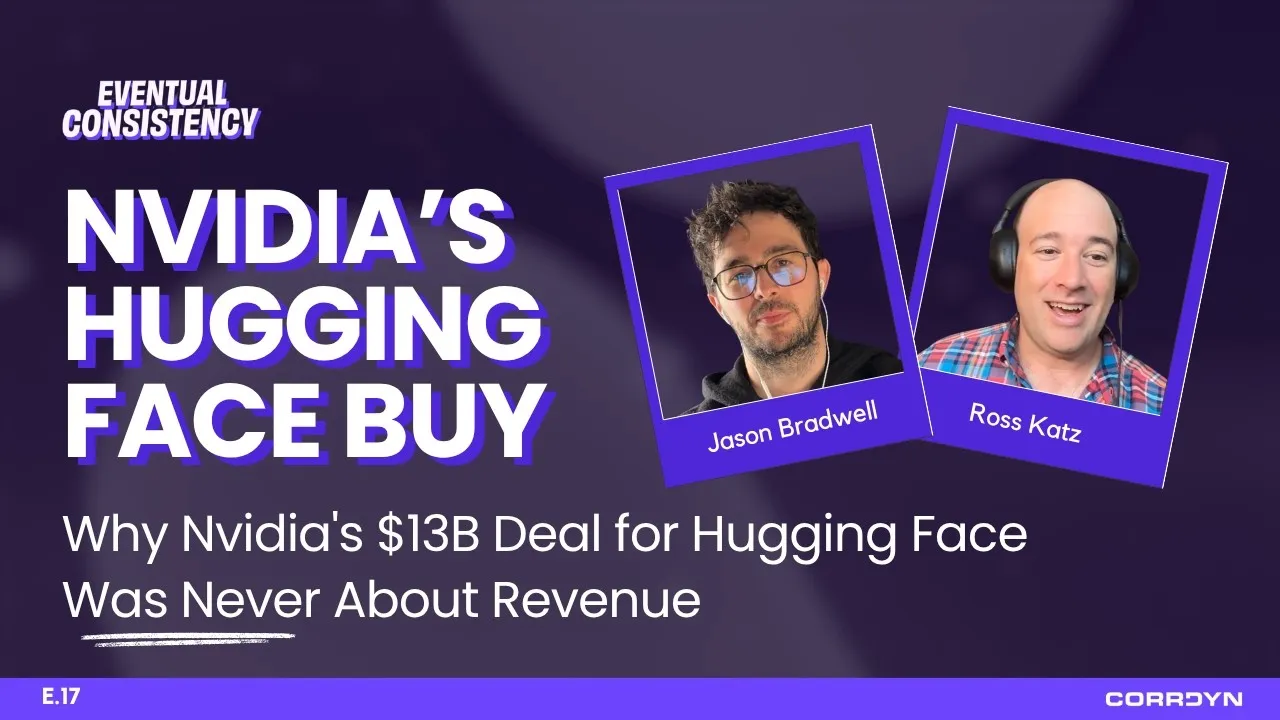
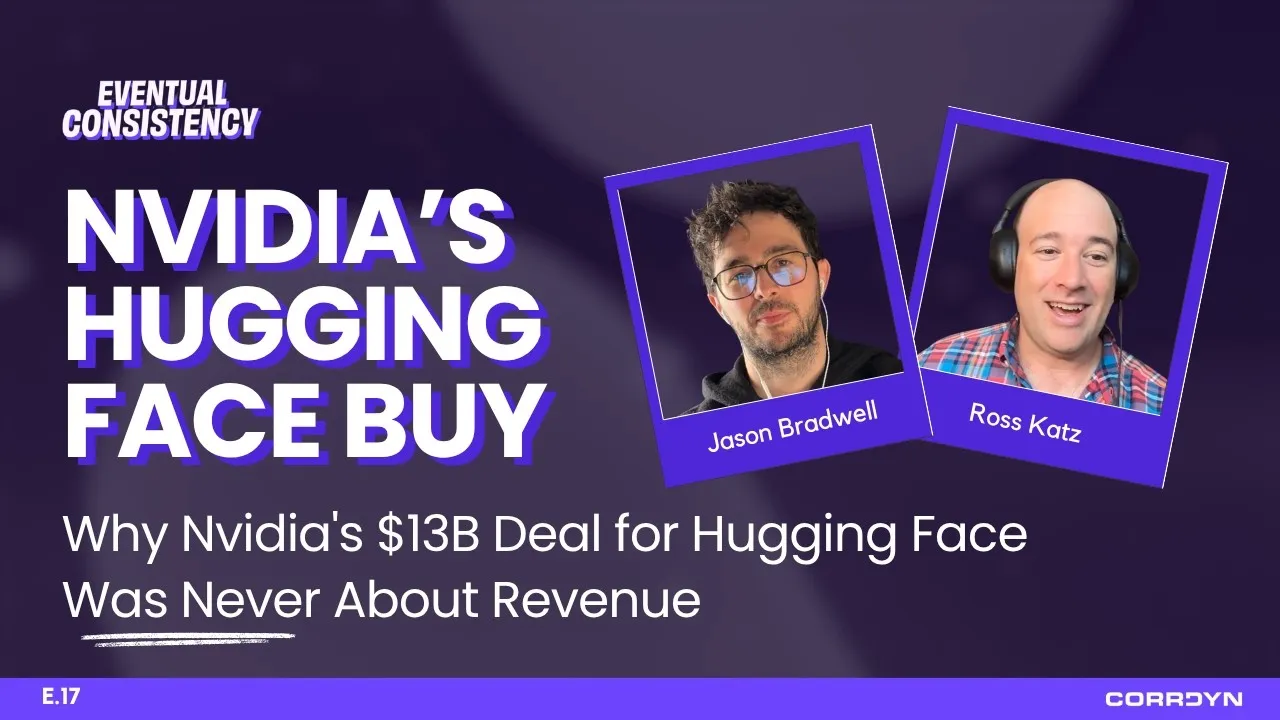
In this episode of Eventual Consistency, Ross Katz (Principal and Data Science Lead at CorrDyn) and Jason Bradwell (founder of B2B Better, host of Pipe Dream) read the deal through supply and demand aggregation and the smile curve Ross borrows from Ben Thompson. Nvidia’s worst case is a model layer that captures all the value while hardware becomes a commodity, and its customers are already moving in that direction with Google selling TPUs and OpenAI talking about its own chips. A hyperscaler that bought Hugging Face would have had reasons to shrink it to paying users or close it. Nvidia is the buyer whose incentives favor keeping it open.
Ross does not think enterprise data teams should change anything on Monday. Enterprise integrations with Hugging Face are limited, regulatory review could take nine to 12 months or longer, and the deal will not close before 2027. What belongs on a three-to-five year roadmap is optionality over where a team’s models come from. Nvidia would buy a frontier lab only if capabilities plateau and its largest customers stop buying its GPUs, and Ross would not bet on AMD, Qualcomm, or Broadcom closing the gap on Nvidia in an open market.
Key Takeaways
Nvidia already owns AI supply, and Hugging Face is where demand collects
The most successful technology companies aggregate both supply and demand. Nvidia has the supply side: the GPUs, the interconnects, the systems that tie a data center together, and a free software and runtime layer that gives developers a good experience and also locks them in, because optimizing a GPU is hard to learn and transfers from one purpose to the next. Hugging Face is the distribution hub for models, datasets, fine-tuned models and their recipes, and model cards, and it maintains open source software used by frontier labs and at-home hackers alike. Ross compares the pairing to Apple building the App Store on top of the iPhone, to Microsoft acquiring GitHub, and, more loosely, to Amazon building AWS on top of the retailer. Nvidia also gets telemetry: most of what happens on Hugging Face is public, but a tightly coupled owner sees which models are under development and which methods are in use before anyone else does.
Nvidia’s nightmare is a valuable model layer running on commodity hardware
Ross borrows Ben Thompson’s smile curve, in which AI value accrues at the hardware end and at whatever delivers value directly to customers. Hugging Face already provides inference and hosts models pulled from the platform, which makes it a nascent competitor to the endpoints Anthropic and OpenAI sell and to the hyperscalers’ AI services. Nvidia sells to roughly 10 primary buyers, all competing for the same end user, and the outcome it fears is the model layer becoming the sole source of value while hardware commoditizes. Google is expanding TPU production and selling TPUs to others, OpenAI has talked about building its own chips, and well-funded startups are working on hardware. Owning Hugging Face keeps rival buyers away from the platform and lets Nvidia commoditize its complement by supporting many model providers, all of whom need Nvidia GPUs. Robotics, a growth area for Nvidia where Hugging Face is increasingly active, and Nvidia’s preference for owning the standards its hardware runs on add to the case.
Nvidia’s incentives say more about Hugging Face’s future than its promises do
Nvidia has said it will keep the platform open and continue to support other silicon vendors. Ross puts little weight on the statement itself and more on where Nvidia sits, since it gains from the community continuing to grow. The Hugging Face founders are ideologically motivated and had already turned down an offer to sell at $7 billion. Nathan Lambert, author of the leading book on reinforcement learning from human feedback, writer of the Interconnects Substack, and a former Hugging Face employee, argued in a LinkedIn post that Nvidia was the best strategic buyer he could think of. A hyperscaler buyer would have either tried to monetize Hugging Face immediately, shrinking its users to those who can pay, or bought it to kill a competitor to its AI services. Ross adds a further point: as a venture-backed public darling with uncertain finances, Hugging Face faced an open question about how long it could hold to its values, and the acquisition spares it from answering that question.
Enterprises should leave their Hugging Face use alone and build model optionality over three to five years
Ross does not expect the deal to change how anyone uses Hugging Face day to day. Enterprise integrations with the platform are relatively limited and mostly consist of pulling open source artifacts. The longer-term move holds regardless of the acquisition: keep access to the fine-tuned models you depend on if Hugging Face goes down, and keep the ability to route to OpenAI, Anthropic, Google, or another vendor when capabilities improve or price-to-performance ratios change. Licensing and supply chain risk need watching, as with any open source dependency. Regulatory approval could take nine to 12 months or longer, Europe could object even if the United States does not, and the deal will not close before 2027. Ross’s advice for the waiting period is to track model availability, capabilities, and internal use cases, because everything in AI changes every six weeks anyway.
Nvidia would buy a frontier lab only if its biggest customers stopped buying GPUs
Every Nvidia move makes sense as positioning to win wherever the AI industry goes. It builds hardware for every major emerging AI use case and invests in companies that will buy its GPUs or grow AI demand, including ones that are not succeeding right now, such as Perplexity. That financing pulls demand forward at a time when even the hyperscalers have run out of free cash flow and rely on complex debt instruments that shift risk to third parties. Ross’s scenario for a frontier-lab acquisition runs as follows: capabilities plateau, lab valuations drop substantially, and the other successful AI companies couple their models to hardware they built themselves and stop buying from Nvidia. Owning a lab tied to Nvidia hardware would then be the way to win, at a reasonable price and with more compute than anyone else. The minute Nvidia bought a frontier lab, the other labs would have a reason to leave, so Ross sees it as a move Nvidia would make only after failing to create a whole world’s worth of buyers, and he does not think Jensen Huang wants an oligopsony of a few large customers.
Challengers will gain share in limited use cases while Nvidia grows the market
Ross would not bet against Nvidia. Manufacturing these chips is among the hardest things humans know how to do, and very few companies have become viable competitors to Nvidia or TSMC, because the leaders know how to build hardware that meets reliability standards and performance targets at a price much of the market can afford. AMD, Qualcomm, Broadcom, and internal chip programs will likely gain share in limited use cases. Ross expects the market to grow faster than Nvidia’s share shrinks. The competitor he could imagine would come from people who know how to do this end to end, backed by something like a sovereign wealth fund, building a Chinese national champion. Inside an open laissez-faire market where Nvidia holds nearly all the cards, he does not expect one soon.
Nvidia’s security resources should make Hugging Face more trustworthy after its breach
Hugging Face suffered a security breach not long ago, put down to an engineering mistake, and regulated industries are nervous about pulling weights off public hubs for that reason. Ross expects Nvidia to invest because its plan depends on trust. Hugging Face has to remain the hub for hosting models and datasets and for evaluation services, and that requires security the market believes in. A startup with $150 million in annual recurring revenue that is burning cash is in a very different position to invest in cybersecurity than a unit of a major enterprise with a vested interest in its trustworthiness. Ross expects Nvidia’s security team to be among the best in the world, and having it review Hugging Face’s infrastructure cannot hurt.
What We’re Watching: the right data warehouse depends on the use case
CorrDyn has just finished a benchmarking study of data warehouses, comparing performance as data size grows, as the nature of the data changes, and as the number of simultaneous users rises. The report comes out later this year, and Ross is holding the results until then. Reviewing the findings reinforced a view he applies to every technology choice. Business buyers often assume there is one best data warehouse, front-end framework, or transactional database, while engineers know every decision trades off performance, latency, the questions a system answers accurately or quickly, and cost. Databricks and Snowflake rest on totally different technologies and produce very different benchmark results, and the same holds for MotherDuck, BigQuery, Redshift, ClickHouse, and Fabric. The work with clients is mapping the use case, and the constraints that define success for it, onto the technology that fits.
Related: AI Strategy & Readiness | Technology Strategy | Episode 25: The Consulting-Lab Land Grab: What Sits Above the Model | Episode 29: The $1 Million Threshold for Self-Hosting Open-Weight AI Models
Full Transcript
Jason: NVIDIA is paying $12.93 billion for Hugging Face. That’s around 86 times revenue and roughly a quarter of 1% of NVIDIA’s market cap. It’s an extraordinary sale for the seller, it’s a rounding error for the buyer, which tells you that it probably was never about the revenue. NVIDIA already owns supply, they own the GPUs, the interconnects. What it’s buying here is demand. On this episode of Eventual Consistency, I’m once again joined by Ross Katz, Principal Data Science Lead at CorrDyn. We talk about why NVIDIA may have been the only buyer that could take Hugging Face without gutting it, what NVIDIA’s actual nightmare scenario looks like as an end game, and whether you should be making any change in your day-to-day based on this sale. Here we go.
Jason Bradwell: So Ross, NVIDIA, they’re paying almost 13 billion dollars for Hugging Face. The revenue of Hugging Face is a rounding error next to that number. What is the reason behind this purchase? What do you think NVIDIA is actually buying here?
Ross Katz: Well, let’s just remember that $13 billion is a rounding error for NVIDIA, and NVIDIA has been on one of the greatest company runs in history. They’re effectively the sole provider, close to sole provider of the picks and shovels of the AI buildout, which is responsible for a non-trivial percentage of the US’s GDP growth this year. So I think their market cap is like $5.2 trillion. So I just want to put that in context. This is not a big acquisition for NVIDIA. But your question still stands, okay, why do they care about making this acquisition of Hugging Face? And there’s a reason why Jensen Huang has created a cult following. He is among the best corporate strategists of this era. And the work that they did, the way that they got here, was by taking this GPU, this graphics processing unit, and turning it into something that is not for graphics. It’s turning it into something that is general purpose. And the way that they did that was by creating an entire ecosystem around free software, CUDA, that made it possible for people to accomplish what was previously not possible using GPUs. And the arc of AI advancement over the previous 30 years is in no small part due to the emergence of this technology and the software that sits on top of it to optimize the hardware for whatever purpose you’re trying to accomplish. So from NVIDIA’s side, they build a small number of things, but on the customer end, they’re able to be the best available for many different purposes. And those purposes span from scientific drug discovery, the kinds of stuff that I talk about on Data in Biotech, to simulations and simulated worlds, to physical AI and robotics, to large language models and the AI craze that’s going on right now, to basically all of the AI purposes that are out there. So with that background, how do we look at the strategy that Jensen is taking on by doing this acquisition? If you look at some of the most successful companies in the hyperscale, in the tech ecosystem, what you see is that they’re trying to aggregate supply and they’re trying to aggregate demand. So NVIDIA has already aggregated supply. They supply the GPUs that are essential to this ecosystem, which is why they’ve been such a successful company. And they also supply the interconnect and the systems, the way that the data centers come together. And then they provide the software and the runtime as a free layer on top that is mostly about helping people to accomplish their goals, making a great developer experience for using the hardware, but also it’s a form of lock-in. Because one of the hard parts is learning how to optimize these systems for whatever goal you might have. But once you learn to optimize an NVIDIA GPU for one purpose, you then have the power to optimize the tool for another purpose. Sitting right on top of that are the frontier labs and the hyperscalers. All of the model developers who are building the frontier AI capabilities or serving the frontier AI capabilities that are driving all of this growth right now. So you’ve got obviously OpenAI and Anthropic, but then you’ve also got Google, Microsoft, and Amazon who are purchasing a large number of GPUs. And then you’ve got the next tier of aspirants such as Meta, Groq, all of these other companies that are trying to become frontier labs or utilize frontier capabilities for various purposes. Now Hugging Face, what Hugging Face does is it’s basically a distribution hub for models and datasets and fine-tuned models and recipes for fine-tuned models, model cards. And it also provides a lot of open source software that helps to support both your frontier labs and your single at-home hackers who are building things using LLMs and other different kinds of AI models. So what NVIDIA gets in acquiring Hugging Face is, number one, it takes ownership of one of the critical points of aggregated demand in the entire ecosystem. So if you think about Apple with the App Store taking their hardware, the iPhone, and then creating a place where they aggregate demand, that creates economic opportunities in the future. The acquisition that everyone’s been pointing to, Microsoft acquiring GitHub, is another example of this. They are suppliers to a lot of developers, and now they have access to one of the prime places where demand is aggregated. And then it’s a looser metaphor, but Amazon building AWS on top of Amazon the retailer, it is also similarly a demand aggregation and a supply aggregation sort of thing. So what they get here is a lot of strategic optionality depending on where things go. And they get a lot of telemetry into what’s happening in the ecosystem. What are the models that are under development? What are the methods that are being used? All of this is publicly available information, but when they’re tightly coupled to Hugging Face, they get an early view of everything that’s going on. And what Ben Thompson says, and what we’ve talked about before, is that the value in the AI ecosystem looks like a smile curve, where the NVIDIA side of the equation, the hardware side, and then whatever delivers value directly to customers, that’s where the value is going to accrue. Well, another thing that Hugging Face does is it provides inference services directly to end users and it hosts models that are also pulled from the platform. So it’s in its very nascent phase of becoming a place that is potentially a competitor for the AI endpoints that are provided by Anthropic and OpenAI, and then also the AI services that are provided by the hyperscalers themselves. And so if you’re NVIDIA and you have roughly 10 primary buyers out there, all of whom are competing for the same end user, what is your nightmare? Your nightmare is that the model layer becomes the sole source of value and that the hardware layer commoditizes. So what you see is Google creating a bunch of TPUs, they have been for a long time, but Google expanding their production of TPUs and selling them to other people in order to create a competitor. You see OpenAI talking about building their own chips. There’s a lot of very well-funded startups that are attacking the hardware angle, and NVIDIA is on top of the world and attempting to solidify its position on top of the world right now. So the world that they want, and you hear this in how Jensen talks about the ecosystem they’re trying to build and why they invest in the developer ecosystem, is a world with many, many buyers for hardware and many, many users of different types of AI across the way that AI is created. And so Hugging Face is the place where all of these people come together. To your point, they only have like $150 million of annual revenue. In a world where Hugging Face gets purchased by one of the hyperscalers, they’re either trying to monetize it immediately by taking all of these people and basically shrinking the people to only those who can pay, or they’re just buying it to kill it because it’s a potential competitor to all of the AI services that they’re providing. And NVIDIA, as the strategic buyer here, in addition to getting the telemetry, in addition to aggregating demand, denies rival buyers access to this demand platform and gives it an opportunity to commoditize their complement by fostering an ecosystem where lots of frontier AI capabilities are being provided by lots of different vendors or users, all of whom need NVIDIA GPUs and the NVIDIA ecosystem. There are other reasons here. Hugging Face is increasingly involved in robotics, and one of the big potential areas of growth for NVIDIA is in hardware that serves the robotics field. NVIDIA likes to own the standards that govern the way that their hardware is used, because it allows it to tightly couple those standards to the hardware it’s developing, and it creates switching costs and solidifies their position. But those are the main reasons why I see this as being strategically valuable for NVIDIA in ways that are not necessarily borne out by the financials of the transaction itself.
Jason Bradwell: I mean, you outlined there a couple of the other potential buyers, and I think what you’re saying is they were not the only potential buyer of Hugging Face, but they perhaps were the best potential buyer of Hugging Face. What’s your opinion on that? Is there anyone else that you think would have been a better fit for Hugging Face to be the acquirer?
Ross Katz: Yeah, so I think Nathan Lambert just yesterday put out a LinkedIn post about this. He is the author of the premier book on reinforcement learning from human feedback, he also runs an amazing Substack that lots of people have heard of, the Interconnects, and he also used to work at Hugging Face. And he’s just a huge proponent of the open source ecosystem. He led the team that trained one of the most important open source models that are out there, not just open weights but open source. And his point was essentially what you just said. That this was the best strategic buyer that he could have thought of. That there was no other buyer out there who had the incentive to foster the ecosystem as broadly and as openly as NVIDIA would have had that incentive. And I don’t know if he made this point, but this is something that’s occurred to me as well as I’ve been thinking about this acquisition: as a venture-backed startup that is a public darling but a financial who-knows-yet, how long would Hugging Face have been able to hold to their values of continuing to foster the ecosystem that they had created out of a belief that eventually the financial outcomes would follow? And so that was an open question for them as a private business. Would they be able to drive the financial outcomes from this ecosystem? And so in many ways, I view the acquisition as saving them from having to answer that question while also creating a home for them where they have the closest analog of that incentive to continue to grow this ecosystem, because there are so many strategic benefits to NVIDIA of seeing this ecosystem continue to grow and develop, and having the power, the optionality over the fullness of time, to move that ecosystem or position themselves relative to that ecosystem in a way that allows them to benefit from whatever direction the AI industry goes. So no, I don’t think there were any other acquirers who were necessarily the best ones to acquire. I think that NVIDIA has shown themselves, similar to Apple, to be control freaks. They want to be vertically integrated, they want it all in house. They have investments in all of these foundation model companies, and it wouldn’t surprise me, depending on where the ecosystem goes, if they chose to acquire one of the foundation model companies at some point as well to continue to build out the fully vertically integrated AI ecosystem that they’re developing. But whatever they choose to do, having the open platform available to them and providing that open platform to the developers who work with AI, I think they care deeply about building goodwill with developers, because they believe that ultimately if the developers are able to accomplish their goals using NVIDIA GPUs or NVIDIA hardware, they’re going to continue to purchase that hardware, and that self-reinforcing loop has been the source of their success to date. So yeah, to answer your question, if you look at the incentives of all of the hyperscalers and of the foundation model companies, they would not have viewed it as strategically advantageous to invest in the community in the way that NVIDIA will.
Jason Bradwell: Yeah, I think you’ve answered my next question, which is, NVIDIA have said, we’re going to be keeping this platform open, we’re going to be continuing to enable support for other silicon vendors, what have you. It sounds like you put a lot of weight into that claim, right? You don’t expect that they’re going to close the doors anytime soon, if at all, because, like you say, they’re trying to foster and develop the community.
Ross Katz: Yeah, so I don’t know that I put weight into the claim itself. But what I do put weight into is, where you stand is a function of where you sit, and I think that they are positioned with an incentive to keep Hugging Face moving in the direction that it’s been going. I also view the Hugging Face founders as being ideologically motivated and wanting to create this ecosystem, and they had already rebuffed an offer to sell at $7 billion. Now everybody has their price, I don’t want to over index on that. But then also when you hear voices like Nathan Lambert, from having been inside Hugging Face and having been one of the proponents of open source AI in the United States, he sees NVIDIA maintaining the direction of the platform. When all of these pieces of data come together, it paints a picture for me of a belief that for the foreseeable future they will have an incentive to keep the ecosystem open and invest in the growth of that ecosystem. Because what they’ve shown, admittedly with trillions of dollars in market capitalization and 75% margins on the hardware that they sell, is a willingness to invest in the companies in the AI ecosystem whose growth is going to fuel NVIDIA’s growth in the years to come. And so I think Hugging Face falls into that category in the same way that its external investments in Anthropic and OpenAI fall into that category.
Jason Bradwell: So a lot of enterprises treat Hugging Face as load-bearing infrastructure. Do you think the deal is going to change how teams should be treating that dependency?
Ross Katz: I do not think that this should meaningfully change the way that people use Hugging Face from day to day right now. I think the number of companies who are deeply integrated with Hugging Face, especially at the enterprise level, the integrations are relatively limited, and it’s focused on the open source artifacts that are pulled from Hugging Face. I do not think that there is any reason to rethink the way that you’re using Hugging Face right now, nor do I think that anything meaningful is going to change. I do think that there are some scenarios that could arise over the three-to-five year time horizon where you want to start… I think that maintaining optionality with regard to the source of the models that you’re using in all of your AI deployments is a good move regardless of what happens. That you want to have access to the fine-tuned models that you’re using if Hugging Face goes down. You want to have the ability to route to OpenAI or Anthropic or Google or any of the other vendors in the event that their model capabilities improve or their price-versus-performance ratios change. I think that just like any other software system where you’re relying on the open source community to maintain things for you, you have to pay attention to both the licensing and the supply chain risk that you’re exposing yourself to when you utilize that software. But I don’t view this as necessarily different in kind from any of those other types of situations. So maintaining optionality with regard to where you get your intelligence, including utilizing open models that are hosted elsewhere or hosted by you, I think that is all a good idea and should be on your three-to-five year roadmap. But there’s nothing that needs to be done in the immediate term based on this. I believe their commitments, and also there’s a lot of regulatory review that this acquisition will need to undergo. And it’s conceivable that, if not the United States, then Europe could have something to say about this acquisition. I don’t personally agree with the idea that this is one of the situations where acquisition is a net negative for the marketplace as a whole, but I think regulatory review could be ongoing for this acquisition, and so nobody should wake up tomorrow and change everything as a result of the announcement of this acquisition, for sure.
Jason Bradwell: Well, they’re saying that the regulatory approval could go anywhere from nine months, 12 months and beyond. So do you expect or anticipate anything to be different in the ecosystem whilst we’re in this limbo period, or is it more of a wait-and-see type scenario?
Ross Katz: I mean, everything’s going to be different in the ecosystem because everything changes every six weeks. But do I think that this acquisition is the thing that is going to drive incremental change in the ecosystem? I do not. So I think that you should pay attention to the availability of different models and their capabilities, pay attention to the use cases that you’re driving internally and how you’re utilizing LLMs to find value for your company. That’s what you should be paying attention to. There’s no reason to pay attention to the regulatory review. It will come to fruition in the fullness of time. I don’t expect any meaningful impact on the AI ecosystem for the next, yeah, like I said, three to five years. It’s going to take a long time for anything meaningful to change in this regard as a result of this acquisition, because obviously there are lots of other factors that are causing change.
Jason Bradwell: Just to take a step away from the acquisition for a sec, you said something really interesting in one of your previous answers, which was around, you foresee a scenario where potentially NVIDIA could go and acquire one of these frontier models as they try and pursue this verticalized status. Talk us through that a little bit, and if you had to crystal ball gaze about NVIDIA’s future specifically and their continued investment into the AI ecosystem, what are some of the outcomes that you could potentially see?
Ross Katz: Yeah. So what they’re trying to do is position themselves to win regardless of where the AI industry goes. If you just look at every action they take through that lens, then it makes perfect sense what they’re doing. They’re building the chips, the hardware that serves all of the major emerging use cases of AI. They are investing in every meaningful enterprise, including those that are not succeeding right now, like Perplexity, that will buy GPUs from them or will grow the AI ecosystem so that more people are buying hardware to get the value from AI. They’re pulling all of this demand forward through these investments, demand that would take longer to come out, because they’re providing liquidity and financing as a result of their meteoric rise that other players in the ecosystem are not as well positioned to provide. Even the hyperscalers have run out of free cash flow and are relying on very complex debt instruments that shift risk onto other third parties in order to purchase the computing power that is in such high demand right now that they’re renting out to the rest of the ecosystem. So what is the situation in which NVIDIA would view it as strategically worthwhile to acquire a frontier lab? I think the answer is something like: at some point AI capabilities plateau and valuations for these AI companies start to drop substantially, and the other successful AI companies are starting to succeed in building their own hardware and coupling their own models to their hardware. And in so doing they’re creating a competitive environment where they’re not buying NVIDIA’s GPUs anymore, and the only way for NVIDIA to win is by owning the AI company that is tightly coupled to their own hardware. So from a valuation perspective they’re able to purchase that company at a very reasonable price, and then they’re able to invest substantial resources. If compute is the main constraint on driving intelligence, nobody has access to more compute than NVIDIA. But they wouldn’t close down… this is a closing of the market. They wouldn’t close down the market like that. The minute they buy a frontier lab, none of the other frontier labs buy their hardware anymore. That’s not strictly true, but it’s more and more true as more hardware vendors become available. So they’re not going to do this unless it’s true that there are only a few frontier companies that are going to drive intelligence forward. They’re going to gather so much of the value. All of that value is going to come from the amount of compute that they’re able to bring to bear. And NVIDIA has not succeeded at creating a whole world’s worth of buyers for their hardware. I do not think this is the outcome that NVIDIA or Jensen Huang wants. I think what they want is a world where they are not dealing with an oligopsony, a very small number of buyers. What they want is a world where everyone’s a buyer. Where the opportunities for the application of AI are endless and the amount of money that people are willing to spend on NVIDIA GPUs in order to get that value is also endless. And so they are just there, and they’re effectively the only seller of the hardware that’s driving this continued boom in intelligence. That’s the world that they are driving toward. But that might not be the world we end up living in. A lot of it depends on what the evolution of frontier model capabilities looks like over the next decade. Or, if you believe the Anthropic researchers who are quitting, the next 1.5 years. But whatever it is, that’s the trend that we’ll see play out.
Jason Bradwell: And NVIDIA’s one of the dominant players in the whole chip market. Where do you think this puts them in terms of their distance to AMD and Qualcomm and Broadcom and internal solutions? Are they now just so far out of the game that no one can catch up to them in your view, or do you think there’s still an opportunity for someone, anyone, to close that gap?
Ross Katz: I mean, they have so much market power right now and so many resources available to them that I would not bet against them. That’s my perspective on it. It’s been shown that manufacturing these chips is among the hardest things that humans know how to do. Many people are trying to do the work that NVIDIA does, that TSMC does, but very few people are succeeding at being viable competitors to those companies, because they have such a lead in terms of their knowledge of how to create the hardware that meets the reliability standards and enables the performance that everyone’s looking for at a price that large portions of the ecosystem can afford. So I think that it is likely that in limited use cases some of these challengers are going to gain market share. But what NVIDIA is trying to do is grow the pie. Because the pie is probably going to grow faster than NVIDIA’s market share is going to shrink. And that’s the way that I see this evolving. Now, if there are people who have the knowledge of how to do this from end to end who go out on their own and who are resourced by, I don’t know, sovereign wealth funds, and able to get enough wind in their sails to build, I don’t know, a Chinese national champion, for example, I think that it is possible that we will see a competitor to NVIDIA emerge in that way. I don’t think that in the context of an open laissez faire market system where NVIDIA holds basically all of the cards we’re going to see a competitor emerge anytime soon.
Jason Bradwell: We couldn’t talk about this acquisition without talking about the security breach of Hugging Face not long ago. It was put down to an engineering mistake. What we’re seeing is regulated industries are nervous about pulling weights off of public hubs for exactly this kind of reason. Now we can go into the reasons why the security act happened at all, and could it have happened to anyone? That’s up for debate. But do you think NVIDIA’s money and the security engineering expertise they can bring to Hugging Face make that kind of objection go away, or do you think people are still going to be concerned?
Ross Katz: I think that NVIDIA has a lot of resources at its disposal, and it has an incentive for Hugging Face to continue to be a trusted provider of the services that they’ve been providing so far: of hosting these models, of hosting these datasets, of providing evaluation services to different AI model companies. They want Hugging Face to succeed in being the hub that it is, and in order to do so, they have to maintain the trust of the marketplace, and in order to do that, they need to make sure that their cybersecurity is effectively bulletproof. And when you’re a startup with $150 million in annual recurring revenue and you’re burning cash, you’re in a very different position to invest in something like cybersecurity than you are when you’re under the umbrella of a major enterprise that has a vested interest in your trustworthiness being one of the most important things. And so I personally believe that this will result in a more reliable and trustworthy Hugging Face. Certainly NVIDIA’s cybersecurity team has to be one of the best cybersecurity teams in the world, I would expect. So having them taking a look at Hugging Face’s infrastructure, it can’t hurt.
Jason Bradwell: Cool. All right, Ross, what are we watching in the world of data and AI this week?
Ross Katz: Yeah, so I’ll do a little bit of a teaser for something that’s going to be coming out later this year. We’ve just done what I believe is one of the premier benchmarking studies of data warehouses, basically comparing their performance as you increase the size of the data, change the nature of the data, increase the number of users you have using them simultaneously. And I think the results are really eye-opening and interesting, and so I’m excited to share those results. I’m not going to share what those results are right now. But reviewing the findings and writing the report has got me thinking about, as technologists, I think real engineers understand that every decision you make with regard to technology has tradeoffs, but there’s this viewpoint in the business ecosystem that there has to be one best data warehouse. Or that there is one best framework for front-end development, or one best transactional database that we should all be using as the back end of our applications. And I think that what all of this loses track of is that at the tiniest level, at the level of the framework, to the intermediate level, at the level of the database, to the highest level, at the level of a data warehousing platform, all of the decisions that you make up and down the stack have tradeoffs with regard to the way that you navigate performance and latency and what questions you can ask that get answered really accurately or quickly, and cost. So if you look at vendors like Databricks and Snowflake, we had a podcast earlier this year about Databricks versus Snowflake and their different strategies. At a fundamental level the technologies underlying those two platforms are just totally different. And the results that you get in a benchmarking study like this are totally different. And it’s the same thing with MotherDuck, and the same thing with BigQuery, and the same thing with Redshift and the same thing with ClickHouse and the same thing with Fabric. And I think that what we try to do with our clients in having conversations about selecting technologies for different problems is help them to understand their use case more deeply so that they can map the technology onto the use case more effectively. I think that a lot of people come to us thinking that really the value that we bring is that we know the technology more deeply, and there’s some of that. Having used all of these technologies before, we have more exposure to what they’re good at and what they’re not so good at, and we also have exposure to a lot of company problems, what leads to success in technology adoption and what leads to failure in technology adoption. But really it’s the mapping of the use case onto the technology itself. It’s that marriage that determines whether the technology is a success internally or whether the technology is a failure. And it’s also understanding the tradeoffs between your priorities as well, because obviously if we all had infinite resources, we would all get perfect latency and top performance. But what we try to do is understand, okay, what are the things that are going to constitute success for you given your constraints, and then what are the technologies that fit you given those constraints. So that’s just a thought I’ve been having as I review the results from this benchmark report we’re going to release later this year. I think it applies to all of the technology selection choices that we make across clients in the data ecosystem. And I just think it’s important to remember that even though you may be most familiar with one data warehouse or one cloud platform or one front-end development framework or one production database, all of them have strengths and weaknesses, all of them have tradeoffs, and it’s just important to check our biases at the door when we’re making decisions like this.
Jason Bradwell: Awesome. As someone who read the first draft of the report earlier this week, it is fantastic. We will probably be doing an episode of Eventual Consistency focused on the report with our co-authors in October, and so it’s going to be a great asset to have in the marketplace, and it delivers a lot of value. Thanks, Ross. See you on the next episode.
Ross Katz: Appreciated, Jason. Thank you.
Jason: Another great episode of Eventual Consistency here, and I think the answer from Ross that stuck out to me is nothing here should change what you do on Monday. The deal’s not going to close before 2027. Of course we’ve got this regulatory review ahead of us. But what it should change perhaps is your thinking around your three-to-five year roadmap in one respect: optionality about where your intelligence comes from. If you’re working out what that looks like for your own stack, that’s a conversation that CorrDyn has most weeks with their clients, and they can be having it with you. Head to corrdyn.com, that’s c-o-r-r-d-y-n dot com, and we’ll see you on the next one.