How to Start Event-Based Marketing: A Bottom Up Approach

Every business relies on marketing to succeed. But not every business has a dedicated marketing team or in-depth knowledge of how to successfully reach both new and existing customers to increase sales. One common challenge is that each lead is at a different place in your sales funnel - why would you treat them all the same?
In this post, we highlight a technique to help you differentiate between these potential customers to optimize your marketing spend, using technology to automate much of the process.
Marketing automation allows targeted messages to leads and customers based on information your company knows about their demand and demographic characteristics. Use of event-based marketing lets you take action based on your prospect’s actions and location in the sales process. Every company can leverage this technique, regardless of maturity.
The first step is to define an event-driven marketing strategy. The second critical step is to implement systems with reliable data integration and process automation.
Event-Based Marketing Strategy
The goal of this strategy is to identify pivotal moments in your customer journey and to define targeted and timely actions to implement at these points. Implementing event-based marketing is a strategic way for your company to drive immediate value and develop layered, relevant messaging and calls to action that reach your prospects at these critical points along their buying journey.
Any event-driven marketing approach has three components:
- The Communication: What message you want to send
- The Event: When you want to send it
- Your Expected Outcome: What you hope to achieve from your messaging
We recommend you start with the potential events and work backwards to the communication in the context of the outcome you want to drive. There are two types of approaches to event identification:
- Bottom-Up: Analyze customer behavior as customers approach transactions, renewals, or churn, and build messages around points where you are losing potential revenue.
- Top-Down: Understand your customer journey in its totality, and distill the moments that require new marketing messages to improve customer migration through that journey.
We tackle bottom-up event identification first because it is the simpler of the two to implement. In another blog post, we will cover the somewhat more complex concept of top-down event identification.
Bottom-Up Analysis of Low-Hanging Fruit
If you have existing data on customer interactions, the bottom-up approach to event-driven marketing is a great starting point.
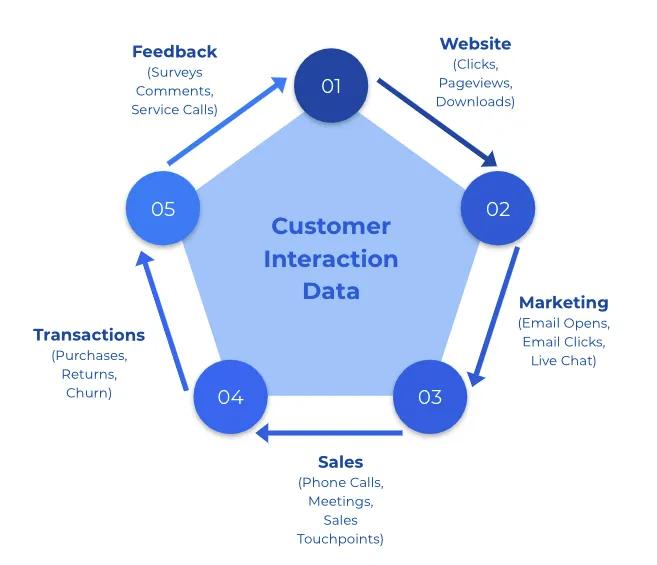
Begin by integrating data on customer interactions from your website, CRM, marketing emails, and advertisements with information about customer purchases. This does not yet need to be a production system, just an integrated data source in Excel or a database.
Think about your customers’ journey, and ask questions about their interactions. It is a good idea to include marketing, sales, and customer success staff in this process. These questions should help identify customers who might be one or two interactions away from a purchase, renewal, churn, or other outcome your company values.
Example questions might include:
- How many abandoned carts do we have per week? What percent of abandoned carts return to purchase?
- How many people are clicking on consecutive pages or communications related to a specific product or service? Do we have a sense of what information they are looking for?
- What are the characteristics of an urgent buyer? Are there any signals we can build communications or promotions around?
- What information do we have on customer satisfaction? Can we review customer feedback to identify our main drivers of churn?
With the right questions asked and the data in place to provide answers, you are ready to implement one-off event-based marketing. If you don’t have all of the answers due to missing data, you can still proceed; this is a sign that you need to acquire additional data to drive high quality event-driven marketing decisions.
Messaging Based on Bottom-up Events
Now that you know whom you want to target and when, we move on to how.
Depending on the events you have identified, review the prospect and customer interactions that you need to monitor in order to know when to trigger a message. For most companies, this means capturing information from customers when they visit your web properties, but can also include personal interactions, event attendance, social interactions, and similar customer activities.
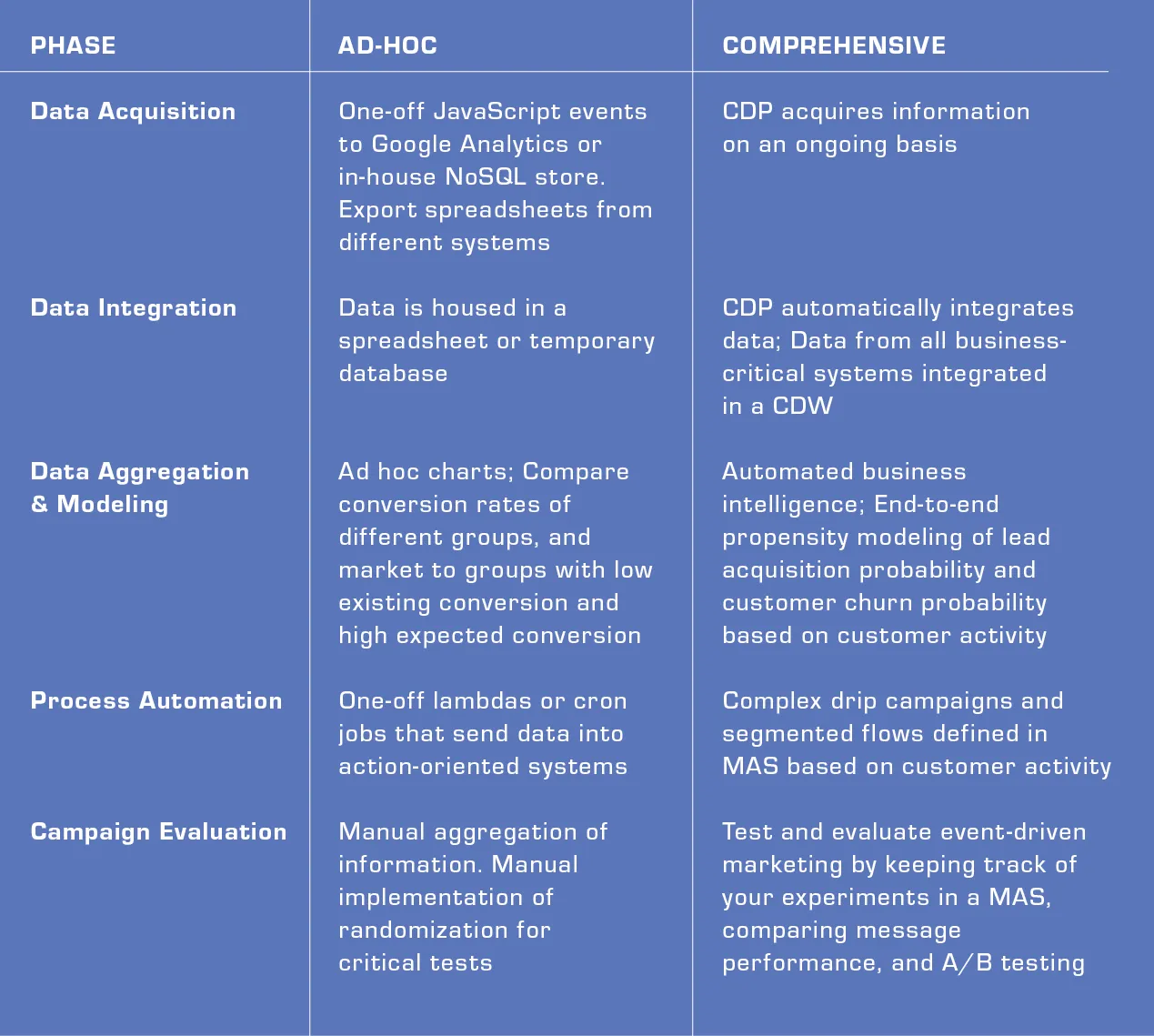
Executing event-driven marketing requires the following phases:
- Data Acquisition: Acquire the data needed to understand your customer’s situation and trigger marketing campaigns that respond to that situation
- Data Integration: Bring information assets together from customer-interfacing business systems (website, CRM, ERP, etc.) so that they can be analyzed together
- Data Aggregation and Modeling: Establish consistent methodologies of summarizing the customer situation in a way that downstream automation systems can understand and respond to proactively
- Process Automation: Trigger outbound communication from the business systems that drive activity, such as a CRM or marketing automation system.
- Campaign Evaluation: Analyze customer response using marketing analytics to learn from experience and adjust accordingly.
If your company wants to utilize event-based marketing at scale, there are three pieces of enterprise software your company should evaluate:
- Customer Data Platform (CDP) (i.e. Segment, Lytics, or Listrak): CDPs provide out-of-the-box event tracking so that your company can ask smarter questions about who your customers are and how you can move them more effectively through the funnel. CDPs also provide immediate data integration benefits, reducing the time it takes to iteratively improve on event-driven marketing campaigns.
- Marketing Automation System (MAS) (i.e. Hubspot, Salesforce Marketing Cloud, or Marketo): MASs enable building complex logic and workflows that trigger branded and targeted communications to leads and customers. They also come with useful campaign monitoring and evaluation tools built-in.
- Cloud Data Warehouse (CDW) (i.e. BigQuery, Snowflake, Redshift, or Azure Synapse): CDWs handle complex analytics workloads in a database environment, enabling deeper, faster, and higher volume analysis and modeling of lead and customer data at a sustainable cost. A well-designed warehouse is the foundation for effective business intelligence. CDWs increasingly come with machine learning tools built-into their ecosystems, which can enable more complex automated customer segmentation and targeting methods.
If you want to validate the possible results of event-based marketing, you may consider an ad-hoc approach to test the value before investing in any of the systems above.
While this may seem overwhelming, regardless of how mature your marketing processes are, CorrDyn can help expand your capabilities and scale up the number and quality of event-driven campaigns your company implements to increase sales and reduce churn. With the right understanding of the touch points, impactful messaging, and systems in place, you will be able to impact your bottom line before you know it. Reach out to start a conversation about how we can help you capture value through intelligent marketing automation.
For more on this topic, listen to The Back End Is the New Storefront and Transforming CPG with AI at TICKR with Sam Kahn.