Listen on
The market’s fear of a “SaaSpocalypse”—a $300 billion evaporation in software company market value—isn’t just Wall Street hype. The core problem: AI agents, like Anthropic’s Claude Cowork, are disrupting the traditional seat-based SaaS business model, forcing executives to rethink technology investments and data strategy. This shift impacts budgets, build-versus-buy decisions, and the very foundation of how businesses interact with software.
Ross Katz, Principal and Data Science Lead at CorrDyn, works daily with organizations making critical technology choices for their data infrastructure. He offers a grounded perspective on what this market turbulence means for the people building and buying data solutions. Ross details why some SaaS companies are vulnerable to AI disruption, while others are surprisingly resilient, outlining eight key factors that determine a platform’s defensibility.
This episode unpacks how SaaS providers are adapting their revenue models and how businesses must proactively establish robust data foundations. It concludes with a critical insight: effective AI agent deployment demands clean, curated data, making strong data engineering capabilities more essential than ever.
Key Takeaways
SaaS defensibility against AI depends on specific attributes, not a universal threat.
Not all SaaS applications face the same risk from AI agents. Platforms with deterministic outputs (like payroll), physical world consequences (like restaurant POS), strong data gravity (system of record), or regulatory moats (like FDA compliance tools) are more protected. Conversely, systems focused on probabilistic outcomes or human-guided workflows are more exposed.
AI agent proliferation accelerates the shift from seat-based to consumption-based revenue models.
SaaS companies are already moving away from per-seat licensing towards consumption models, where businesses pay for API requests or data utilization. This strategy relies heavily on the vendor’s ‘data gravity’—how essential they are as a system of record—and their ability to lock down that data, making migration difficult despite AI’s transformation capabilities.
Effective AI agent deployment requires robust, clean data foundations.
While AI agents are powerful, they are probabilistic. Their value is directly tied to the quality of data they access. Companies aiming to maximize agent performance must invest in well-organized, well-documented, and integrated data from across their platforms, using the data warehouse as a single source of truth for context and reliability.
AI-driven code generation changes the build-versus-buy equation for software solutions.
The ability of AI to generate code significantly lowers the barrier to internal development, making ‘building’ a more viable option than before. Data leaders must re-evaluate traditional procurement strategies, considering whether current SaaS vendors can deliver necessary AI integrations or if custom solutions are now more feasible.
Related: CorrDyn helps clients with AI strategy and data cost optimization. See our insights on the SaaSpocalypse and how strong data engineering powers effective AI.
Full Transcript
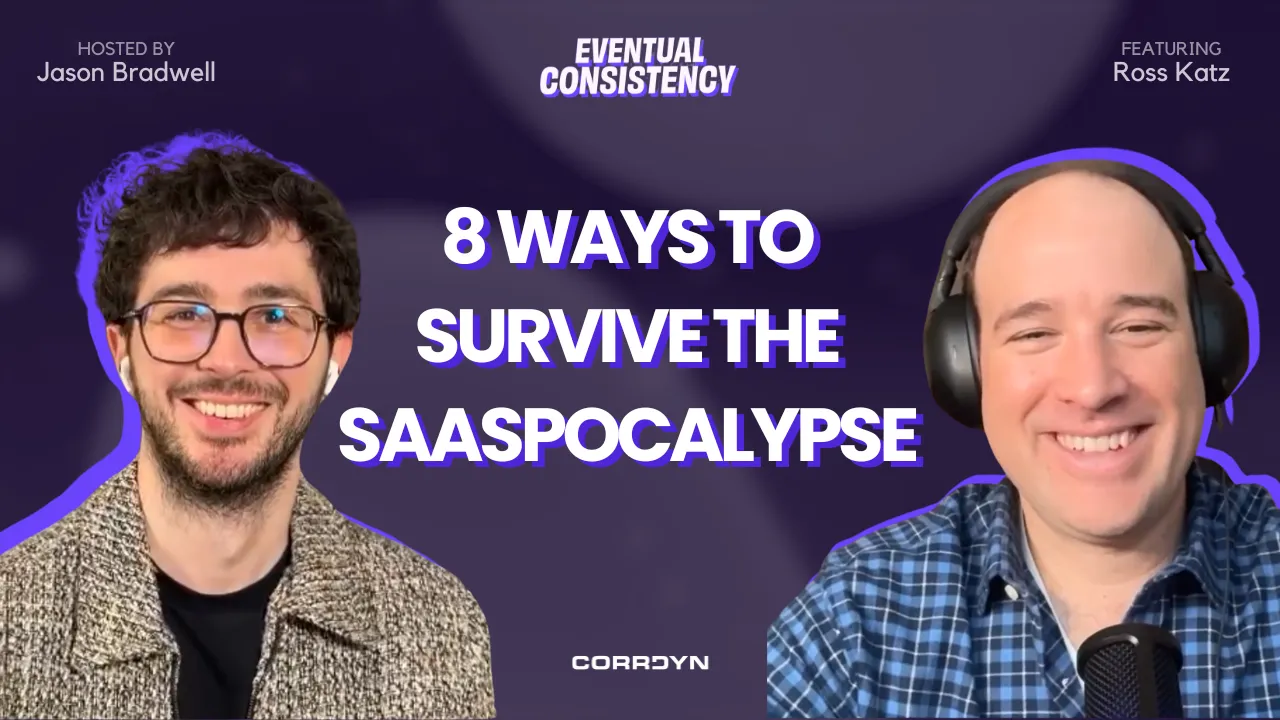
Jason: Welcome to Eventual Consistency. I’m Jason Bradwell, one of the producers on the show, and today we’re turning the tables a little. Usually, Ross Katz hosts the show, but for this episode on the SaaSpocalypse, I’m interviewing him. The data industry moves fast. Every week there’s a new tool that’s going to change everything, another hot take about how we’re doing it all wrong. We’re not here for that. We’re here to talk about what’s actually happening, honestly, the way that you talk about it with your team. Today, Wall Street has been calling it the SaaSpocalypse. $300 billion evaporated from software companies in a single week. Ross works with data teams day-to-day at CorrDyn, so let’s talk to him about what this actually means for the people building and buying data infrastructure.
Jason Bradwell: Okay, so here’s what’s happened. Between January the 30th and February the 4th, 2026, nearly $300 billion in market value evaporated from software companies. The trigger was Anthropic’s launch of Claude Cowork, an AI agent that autonomously manages files and completes workflows. The deeper issue is investors are suddenly pricing in the risk that AI agents will disrupt the seat-based SaaS business model. Some of the major casualties: Atlassian at one point was down 35%, Intuit was down 34%, ServiceNow, Salesforce, Adobe, Workday, they all took significant hits. The software ETF was down by 30% from its highs. The core fear here is that for 20 years, the model was buy software, hire people to use it. All right, Ross, so you obviously at CorrDyn are working with data teams all the time, every day, companies trying to build out their infrastructure, they’re trying to make technology decisions. When you start hearing about this SaaSpocalypse, are any of the people that you’re working with actually talking about it, or is this just kind of LinkedIn hype?
Ross Katz: The SaaSpocalypse is an artifact of the market, the marketplace definitely has moved. For a long time there’s been a lot of conversation about what is AI going to do to the software as a service, the SaaS model, and what impacts might we see. What triggered the most recent version or the recent moves in the quote unquote SaaSpocalypse is Claude releasing Cowork, which is its Claude code agentic interface for doing the kind of knowledge work that people like you and me do every day, and then also releasing modules that were focused on specific verticals like the legal vertical. The moves in the market are very real and the fears that the market has about what this will do to the software as a service business model are also real because the capabilities of AI have reached a point where it can do a lot of work that these SaaS tools were designed to do. But in terms of what business leaders are talking about on a day-to-day basis, what they’re thinking about is how do I architect my business now that this capability exists. These two conversations, the conversation of the market and the conversation of the business leaders, they’re in tension with each other. You’ve got the business leader saying, well, do I need fewer seats for my SaaS application, and from a market perspective that means less revenue for the companies that have seat-based licenses. Then you have SaaS companies that can — the places where AI is most powerful is in code generation and software engineering. You have SaaS applications that can release more features more quickly and potentially that gives an opportunity to business leaders to consolidate the number of SaaS applications that they’re doing, which compresses the revenue for the industry as a whole. I do hear about budget reallocation based on things like this and I know we’re going to get to this later, but the other question that this opens because of the code generation we just talked about is the build versus buy question changes the tradeoffs because building feels a lot more viable than it did previously. The conversation is very real, but it’s not apocalyptic for business leaders, it’s just the market giving back a bunch of money for, broadly speaking, any company that has a software as a service business model.
Jason Bradwell: When I saw this story start to break, I was getting a feeling of deja vu because I remember back in I think it was 2023 or 2024 reading stories about how Salesforce were cutting 10% of their global workforce, predominantly made up with software engineers because AI is coming and we don’t think we’re gonna need them. As recently as last year, you’ve got the CEO of Salesforce or executives from Salesforce saying that they quote unquote regret that decision and they’re actually going out there and re-hiring a lot of these people because they realize the technology doesn’t go as far as they thought it could. Yet here we are again. What’s different this time? What makes this situation not something that’s going to end up seeing history repeat itself in another 12 months and everyone’s buying more licenses than ever?
Ross Katz: I think the answer is we don’t know. What the market is doing is pricing forward expectations about what revenue is going to look like. The scenario in which companies can cut the number of seat-based licenses that they need for some software as a service systems, the scenarios in which they can build more features or they can consolidate more vendors or they expect more from their software as a service tools in terms of integrations with AI for example, creates market dynamics where buyer expectations have changed. When buyer expectations change for what the tools need to produce, that creates pressures on the marketplace. From Salesforce’s perspective, we can talk about the strategic dynamics of Salesforce’s business and why it’s under threat and why it’s potentially a winner, but from their perspective, they need to reposition themselves for the new world in which AI agents are one of the main interfaces through which businesses interact with the Salesforce CRM system. That requires more software engineering talent and in particular software engineering talent who already know the nitty-gritty of Salesforce’s fairly convoluted architecture that was developed a couple decades plus ago. Even in a world where AI can generate code, it still requires software engineering expertise, and I would say the same for data science, data analytics, data infrastructure, data engineering expertise in order to make sure that the code that’s being written is the right code for the solution that needs to be developed. If I were just guessing at why Salesforce regrets cutting 10% of their talent, that would be my guess. That doesn’t mean that they’re not going to need fewer software engineers per feature, but maybe the landscape is shifting so fast that they just need to put out that many more features in order to keep up with that shifting landscape.
Jason Bradwell: Awesome. This story obviously came across our desks and became the foundation for this episode after a few articles made it into our Slack chat. There was one from Forbes titled $300 billion evaporated, the SaaSpocalypse has begun, article from CNBC, AI fears pummel software stocks, is it a logical panic or is it a SaaSpocalypse? Those headlines would make you think the entire world is crumbling down around you and business as we know it is no longer going to exist. But I’m curious, Ross, your thoughts on what do you think the reporting has gotten right about the SaaSpocalypse and what do you think it’s gotten wrong about the SaaSpocalypse?
Ross Katz: What it’s gotten right is that the markets are actually moving and that software as a service businesses are under threat, and that software as an industry just generally is going to change really quickly because the barriers to entry for new competitors to build software, the ability of existing companies to add features that basically bundle up previous software systems that you might have needed to purchase separately, these factors are real and they’re going to have an impact on some of the players in the software as a service industry writ large. That is right. What I would say is wrong is that that impact is going to be across the board, all software businesses are under threat. I did a little bit of research before coming on the podcast, you can see that even the market is pricing differential returns depending on the types of SaaS and the models of the different SaaS companies that are out there. I think that there are roughly speaking eight factors that govern which companies are winners and which companies are under threat or potential losers from the SaaSpocalypse. The first one I would mention is, is the output of the system deterministic, that is does it need to be practically 100% correct, or is it probabilistic? Is it an output that doesn’t need to be exactly right, it just needs to be good enough and good enough will serve the needs of the business. If you look at a company like Workday that’s a human resources platform, payroll is deterministic, people need to get paid the amount that they’re owed. But your human capital management modules, things like employee engagement surveys, workforce planning tools, talent management dashboards, these things are not deterministic, they’re more probabilistic. You can imagine a world where Workday is still being used by a lot of companies as a result of the payroll system that needs to be right and some of the compliance things that it does as well, but some of these human capital management modules maybe people aren’t adding those on as often. The second factor that I would note is physical world consequences. That is if I remove this system from my business, does it have real-world consequences with the business? The example I would give you here is Toast. Toast is a back-office hardware and software platform for restaurants. If Toast goes down, the restaurant is not taking any orders. They can’t process credit card payments, they can’t route tickets to the kitchen, it’s the end of business as you know it. You’re not just going to say, oh well AI could do everything Toast can do because that’s a much longer term conversation and that gives Toast time to respond to the needs of the business. Another factor that I would consider is does AI need this software as a service system or does it compete with it? The example I would give you here is a company like Okta, which basically does single sign-on type work. It’s enterprise security and identity and access management. Okta as an example is basically flat year-to-date from a stock perspective because when you’re deploying a ton of AI agents across the enterprise, they need identity credentials. They have to have permissions that allow them to access certain systems, they need an audit trail. These are all things that Okta does. AI actually relies on Okta inside of the business. The fourth factor that I would point to is data gravity, which is this idea that the importance of a system is based on the extent to which a system is the source of truth for your enterprise. It’s the place where you house all of your most important data. This is where I would point to a company like Salesforce that has really deep data gravity. Salesforce has all of your enterprise’s most important data, that’s why Salesforce is still in business as a software as a service entity decades after it launched despite it sometimes being difficult to work with. To use some of the factors that we’ve talked about earlier, Salesforce is a mix of deterministic and probabilistic outcomes. Some of the things that Salesforce does you have to get right and some of the things, an AI agent can send an email as an example. That email can be crafted by another system, it just needs to access the data that is in Salesforce and that’s the data gravity. If you turn off Salesforce typically nothing stops in the physical world. You can still pick up the phone and dial somebody, you can still save your information in a spreadsheet, but obviously if you’re an enterprise there are much greater implications, so saying that nothing stops in the physical world is a slight exaggeration but it’s not like your entire business grinds to a halt. What I will say about Salesforce is that, as we mentioned earlier, the per-seat pricing is exposed to headcount compression because some of the things that you would have Salesforce do previously are things that you can now have AI agents do just by accessing the data and doing it outside of the Salesforce system. You might reduce the number of licenses that you have with Salesforce while still keeping Salesforce because it’s a system of record for your business. The fifth factor I would point to is does the system exist above or below the agent layer? Where below is AI agents are accessing it, they rely upon it, and above is AI agents are actually a better interface or a better way of doing the thing that the software as a service system did previously. A good example here is Intuit with, for example, TurboTax. If you’re already somebody who is doing your own taxes and all you needed was TurboTax to guide you through the process, and you’re not making so much money that you’re terribly worried about being audited, an AI agent can do a reasonable approximation of TurboTax. An AI-driven application that knows the tax code could potentially take TurboTax’s business because you actually don’t want to step through the steps in a SaaS application, you want to have an AI agent asking you the questions yes yes no no whatever. You don’t want to have to point and click, you just want the thing to be done because you want to spend as little time as possible getting a reasonable tax submission out the door that minimizes your risk of being audited. That’s an example of a company that’s above the agent layer and is vulnerable to disruption as a result. The sixth factor that I would point to is customer unit economics, which is basically do AI agents create more demand for your services or do AI agents create less demand for your services? Just as an example here, there’s a SaaS platform called CrowdStrike that is a cybersecurity tool that helps protect against new attack surfaces, data exfiltration risks, new compliance requirements that arise. Basically every AI agent that is interacting with your systems could create another attack surface. It’s basically a cybersecurity nightmare and you want to automate deterministically that these AI agents are not going to do things you don’t want them to do. For a similar reason to what I said earlier about Okta being valuable, a SaaS platform like CrowdStrike is also increasingly valuable. The seventh factor I would point to is a regulatory moat, and the example I would give here is Veeva Systems, which is a company that helps with things like clinical trial documentation for the Food and Drug Administration, the FDA, pharmacovigilance reporting, dealing with drug safety. These are things that you cannot have an approximation of GXP compliance, you need to have the real thing. Systems that have built up, that have gained industry approval, that have already passed muster from a regulatory perspective in industries where these companies cannot afford to try something new and see what happens, those systems are going to be relatively well protected against the emergence of AI. The last factor that I would point to is revenue model alignment. What are customers paying for? If they’re paying for seats, then you’re vulnerable to seat compression. If they’re paying for some combination of consumption and utilization and AI agents are consuming more and utilizing more of that resource, then these are companies that are likely to benefit from the emergence of AI. The example I would point to here is Cloudflare. Cloudflare provides content delivery networks, web security, filtering threats at the edge where people are trying to access your website, but customers pay for the bandwidth, they pay for the API requests, they pay for the compute at the edge, and AI agents are just creating more of the need for bandwidth and API requests and compute at the edge. I’m certain there are other factors but those that I came up with broadly speaking characterize the SaaS platforms that are likely to benefit from the emergence of AI and those that are likely to encounter difficulty either staying alive or just see reduction in their revenue as a result of companies needing less of their services or consolidating on vendors broadly and thereby compressing the amount of spend that’s going out to these different vendors.“
Jason Bradwell: Ross, that was a really fascinating breakdown of these different paradigms that if you’re a SaaS company you could be looking at your business through and determining whether or not you have a chance of survival. You’ve got probabilistic, deterministic, you’ve got physical world consequences, does AI need this software or does it compete with the software, data gravity, does the system exist above or below the agent layer, customer unit economics, regulatory moat, and then revenue model alignment. It feels like if you’re listening to this podcast those are eight great places to start in terms of evaluating your organization. My question then is, okay, how are these software businesses going to start responding to the SaaSpocalypse, because to me of those eight, the easiest one at least on paper to address is your revenue model alignment. If you’re already charging for seats, let’s just start charging for credits and maybe have to invent a reason to start charging for that. What are your thoughts there?
Ross Katz: I think that what you’re talking about is exactly what companies are going to do, they’re going to look at their revenue model, and this has already been happening. This is not something that’s happening in response to the SaaSpocalypse. Companies have seen this coming for a while. They’ve seen the AI on the horizon, especially in software industries where they’re interacting with AI at its best on a day-by-day basis. They have known that this is going to be a problem for them. Already companies have been preparing strategies to shift their revenue model from seat-based, where you’re paying for each human being that has a license to the platform, to consumption-based, where all of the things we talked about just a little bit ago with Cloudflare for example, where AI is utilizing the software as a service system as part of its workflows, you get charged for the volume of those requests. What they’re relying on is the data gravity. They’re the system of record that you have to use and it’s going to be difficult to migrate that data to another system of record that accomplishes the same goals. A lot of these software systems were developed because businesses really need workflow support tools for these kinds of things, and those processes aren’t going to change very quickly because human processes, especially in successful businesses, don’t tend to change that quickly. Maybe over the long term AI makes data migration in and out of these tools relatively easy, but I would be skeptical. Honestly one of the expectations for second-order effects that I see coming down the horizon is that these tools are going to lock down their data even more than they already were. There were already companies that would hold your data hostage and make it very difficult to migrate your data into another system. In a world where AI can basically do whatever transformations you need on the data or accelerate a company like CorrDyn doing those transformations on your behalf, companies are going to fight back against allowing you to move that data because that data gravity is basically the only thing holding you in place even as they’re changing their revenue model.
Jason Bradwell: All right, Ross, as we look to round out this episode, let’s get a hot take prediction from you. Fast forward three years, it’s 2029, a data leader is building out their tech stack. What does it look like? Is seat-based SaaS dead? Is it transformed? Or is it unchanged and AI is just simply a feature? What do you think?
Ross Katz: If you look at what Anthropic and OpenAI are doing, they’re doing a combination of seat-based and consumption-based licensing. Depending on the use case, it makes more sense to do one or the other. My expectation — and apologies this is not the podcast for hot takes — is that you’re going to see more of these hybrid models because there’s still going to be plenty of people that need to interact with the system, need to do workflows that AI is not set up to do, or you need a human reviewing the output or executing the output in order to be confident in the outcome that your business gets. For all of the talk about AI agents being able to do all the work that humans do, the one thing that AI agents cannot do is be born, live a life, get a job, build a career, and have a reputation that follows them from job to job. It’s those kinds of long-term incentives that we generally expect to keep the behavior of humans who are in jobs in alignment with the company. An AI agent can do something that follows the instructions it was given in the short term but doesn’t follow the spirit of what the company wants in the long term. Those kinds of workflows, the things where you can’t rely on AI agents to do it, are still going to have humans who require seats to software as a service because software as a service typically does make it faster for humans to do what they need to do, and AI-based features inside of software as a service platforms will make it faster for humans to be able to do what they need to do. But if AI agents are the interface for the new workflow, if AI agents are creating new workflow automations across the organization, then ultimately that’s just going to lead to an increase in the consumption for these systems of record, these companies that have regulatory moats, these companies that exist below the agentic AI layer. It’s going to create another revenue stream for software as a service businesses that didn’t exist previously. I’m skeptical that AI eats software as a service. One of the reasons why I was excited to record this podcast is I think that the impacts are much more complex, that the industry has responded and will continue to respond, and that there’s too much work to be done and too much context to be understood for Anthropic to take over all of the verticals of SaaS and horizontal SaaS. There’s just too much economic activity out there and Anthropic will concentrate on the aspect of AI automation that are most valuable where they can capture the most value. If you’re in one of those places, then I would be concerned, but the vast majority of SaaS platforms are not in that situation and they are an important revenue vector for OpenAI, Anthropic, and Google, so I think that software as a service will still remain but that there will be winners and losers in about three years.
Jason Bradwell: Ross, this has been a great breakdown of the SaaSpocalypse and your eight paradigms for evaluating the defensibility of a SaaS business. Let’s now go to what we’re watching.
Ross Katz: What’s brewing in the data space for me is the rapid advancements in the interface for AI in a desktop environment. Anthropic’s Claude Cowork and Claude Code have taken the world by storm over the last month or so. What I think it’s doing is reopening the conversation about what does this mean for my business, what does it mean for what we need from our data platform and our data stack, and how do we get the most value out of these tools for our business. I have said this from the very beginning, but what I’m watching is are companies starting to realize that they need better data foundations in order to drive value from these agentic AI systems, because ultimately when it comes to software as a service platforms, one way of building these agentic AI systems is to allow the agent to interface with each SaaS platform separately and draw its own conclusions. Another way of developing workflows like this is to use the data warehouse as your single source of truth that combines data from across your different SaaS platforms, internal platforms, on-premises databases, etc., and then making sure that that data is as clean and curated as it can be in order to get the most from agentic AI. Typically speaking, obviously agents are already probabilistic, they’re not going to produce the same output every time, but the better data you give them, the better context you give them, the better outputs you tend to get. What I’m watching is are companies thinking that AI is so smart that it will just figure everything out without any context whatsoever, or are they starting to realize that these data foundations, that having really clean, well-organized, well-documented, well-integrated data is essential for getting the most from these agents. Are companies seeing that or is there a story that needs to be told that helps them to understand the why behind that?
Jason: So that’s it for this episode of Eventual Consistency. Thanks to Ross and the team at CorrDyn for allowing me to sit in the host seat today. If you want to talk about your data challenges or you think that we’ve got something wrong and want to tell us how, you can find us at corrdyn.com. We’re doing this every two weeks, so we’ll see you next time where maybe we’ll be a touch more consistent. Thanks for listening.