Listen on
Overview
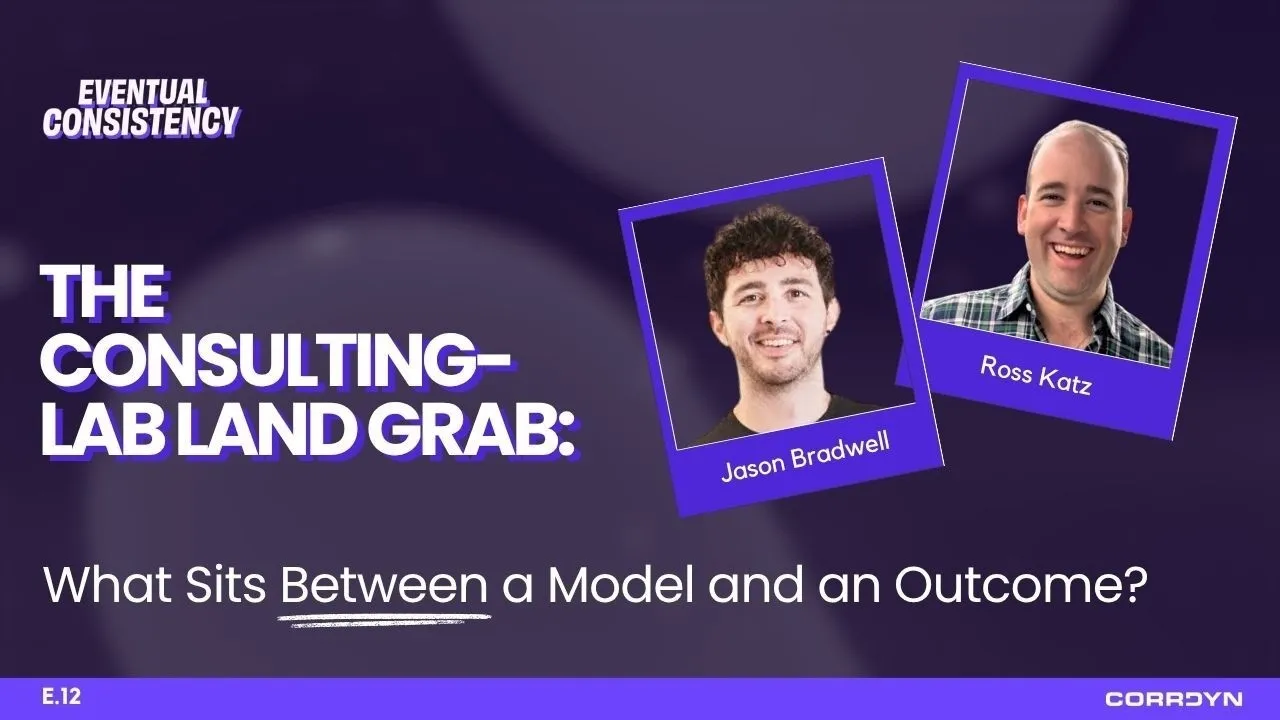
Every major AI lab has spent the last ten months buying its way into the services business. Deloitte has committed to putting Anthropic’s Claude in front of more than 440,000 people. OpenAI and Anthropic each stood up a private-equity-backed deployment company within a week of each other. The headlines read as reach and scale. The more useful question is why models this capable still need an army of consultants and private equity checks to do anything inside a real business.
In this episode of Eventual Consistency, Ross Katz (Principal and Data Science Lead at CorrDyn) and Jason Bradwell (founder of B2B Better, host of Pipe Dream) read these deals from the outside, as practitioners who put models into enterprise data estates rather than as a lab or one of the Big Four. Ross reads the partnership wave as an admission rather than a show of strength. The model is not the product. Getting from a signed contract to a working system means clearing six layers that sit above the model, and the one nobody wants to fund is organizational change.
The conversation gets into why labs, consultancies, and private equity are all rushing the same space at once, and what each side extracts from partners it expects to compete with later; why the value in AI collects at the two ends of a smile curve and thins out in the middle; why this looks more like a 1970s mainframe rollout than the self-serve SaaS era; and how a data leader can tell a real engineering partner from a model license with a slide deck on top.
Key Takeaways
The partnership wave is an admission about what models cannot do
Every major AI lab has spent the last year attaching itself to a services business. Read that as an admission. Deloitte has committed to putting Anthropic’s Claude in front of more than 440,000 people, while OpenAI and Anthropic each backed a deployment company with private equity. If capable models could integrate themselves, none of this would be necessary.
Labs, consultancies, and PE firms each want something different from the deal
These partners should not fit together. The labs want model penetration, buyer relationships, and feedback data, plus the IPO-grade revenue quality that consumer subscriptions cannot provide. The consultancies want brand association and early model access, and the labs subsidize their retraining; Accenture’s AI-project revenue already runs into the billions and keeps growing, and it wants to defend that. The private equity firms want capabilities for their portfolio companies and a read on which businesses to buy and transform next.
Six layers sit between a model and a useful output, and the model is only one
Ross names six layers of work that sit above the model itself: the data substrate, the context and semantic layer, governance and identity, evaluation and observability, orchestration, and process and change. The model is foundational. The real work is above it. Process and change gets discussed least and matters most, because you cannot lay AI over existing workflows and press go; the processes have to change first, and that is organizational, not technical.
AI value collects at the two ends of the smile curve, not the middle
Ross maps value capture as a smile curve. At one end sit compute and the models, where Nvidia, the hyperscalers, the neoclouds, and the labs collect; at the other sit the outcomes, the services, and the customer relationship, where implementation happens. The middle, the generic integration and storage and semantic plumbing, captures the least. The platforms that span model, compute, and outcome are positioned best, which puts Databricks and, to a degree, Snowflake in the frame, alongside labs coupling their models to real work through Claude Cowork and Claude Code.
AI deployment looks more like a multi-year ERP rollout than a SaaS purchase
Ben Thompson has argued on Stratechery that this is a return to the 1970s mainframe integrator era, and Ross agrees. The self-serve SaaS era is the wrong template. SaaS was built to be bought piecemeal, one tool per function, while AI transformation is closer to a multi-year ERP rebuild that needs unconditional buy-in from the top. Those projects fail often, usually on human aversion to change, and Ross reads the real timeline as decades, not the three-year capital project the labs and their clients are budgeting for.
A good partner earns its fee three ways: acceleration, enablement, or prevention
When every systems integrator is chasing the agentic-AI mandate, Ross offers a filter. A consultant earns its fee three ways: acceleration (reaching an outcome sooner that you would have reached anyway), enablement (reaching one you could not have reached alone), and prevention (stopping a failure before it burns millions and returns nothing). Ask which one you are buying and how credible the case is. A partner who cannot answer has answered.
Related: AI Strategy | Digital Transformation | Episode 24: Similar Keynote, Different Platforms: Snowflake vs. Databricks
Full Transcript
Jason: Welcome to Eventual Consistency, the show that cuts through the data industry’s noise to work out what is really changing and not what is just being hyped. I’m Jason Bradwell. In the space of about 10 months, every major AI lab has done the same thing. They’ve gone and bought itself a consulting firm. Deloitte has committed to putting Anthropic’s Claude in front of more than 440,000 people. OpenAI and Anthropic have each stood up what are effectively private equity-backed deployment companies within a week of each other, and every headline is about reach and scale. There is a more interesting question, though, sitting underneath all the press releases. If these models are as capable as everyone says, why does it take an army of consultants and private equity checks to get one working inside a real business? What actually sits between a model and a useful output? And who captures the value once that model becomes a commodity? To get into it, I’m joined by Ross Katz, principal and data science lead at CorrDyn. Ross spends his days on the path these announcements skip over, which is getting real enterprise data estates into a shape where AI can actually do something with them. So, he reads these deals from the outside as a practitioner, not as a lab or as a consultancy. Here is our conversation.
Jason Bradwell: So, Ross, welcome again to Eventual Consistency. You’ve watched this whole run of announcements land over the last few months, and as you’re reading them as someone who actually puts models into enterprise data estates, not as a lab or one of the Big Four, what is that gap that you see between the press releases and what they say and what you know deployment actually takes? So Ross, you’ve obviously watched this whole run of announcements land over the last few months, so reading them as someone who actually puts the models into enterprise datasets, not as a lab, but as a consultancy, what’s the gap between what these press releases say and what you know deployment actually takes?
Ross Katz: Yeah, well, I would just say that the biggest thing that the announcements say is that you need additional expertise and human labor in order to get the value from AI inside of your organization. The question is, what is it that these different organizations — the labs, OpenAI, Anthropic, to a certain extent GCP, and these Big Four consultancies and strategic integrators and private equity firms — what are they trying to get out of these partnerships? And what does that say both about how successful deployment is achieved and about how they’re positioning themselves for where value will accrue in the future? The main criticism you would give of the labs is, well, if the AI is so good, shouldn’t it just integrate itself? Why should you need a consultant to come alongside and get the value from these models? But I think anybody who’s spent any time with AI or with digital transformation over the long haul understands that, yes, technology can move really quickly, but organizational change takes a lot of effort and a lot of intention and it needs to be grounded in the specific context of the organization in which it’s being embedded. So why would these labs partner with consultancies? The first thing is the labs are trying to do many things across many fronts. They’re trying to grow model penetration, they’re trying to build buyer relationships, they’re trying to ensure successful adoption, they’re trying to gather more data and get feedback on their models so that they can improve the models, they’re trying to learn the value that these models can drive in organizations and what the repeatable integration patterns look like in order to drive that value, and then, yes, over the medium to long term, they’re trying to teach the models to integrate themselves. But in the short to medium term, what they really need is to demonstrate revenue quality for the IPOs that they’re about to undergo and to capture the market ahead of their competitors. One could argue, well, why don’t they just hire a bunch of people internally and deploy a metric ton of forward-deployed engineers into different companies? Well, one thing is that services businesses are low margin, and so it’s not going to look good on their balance sheet. And the other thing is that these companies don’t know how to do consulting engagements, nor have they built the relationships over time to do it, and so there’s a lot of risk and the potential for blame that would come with taking ownership of those implementation projects. So, what they get to do is get the benefit of the buyer relationships and the experience of the consultancies, and while continuing to capture that market, ensure their revenue quality, deepen the penetration of their models, and lay the foundation for them to learn what they need to learn in order to be automatically integrated in the future. So, why would the consultancies do it? Well, if you look at the publicly available results from the major consultancies that we have available, for example, Accenture, what you see is that quarter over quarter, year over year, the amount of revenue that they’re getting from AI projects is large and growing, in the billions of dollars and growing. So they get the benefit of partnering with the AI labs, which gives them the brand association, which also gives them the tacit approval of these labs to go and do the best practices integrations. And while they’re doing that, as a result of these partnerships, they get exposure to the integration methods that the labs would recommend, they get early access to the capabilities of the models that are being released, and they also get some degree of subsidized talent transformation. There’s a lot of learning and instruction for their people that’s coming from the labs themselves. And over time, what that does for them is gives them this privileged integration knowledge that allows them to differentiate themselves from other consultancies, and because they have this privileged integration knowledge, they can defer the battle with the labs over who gets the value from implementation and integration until later, but at least ensure that they’re not at an information disadvantage when the time comes that the labs inevitably try to automatically integrate themselves. And then, if you look at the private equity firms, it’s actually pretty simple. They just want to get access to the capabilities for their portfolio businesses but also get a foothold in this new investment class, which is AI-transformed businesses, and they’re also trying to gain intelligence about how the markets are evolving as a result of AI. That experience of being on the ground with a bunch of portfolio companies doing AI-driven digital transformation allows them to thereby come up with better theses for what kinds of companies would be the right kinds of companies to invest in and then transform with AI later. It also gives them, similar to the consultancies, this legitimacy with investors that they can use to then capture more investment dollars, which for them leads to better revenue because they take fees off of the funds that are invested. So, when you look at the entire ecosystem, what you see is these players that on paper should not be partnering together, that are partnering together because they all understand that AI deployment requires people on the ground, it requires contextual business knowledge, and it requires integration with the specific businesses that they’re implementing with in the specific ways that drive value for each of those businesses. And they’re also all sharing the risk and also sharing the information about how these implementations go, so that even though over the long term they might not always be natural partners, they’re able to gain the information they need to position themselves effectively for where AI is going over the five-year time horizon which, no matter what anybody says, nobody knows where the technology is going over that time horizon. So, to answer your question about what does it say about how AI is deployed, I think what it says is that it requires context, it requires nuance, it requires specific business understanding, and it requires the technical expertise both from the perspective of the technology itself, but also from the perspective of the domain knowledge that’s needed to really drive value from it. Because you can’t just layer AI on top of existing processes — there has to be process change that is there as the foundation for the increase in efficiency, the improved capture of value that you’re expecting AI to deliver.
Jason Bradwell: What I’m hearing is that every lab needs the channel, every consultancy needs model access, and so when you think about this, do you see it as a strategic partnership, rising tide lifts all ships, or is it increasingly just two sides who are going to find it hard to reach the buyer without each other? ’Cause I think there is a difference between those two points.
Ross Katz: Yeah, I don’t know that either side would find it hard to reach the buyer without each other, but certainly when you talk about the number of businesses that this technology touches and the scope of work that’s needed, you look at an organization like Accenture with hundreds of thousands of people purely devoted to technology implementation in different businesses across the economy, and that’s only one player in this very large space. No one organization is going to be able to develop the relationships, hold the business context, and do the implementation with all of the different buyers in the space and all of the different levels of the space. ’Cause the other thing is that even small and medium-sized businesses have the potential to gain from adoption of this technology if it’s implemented correctly, but even at that level it requires expertise from someone like us. So what I would say is it’s not that they don’t have the capability to do it, it’s just that the time horizon is so important that mutually accelerating each other toward sharing buyers, sharing implementations, sharing the market capture that they’re trying to do just makes strategic sense. Because there are a lot of players in the space who see the opportunity, and so the more shared boots you can have on the ground doing the selling and doing the implementation, just the bigger the economic opportunity is for all of the parties involved.
Jason Bradwell: So you’ve got these labs that can train trillion parameter models, but they apparently can’t get into production at a bank, let’s say, on their own. So, from your viewpoint, what’s the work that has to happen between the customer signing the deal and then AI ultimately doing something useful within that business?
Ross Katz: Yeah, so I would think about the distance between — where is there value in this AI stack? Obviously the model itself that is trained is really important because none of this value existed prior to the existence of these models. But there are roughly speaking six other layers that I would point to within a given business that are worth thinking about as places that work needs to be done in order for value to be captured. There’s the model, then there’s the data substrate, which is just all of the source of truth systems and how it gets captured and how it is served for people to ask and answer questions. And then there’s the context and the semantic layer that sits on top of that. On our previous episode we were talking about what Snowflake and Databricks were talking about — they were talking primarily about the context and semantic layer because they’re already very firmly embedded in that data substrate. Then you have governance and identity on top of that. Who gets access to what? How do you ensure that the actions that are being taken are allowed to be taken by the different people in the organization and by the agents that are acting on behalf of them? Then there’s evaluation and observability. Once you have agents or models taking action inside of your business, you need a way of understanding what is the performance of those agents and how do you observe what is going on so that it can be improved, how can it be made more efficient, how can it be made more effective? All of that relies on infrastructure that gives you visibility and allows you to evaluate before you go to production with something that doesn’t work. Then there’s the orchestration layer, which is how do you ensure that all of the things that need to run are running in the correct way and observe the correct dependencies between them, and you don’t run into situations where something is running that depended on something else that needed to run but didn’t run successfully. And then the last layer, and the one that gets talked about possibly the least because it’s the most amorphous, is the process and change layer. These are the people whose jobs need to change and whose approach to their jobs need to change, and organizations whose structure needs to change, and ways of evaluating human performance that needs to change. There’s just all of this organizational stuff that needs to get worked out in order for all of the other six pieces to really work. So yes, the model is a foundational piece of technology, but I think what you see is that the work to be done is not just bring the model into the organization and press go — the work to be done is identifying, okay, which processes need to change in order to drive value? What are we trying to accomplish? What data needs to be there? What is the context that needs to be present at runtime? What kinds of permissions and controls need to be in place? How do we evaluate the performance? What is the expected behavior of the system? How do we know when something is not working correctly? And then how do we ensure that it’s working consistently and that all of the dependencies in the system are mapped out? These are things that take real individual thought on a business-by-business and process-by-process layer. Even though these models are very incredible in their capabilities, they cannot do all of this work because there is a lot of tacit knowledge built into each organization that a consultant or an expert inside the organization needs to document and understand and map out in order for any AI to be successful at all. So, to answer your question, the work that needs to happen between someone signing a deal and AI doing something useful is stepping through all of those layers and ensuring that all of the foundations are in place such that when you feed the information into the model and you get an output, it goes to the correct location for the person or process or software system to take the action that is needed to receive the value from the AI integration. But the model can only get you so far, and I think what you see with the increase in consulting utilization with regard to AI is that a lot of companies, and I think the labs themselves, view this as partially a one-time buildout where you need to establish these systems through these huge capital investment strategic projects so that you can then do the work of integrating in various ways over time. I think what we’ll find is that the transformation that needs to occur is not a three-year buildout, it’s a decades-long buildout, but that is the work that needs to be done — mapping out across all of those layers where the value requires organizational change in order to retrieve it.
Jason Bradwell: Anthropic’s own reason for these joint ventures is that every dollar that a company is spending on software, they’re spending six dollars on software, on services. I think that’s what the quote was. And so if they themselves are conceding that the value is in the bodies and the integration of these systems and not necessarily the model, what do you think that kind of tells us about where the money in AI actually ends up?
Ross Katz: Where the money in AI actually ends up is basically a smile curve of the different elements that go into it. On the left-hand side we have the compute and the models themselves, which are going to capture a lot of value from AI. You see this with Nvidia and all of the chip manufacturers and the hyperscalers and the neoclouds — the labs themselves are going to capture a good amount of the value. And then on the other end, the outcomes, the services, the customer relationship, the actual implementation where AI gets applied, that’s going to be another big place where the value is going to get captured. I’m more skeptical about the middle — the generic integrations, the undifferentiated portions, the storage, the nature of the storage and the way that the semantic layer is structured or queried. I think that there’s less value to be captured there. But the platforms that are able to deliver the full end-to-end, including model and compute and outcome, are really well-positioned. I would put Databricks and, to a certain extent, Snowflake in this category, but also the labs who understand how their models work, and as they get more deeply embedded into businesses, they can couple their models more tightly to the way that work gets done. You see this with Claude Co-work, Claude Code — that coupling is a flywheel that they can use to become more and more embedded in the outcomes that get driven within the business. And that is a great way for both Anthropic and OpenAI and Google, if they can reproduce it, to capture value from these models. But as long as you’re in the middle as a framework or an approach to context or semantic layer or storage or search, I don’t see the value from AI accruing there. Obviously I can be wrong about this, but that’s the way things look to me right now.
Jason Bradwell: you’ve got Bain, you’ve got Capgemini, and McKinsey, they’re all buying equity in the very vehicles that are built to automate the implementation work that ultimately pays their bills. And so are you viewing that as a hedge and a smart one, or do you think that they’re funding their own ultimate disruption?
Ross Katz: It’s a little bit of a hedge, but realistically, if they get disrupted out of business, the hedge isn’t going to pay enough back for it to be meaningful to them. I think I view it as the way that these deals are structured — basically as credit arrangements. Their upside is capped and their downside is also capped. They’re investing some money, they’re investing some resources. What are they getting in return? To me, what they’re getting in return is what we talked about earlier. They’re getting the brand association with the labs, they’re getting exposure to the integration methods, some subsidies for transforming their talent pool so they have a talent pool that’s more ready to do these kinds of integrations, and then they’re getting these big AI projects from companies that want to invest a lot with the labs. In the ideal for the labs, you would have this partnership in phase one, but over time, there’s this drifting apart that happens where eventually the labs are able to selectively disintermediate the consultancies by automating the integration with companies of various sizes and scale. I think if you’re in the position of consultancies and your industry is being disrupted substantially and you’re trying to think through, well, how do we position ourselves effectively for the different ways that this AI evolution might go? You’re thinking to yourself, well, getting in front of more customers and doing more projects in the short term while gaining these AI skills is a great short-term decision, and it also gives us the information that we need to try to figure out what our business looks like in a world where maybe we can automate much more of our own work and start moving toward more outcome-based pricing. Now, to me, that’s pie in the sky. That outcome-based pricing is probably not going to pan out as well as they hope that it does, but I do think that’s what they’re thinking to themselves, and that’s their angle for how this next phase evolves.
Jason Bradwell: So Ben Thompson, author of Stratechery, the famous newsletter, framed all of this as like a return to the 1970s mainframe integrator era rather than the self-serve SaaS era that we’ve been living in over the last 10, 15 years. And so from where you sit, does that analogy hold? And if it does, what is the modern equivalent of a multi-year SAP rollout and who’s doing those kind of projects?
Ross Katz: Yeah, I love the Stratechery newsletter and I love Ben Thompson — I really enjoy his stuff. I do agree that this is more akin to the mainframe rollout and an SAP integration than it is software as a service. Because software as a service was explicitly designed to be piecemeal — you select one component for each portion of your business. And I think a lot of businesses are going to need to undergo these multiple-year transformations similar to an ERP implementation in order to realize the full value of AI inside their business, especially if the full value that they’re hoping for is substantial automation of things that used to be done by humans previously, which I think is what a lot of companies envision on the horizon for themselves. I think that is the right analogy. Who is going to do the implementation? I think it’s similar to the IBMs of the 1980s. You’re going to get organizations that are oriented around how do we alter the structure of your business in order to make it optimally situated to take advantage of what AI has to offer. Now, the problem with those engagements is that it requires absolute unconditional buy-in from the top, and there are a lot of failed stories of these massive transformations that go on. And I think that you can’t underestimate the human aversion to change that happens across human existence, but especially in large organizations where things are used to changing relatively slowly. So I think these consultancies position themselves rightly as, well, we are well-positioned to do these implementations for you. And I think that a lot of companies are trying to do the homegrown solution of creating an internal team that has the requisite expertise to do the work internally, but I think one of the reasons why all of the hyperscalers and the labs and the consultancies themselves are experimenting with all of these different organizational structures is because we are ultimately in an experimental phase with AI, and the capabilities are evolving rapidly in a way that is hard to understand. And the practices that took decades to evolve for software engineering are just now being hammered out for the use and utilization of AI. And so I think the question of how it gets implemented is ultimately an open question, and that’s why you see these creative approaches and solutions, because nobody really has the answer. And that includes me.
Jason Bradwell: For the VP of data who’s listening to this episode who’s been given this top-down mandate to “quote” do something with agentic AI by the end of the year and they’ve got every systems integrator in the market wanting to take the work from them, what do you think the sequence is there? How do you tell the partner doing real engineering from the one who’s ultimately just reselling a model license with a fancy-looking deck on top of it?
Ross Katz: Yeah, I think ultimately it’s — can the consultant speak intelligently to both the technical challenges that you face, and can they provide analogies from their cross-domain experience that help to elucidate the domain in which you operate in a way that helps you understand what the roadmap looks like, and also helps you understand what the consultancy brings to the table that you can’t bring yourself? Ultimately there are a limited number of ways that a consultant can drive value for your business. There’s acceleration, which is the situation where you would have reached the outcome anyway but later, and the value that you can get is the business value of the time that you saved by someone like me getting you there faster. There’s enablement, which is you never would have reached that value if you didn’t have someone with the expertise that an organization like ours is able to bring, and the value is the outcome that you’re able to achieve that you wouldn’t have been able to achieve otherwise. And then there’s prevention, which is basically you would have ended in a bad place — this AI transformation initiative would have spent millions of dollars and led to nowhere. As a result of having external experts brought in, you’re able to avoid that loss and capture the value that you were setting out to capture. So, as you are listening to consultants pitching what they’re bringing to you, you want to understand where exactly is this value going to come from and how credible is the case that the consultant is making that they’re going to be able to deliver that particular type of value to my organization?
Jason Bradwell: All right, Ross, what have we been watching this week?
Ross Katz: Yeah, so I think this conversation that we’re having about the AI labs is just highlighting for me where their incentives lie as they move toward IPO. All of the news over the last four to six weeks or so has been about OpenAI and Anthropic preparing themselves for IPOs, submitting their S-1s. And I think what you see is that as they prepare to open their books to the public, they have to think about what the analogous companies are that investors are used to evaluating and valuing, and how their businesses compare to the businesses that are already in existence today. And so ultimately they’re moving from startup mode to enterprise mode faster than any business has ever been asked to do it. On the OpenAI side, that’s moving from consumer subscriptions, which are a relatively low lock-in revenue source, to things that are more like enterprise agreements where the enterprise is paying three, four years in advance for the capacity that you’re going to deliver to them. And Anthropic is the same way, but is also tinkering with to what extent they want to use API tokens or usage-based pricing that roughly ties their revenue to their cost basis but is also more volatile — it’s more flexible versus the locked-in revenue that you get with your enterprise-level agreements, with your services and outcomes contracts. And so I think the volatility that I see in the way that these things are priced, and how that relates to the value that you get from them, is really interesting and also provides you a little window into how pricing might evolve. And I think roughly speaking, these companies start to look a lot like the hyperscalers that they’re already competing with, where at low levels you’ve got your on-demand pricing, but then if you want to receive discounts, you need to pay in advance for years of utilization. So that’s my guess of where things go, but obviously I’m watching to see how right I am or how wrong I am as that evolves.
Jason: Thanks again to Ross for joining me on Eventual Consistency today. Ross’s read is that these announcements are an admission, they’re not a boast, right? The labs partnering with the consultancies and the private equity firms is the industry conceding out loud that the model on its own does not create the value. So getting from a signed deal to something useful means working through six layers that sit above the model: the data substrate, the context, the semantic layer, governance and identity, evaluation and observability, orchestration, and the one that nobody wants to talk about, which is process and change. You cannot lay AI over how a business works and just press go. The processes have to change first, and that is people and organizations, not tokens. Which is why, as Ross puts it, this looks less like a three-year buildout and more like a decades-long one, closer to an ERP rollout than anything self-serve. On where the money goes, his answer was a smile curve. Value collects at one end with the compute and the models and at the other end with the outcome and the implementation. The middle, which is the generic integration and storage and the semantic plumbing, captures less. The players worth watching are the ones who can span this whole thing, and the labs coupling their models ever more tightly to how the work gets done through things like Claude Code, they become the flywheel rather than just the component. So if you’re the data leader who’s been told to do something with agentic AI by year end, Ross leaves you with a filter. A good partner earns their fee in one of three ways: acceleration, getting you to the outcome sooner; enablement, getting you somewhere you could not have reached alone; or prevention, so stopping an expensive failure before it happens. Ask which one that you’re buying and how credible the case is. If they can’t answer that clearly, you have your answer. If you want to talk about your own data challenges or you think we got something wrong, we are at corrdyn.com, that’s c-o-r-r-d-y-n dot com. Ross, thank you as always, and we’ll see you next time on Eventual Consistency.