Parking Revenue Optimization for a Major Entertainment Venue
CorrDyn built demand prediction and dynamic pricing models for a multi-venue entertainment complex, optimizing parking revenue across nine lots.
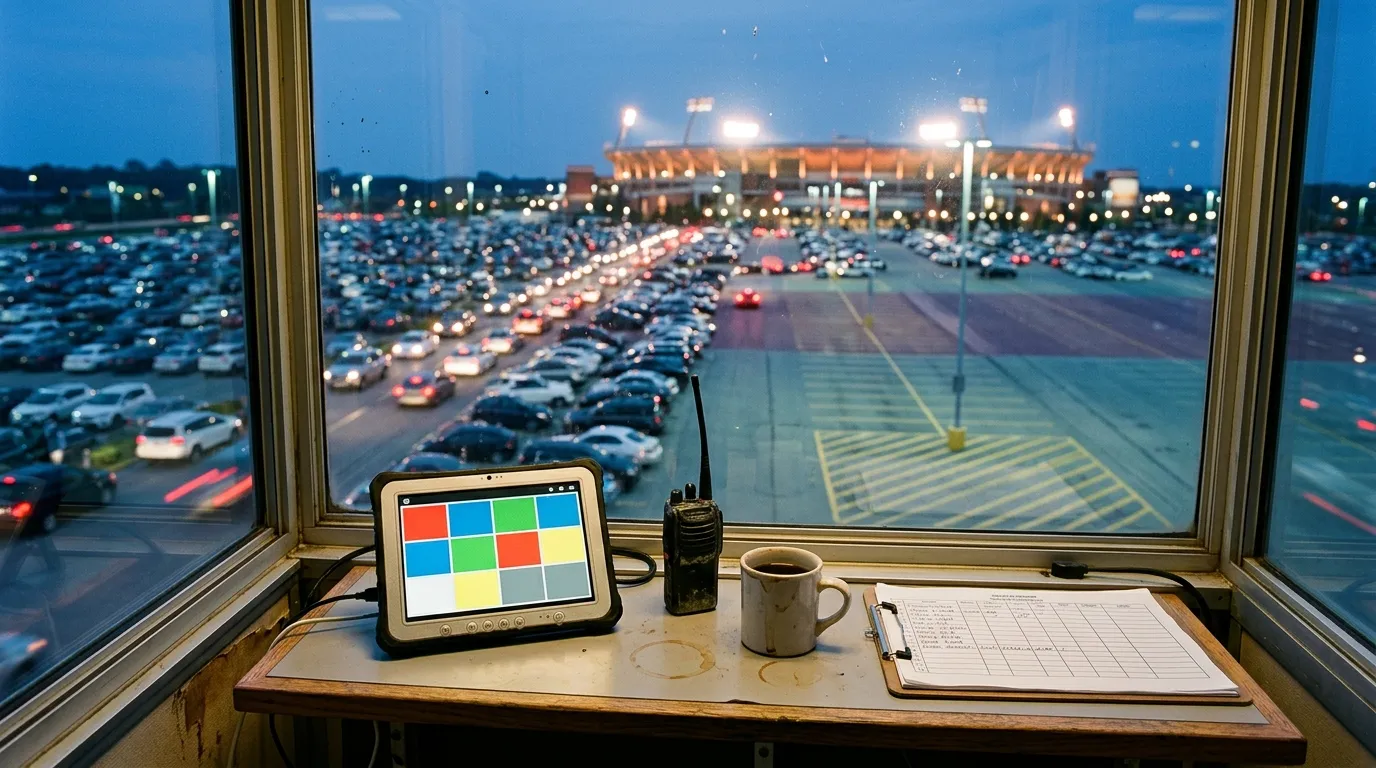
9, with per-lot demand prediction and pricing
Parking lots modeled
Automated price recommendations per lot per event
Revenue optimization
Within 1% of actual demand
Best lot prediction accuracy
The situation
A multi-venue entertainment complex hosts concerts, sporting events, trade shows, and conventions across three distinct venues. The complex operates nine color-coded parking lots, each serving different areas and price points. Parking pricing had been set manually based on general event size and type, without a systematic way to predict demand per lot or to optimize prices against that demand.
The challenge was structural. Demand for any given lot depends on which venue is hosting, the type of event, expected attendance, day of week, time of day, and the prices of neighboring lots. Those variables interact: raising the price of one lot shifts demand to adjacent lots. Manual pricing could not account for those cross-lot dynamics, and the venue had no historical analysis connecting pricing decisions to revenue outcomes.
What we built
CorrDyn started with a data engineering effort to consolidate the venue’s event and parking data. Ticketing platform exports, parking system records, and internal event scheduling data were brought into a unified pipeline using dlt for ingestion and dbt for transformation in Databricks. The result was a clean, event-level dataset linking attendance, ticket sales, parking transactions, and pricing history across all nine lots and 136 historical events.
On that foundation, we built a demand prediction model for each lot using Random Forests. The algorithm was selected for its ability to handle non-linear feature interactions with a small training set while resisting overfitting. The model takes event characteristics and lot prices as inputs and predicts how many spots each lot will sell.
The pricing optimization layer sits on top of demand prediction. It varies prices within operator-defined bounds, predicts the resulting demand per lot, calculates total revenue, and iterates to find the combination that maximizes revenue across all lots simultaneously. The output is a recommended price per lot per event, delivered as a CSV that operators can review and adjust before applying.
We also built a timing analysis showing when parking purchases spike relative to event start times. The data consistently showed that the 2 to 4 hour window before an event’s start is when most purchasing happens, giving operators a concrete window for when price changes have the most impact.
What changed
Venue operators now receive data-backed price recommendations for every event instead of relying on rules of thumb. The feature importance analysis revealed which variables actually drive demand in each lot, replacing assumptions with evidence. The timing analysis gave the operations team a specific window for price adjustments rather than guessing when to act.
The model continues to learn. Each new event adds training data, and the demand predictions sharpen as the dataset grows. CorrDyn also built Ticketmaster reporting overlays and a parking data pipeline that feed the venue’s broader analytics efforts beyond pricing alone.
Frequently Asked
Questions
We set parking prices by gut feel before every event — can data actually do this better?
How does dynamic pricing optimization work across multiple parking lots?
Why hire a data consultancy for pricing optimization instead of buying off-the-shelf software?
Related Work
Similar engagements across our portfolio.
ML Customer Segmentation for an Automotive Dealer Group
CorrDyn built an ML clustering pipeline on Databricks with LLM-powered profiling to segment customers across vehicle brands for a dealer group.
Manufacturing Throughput Optimization for a Biotech Producer
CorrDyn built process time analytics and a batch production simulation for a biotech manufacturer, enabling data-driven throughput optimization.
IoT Analytics for a Biotech Manufacturing Operation
CorrDyn built machine monitoring pipelines, ML failure detection, and real-time Grafana dashboards for a global biotech DNA/RNA synthesis manufacturer.
Related Conversations
Podcast episodes that cover the same ground.
Unlocking the Power of Semantic BI with Hashboard
with Carlos Aguilar, Hashboard
Carlos Aguilar explains how Hashboard eliminates multiple sources of truth in analytics through semantic BI, version control, and governance.
Physics, Free Energy, and Computational Drug Discovery
with Robert Abel, Schrödinger
Robert Abel of Schrödinger on why ML alone fails in 10^60 chemical space and how physics-based simulation reaches near-experimental accuracy.
Applying ML/AI to Drug Development with Anil Kane
with Dr. Anil Kane, Thermo Fisher Scientific
Dr. Anil Kane of Thermo Fisher Scientific discusses how AI, machine learning, and digital tools are reshaping drug development and manufacturing efficiency.