Listen on
Overview
Drug development faces relentless pressure: shrinking timelines, escalating costs, and the critical need to deliver effective treatments faster. The traditional “trial and error” approach, while historically necessary, often results in costly rework and delays, hindering innovation and market entry. This episode highlights how advanced digital tools and machine learning offer a direct path to mitigate these challenges, transforming pharmaceutical R&D from a reactive process into a data-driven, predictive science.
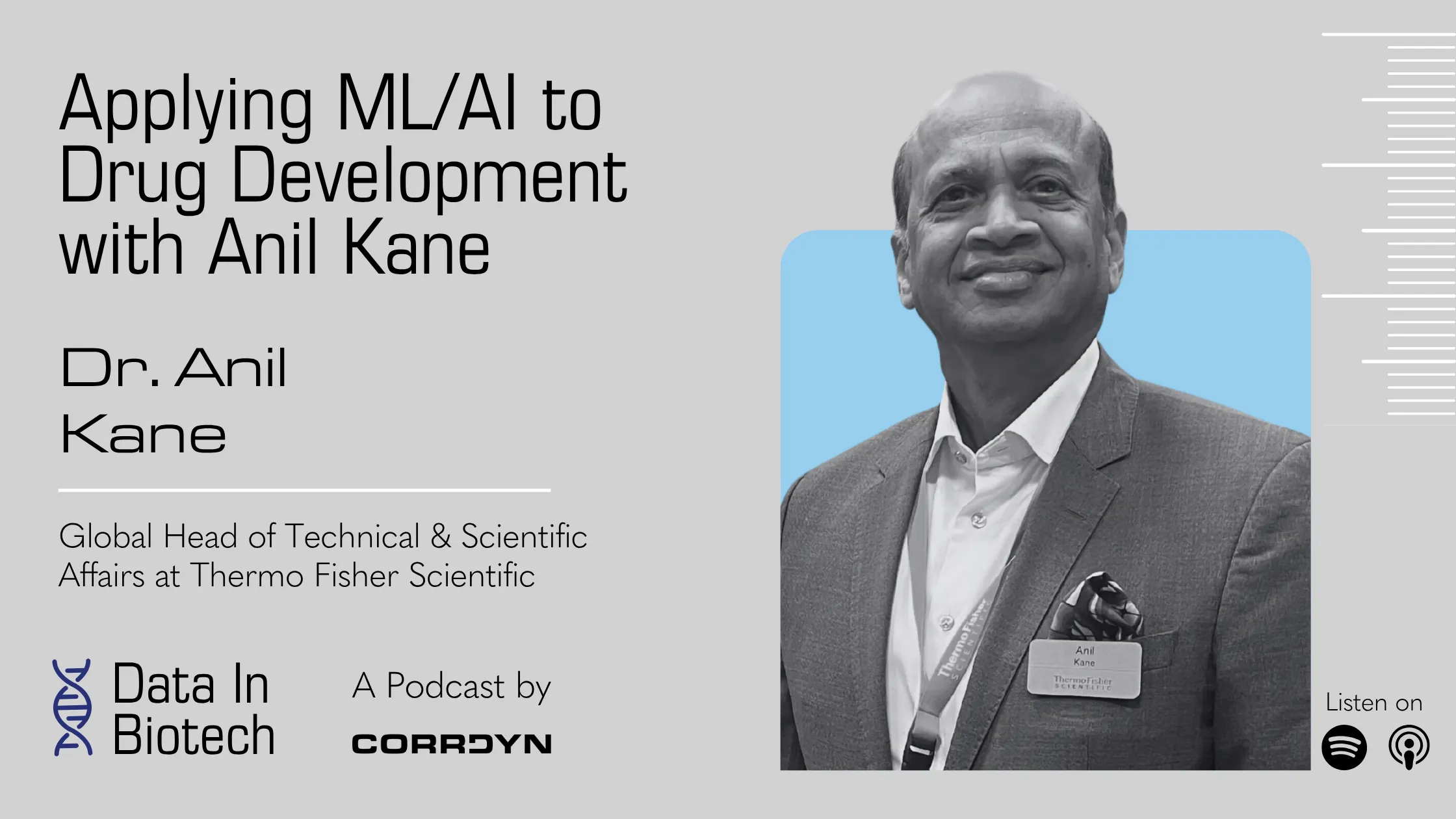
Host Ross Katz speaks with Dr. Anil Kane, Executive Director and Global Head of Technical & Scientific Affairs at Thermo Fisher Scientific, who shares his decade-plus experience implementing AI/ML in drug development. He provides concrete examples of how Thermo Fisher, a global contract development and manufacturing organization (CDMO), deploys predictive modeling to accelerate formulation design and stability testing, and integrates digital tools to enhance manufacturing efficiency and supply chain visibility.
This conversation details how these strategies translate directly into reduced development cycles, lower operational expenses, and a higher probability of successful drug progression—critical metrics for any CEO, CDO, or VP of Engineering seeking tangible ROI from data initiatives in biotech.
Key Takeaways
Predictive formulation design drastically cuts costly development rework.
Traditional drug development’s trial-and-error approach generates significant rework, consuming budgets and extending timelines. Tools like Thermo Fisher’s Quadrant 2 use molecular properties and historical success data to predict optimal formulation technologies. This prioritizes promising paths, eliminating unproductive experiments and accelerating molecules to clinical phases with higher confidence.
Accelerated stability programs shorten time-to-market and inform early decisions.
The 12-month standard for drug stability testing creates bottlenecks in clinical development. Programs like ASAP Prime simulate long-term stability in just 21 days by subjecting compounds to accelerated temperature and humidity conditions. This rapid data enables faster selection of optimal formulations and packaging, reduces time to first-in-human trials, and is increasingly accepted by regulatory bodies for early-phase decisions.
Digital SME and automated inspection drive significant manufacturing cost savings.
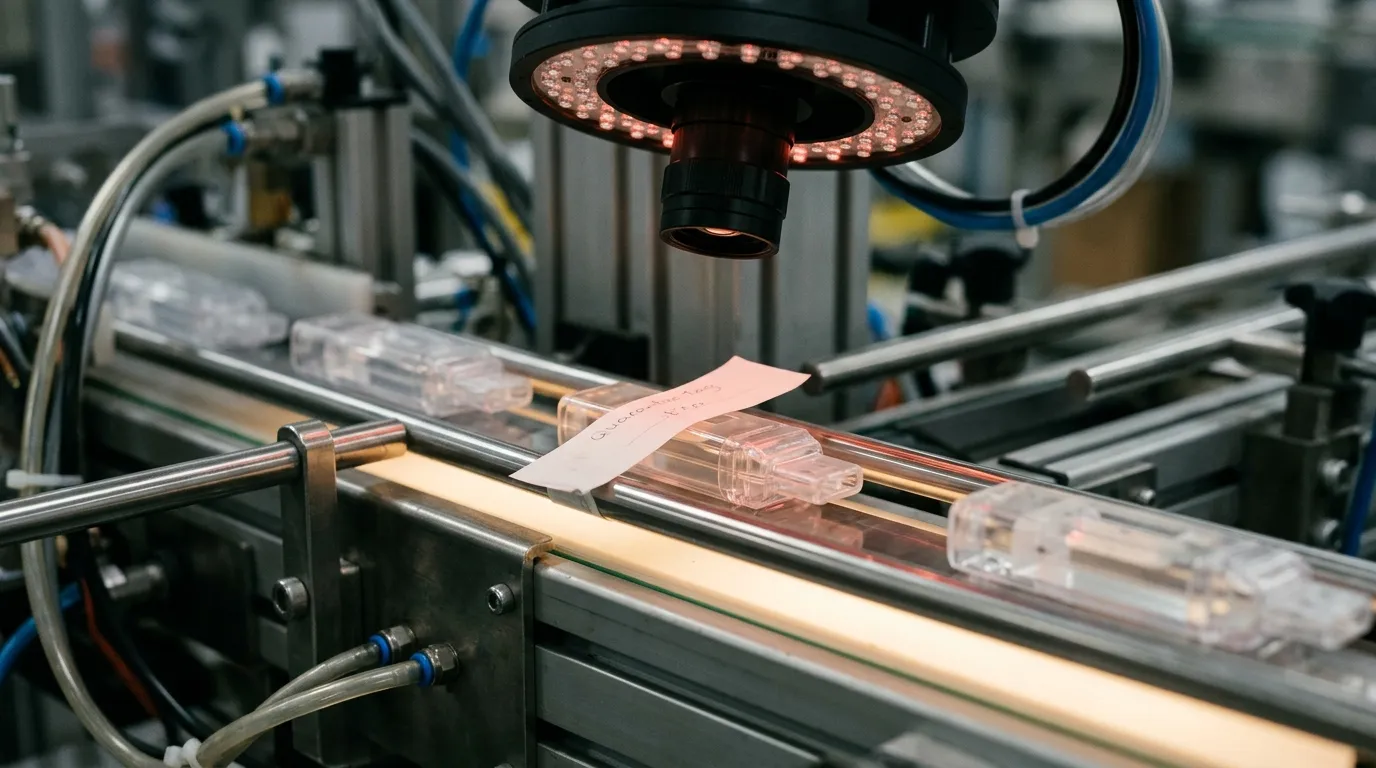
Operational inefficiencies in drug manufacturing—from equipment downtime to manual inspection errors—directly impact cost and output. Thermo Fisher’s “digital SME” approach uses sensors for predictive maintenance and streamlines planning. Automated Visual Inspection (AVI) tools, demonstrated by an 85% reduction in false rejection rates at one facility, replace error-prone manual checks, improving throughput and product quality.
Machine learning models gain accuracy with more data and complement human expertise.
The power of machine learning in drug development grows with each new data point. Initial models, trained on hundreds of molecules, become increasingly reliable as they process real-world success and failure data from new chemical entities. This iterative improvement, combined with the irreplaceable judgment of human scientists, forms an effective approach that accelerates discovery without sacrificing critical oversight.
Related: CorrDyn helps clients in biotech and life sciences apply machine learning and sophisticated data engineering to improve operations. Learn how we drive operations analytics for better decision-making.
Full Transcript
Dr. Anil Kane: Traditionally, there has been the empirical ways of drug development, which, in other words, we often call it as a trial and error. Just as a human brain, the more you train a brain, the more you train the algorithm, the more robust the tool gets. Even though the AI ML tools are here to speed and help bring speed of decision making, the human intelligence, along with the machine intelligence, is here to stay. Leveraging both is going to be equally important.
Jason: Welcome to Data in Biotech, a podcast from CorrDyn where we explore how companies leverage data to drive innovation in life sciences. Every two weeks, we sit down with an expert from the world of biotechnology to understand how they’re using data science to solve technical challenges, streamline operations, and further innovation in their business. Here we go.
Ross Katz: Anil Kane, welcome to the Data in Biotech podcast.
Dr. Anil Kane: Thank you very much. It’s a pleasure to be here.
Ross Katz: Awesome. Well, just to kick us off, would you mind giving us an introduction to your background and what brought you here today?
Dr. Anil Kane: Sure. My name is Anil Kane, global head of technical and scientific affairs in the pharma science group of Thermo Fisher Scientific. This AAPS meeting is an excellent forum which we participate in almost every year, with the exception of the pandemic, of course. This is an exciting time where digital tools have really gained importance also because of fast computing and the techniques, technology that we have. We see a lot more applications that can be leveraged. Artificial intelligence is a new buzzword, but it’s a platform where machine learning and algorithms-based predictive modeling has been leveraged in the years gone by. We at Thermo Fisher have had the opportunity to leverage and already utilize and reap benefits for ourselves and our clients in the last around 10 years already. The newer digital tools with faster computing, etc., gives us even faster outputs that can be leveraged through these digital tools. We see more and more applications of these machine learning, algorithm-based tools and models that we can use as predictive modeling in a variety of different areas. This is what Thermo Fisher would like to learn, build, share, and leverage these benefits to our partners.
Ross Katz: That makes a lot of sense. We’re going to have a chance to dive into the specific use cases of how you’re using machine learning and AI throughout the podcast, but just starting with the way that things look traditionally. Prior to the integration of these digital tools, what inefficiencies or what were the aspects of drug development that needed to be digitized in order to reap value from the application of the digital tools?
Dr. Anil Kane: Prior to the digital tools, traditionally, there has been the empirical ways of drug development, which, in other words, we often call it as a trial and error. Based on the scientific data, based on the judgment, the scientist in the pharmaceutical industries in the decades gone by would try one technology or the other, of course, prioritizing one over the other, and try out to find solutions to solve the technical challenges and see if the outcomes are favorable to move to the next stage of a development program. This empirical approach often led to rework if it did not show a promising outcome. What we want to solve by using these digital tools and predictive modeling is how can we just eliminate that rework? In today’s time, there is a tremendous cost and time pressure in drug development for the entire industry. I don’t think there is ever a possibility of going back to the drawing board. All the investment has to show as much promising results as we can. Hence, the application of these predictive modeling tools really eliminates the need for rework or going back to the driving board and only focus on techniques, technologies, and outcomes that are favorable to take the drug to the next phase of the milestone, speedier and in a cost-effective way.
Ross Katz: I’m interested in examples from you. Where are companies experiencing most strongly the cost of being wrong or having to do this trial and error in this rework as you described it, that’s really extending the timelines and also increasing the costs of drug development?
Dr. Anil Kane: There are several ways and areas that have shown to reduce the cost and time in the drug development journey. The one area that we at Thermo Fisher, being a global contract development and manufacturing organization, feel strongly about is a one-stop shop, where we at Thermo Fisher provide end-to-end services as a single vendor or a partner, to support everything from drug substance development coming out of the drug discovery, taking it through clinical phases, first-in-human trials, and doing everything that is required to bring the molecule to an approval and bring it to patients, which includes the drug substance manufacturing, GMP manufacturing, drug product manufacturing, clinical trials, distribution, and also clinical trials per se. The benefits of a single vendor providing these end-to-end services has been shown by a study conducted by Tufts Center to reduce the overall time of development and also cost of development for the pharmaceutical sponsors. That certainly is one area that we would want our pharma partners to leverage and bring advantages to the table.
Ross Katz: The first one that you mentioned in your presentation is AI/ML for formulation design. You highlight Quadrant 2, which is this platform for formulation. Can you just introduce the audience to what Quadrant 2 does and maybe a little bit about how it works?
Dr. Anil Kane: Absolutely. We recently launched a platform called OSD Predict, which essentially is for oral solid dose drug delivery. The “predict,” of course, relates to predictive modeling. Under the platform of OSD Predict, Quadrant 2 is one of the predictive modeling tools, which helps identify the most promising technology to solve poor solubility, poor bioavailability challenges of small molecules that come out of drug discovery. We are finding more and more small molecules coming from discovery to clinical candidates are poorly soluble. They don’t get absorbed. We would certainly encourage our industry partners to adopt this predictive modeling tool under Quadrant 2 to select the right technique, technology that shows promise. With that predictive modeling, we would then predict whether it’s amorphous solid dispersion by way of spray drying or hot-melt extrusion or lipidic delivery, targeted delivery. What should be the drug loading in an amorphous solid dispersion that will be more patient-friendly? What are the techniques that will show promise? Using this predictive modeling tool, one without any need of very expensive drug substance, just based on some molecular properties, it could be as simple as chemical structure, Log P, pKa, melting point, and any other molecular properties that are available, this can be fed into then an in-house built algorithm that has been generated from known compounds that will help as an outcome predict which technology will show promise.
Ross Katz: Just imagining the setup of the model. You’ve got all of these molecular properties that are going into it, and then you know in the end which formulation strategy was selected for each of the compounds. As I understand it, there’s this ranking that comes out that classifies these are the formulation approaches that are most likely to work for your compound, these are the ones that might work but require further research, and then these are the ones that are likely not to work. First of all, am I understanding that correctly?
Dr. Anil Kane: That is absolutely correct. We would rank order them. We would prioritize to say that a technology X, for example, spray drying or hot-melt extrusion, which is an amorphous solid dispersion format, has a higher probability of success. There could be others which could be maybe we should try this, and some others are not likely. Certainly we would want to give choice, also because drug development is a tricky area where doses are not defined. For a certain indication, one would start with a smaller dose and there are ascending dose studies and single ascending, multiple ascending dose studies which will then define what are the doses that are likely to show therapeutic efficacy. The success of a technology is also based on how much of the dose is going to show effectiveness for a certain indication. There is only so much we can pack in a pill or a capsule or a tablet. There are always variables that will show a higher probability of success with certain technologies and maybe for others. This will guide us into focusing on those technologies to make most effective use of the time and money that is invested in drug development.
Ross Katz: I’m imagining that some of your customers might come to you with ranges of doses that are expected to be there. Is the idea then that you run the predictive model at different parameters to understand the space? I’m just interested in how you think about the uncertainty both in terms of the modeling side, the model has some uncertainty about it, but then also the parameters that you’re getting from your customers also have some uncertainty around them and how those come together in a model like this.
Dr. Anil Kane: Yes, absolutely. The estimated dose, which is predicted by the clinicians of a pharma partner, are essential to understand. Based on the mechanism of action, and with good discussion with the clinicians, and the animal pharmacokinetic data, there are predictions from that area as well. The likely dose to be effective in a human subject could be in tens of milligrams or hundreds of milligrams or whatever is the estimated doses. We certainly would want to get an understanding of where could be the likely estimated range of dose, and that is factored into the predictive modeling as well.
Ross Katz: How does a model like this help to save time in the drug development process?
Dr. Anil Kane: As we talked earlier, this certainly helps reduce the trial and error. Rather than trying out a technology and if it’s not working to the extent that we want to and going back to the drawing board—we’ve had some situations where partners have tried X, Y, Z and have come back and said, we would rather go an approach which is science, data-based prediction of the technology and so on. To answer your question, certainly this is where we would want to save the time and the money that is invested in doing the most appropriate technology development. This is the predictive modeling which helps guide the technology. We would then have all the equipment, the expertise in-house to actually generate samples, which can be tested in an animal PK model before taking it in first time in a human subject study. There are multiple case studies that we have with the success of predictive modeling. This has helped reduce time and cost for the molecule to progress to a first-in-human clinical trial.
Ross Katz: That makes sense. I’m imagining that customers when they have a molecule that they’re trying to bring to market, they may have some more understanding of one formulation method or manufacturing method, and so they are biased toward the thing that they know, whereas when you can use a model like this, you can infuse that model with information about things that have been successful across the entire ecosystem of drugs that have been successfully launched and manufactured, and that model can bring more unbiased knowledge to bear in terms of that decision. Am I thinking about that right?
Dr. Anil Kane: That’s right. The model is technology agnostic. It’s purely based on scientific data that every molecule brings and it’s also based on the properties, the indications are different, the doses are different. We would have to make sure that all these are factored into the success.
Ross Katz: How do you think about improving a model like this over time? There’s a challenge of you only know the paths that you took. You don’t know the paths that you didn’t take. The counterfactuals of which manufacturing strategies and formulation methods might have gone into it, it’s hard to integrate that data. I’m just interested in what does a feedback loop look like for improving the model?
Dr. Anil Kane: That’s a great question. With this machine learning, that’s how the machine learning works is that you feed a certain number of molecule data in an algorithm. Initially, we started with around 200 molecules which are in the public literature, public domain, or in the literature. With the molecule properties of around 200 molecules and their success rates in a certain technology, that was a starting point to build the machine learning algorithm and the tool itself. As we applied this tool on the new chemical entities and fed this tool itself, the more and more molecules that we work on, this gets added to the machine learning. Just as a human brain, the more you train a brain, the more you train the algorithm, the more robust the tool gets. Today we have more than 400 molecule data in that model. That’s the nice part of a machine learning tool. It gets more and more robust as we generate more data and feed that tool with more molecules.
Ross Katz: Interesting. It’s trained on the success rates of the molecules in these different formulations. Okay. That’s really interesting. Moving on to predicted stability and digital shelf life modeling, my understanding is that Thermo Fisher has developed this predicted stability modeling or the accelerated stability assessment program, right? It’s the ability to do 21-day simulations of stability rather than having to do something like the traditionally takes 12 months of studying stability. Can you outline what that ASAP program does?
Dr. Anil Kane: Sure. We at Thermo Fisher have in-licensed the ASAP Prime software, which is a well-established tool which can predict the stability of oral solid dosage forms or even liquids in packaging components as well. It can predict based on Arrhenius plots, the rate of degradation, to determine the shelf life or a retest date, which is more important in clinical space, sooner than the traditional ICH stability at an accelerated temperature humidity conditions. In clinical development, as mentioned earlier, time and speed of development is very critical. To understand the molecule, its properties, its stability, its manufacturability, and scalability is of prime importance. To understand the stability in a shorter duration of time is a fantastic opportunity and a tool. This is being done by the ASAP program by exposure of these molecules, these formats, these dosage forms and the packaging of these compounds to higher temperature humidity conditions in small chambers, in small cells at a higher temperature, higher humidity conditions to predict or to simulate those conditions to give us the information and data sooner. That’s what that 21-day period is what we mentioned earlier.
Ross Katz: Are the outcomes of this stability modeling being communicated to regulators or how do the outputs inform the process as you go from here?
Dr. Anil Kane: This is certainly a decision-making outcome, where we would choose from formulations A to E, F, whatever the number of formulations we are evaluating. That’s the first outcome. Selection of dosage form, selection of formulation, selection of packaging components, etc., is a first outcome. Then this ASAP stability can also be used to generate the clinical stability along with the well-established ICH stability predictions or stability conditions. This ASAP Prime is also definitely now being submitted to the regulators as well. There are sponsors who are submitting the ASAP stability data for an approval for first-in-human clinical study, etc., as well. Many companies use the ASAP platform for early decision making in clinical space and then once we have robust formulations being scaled up in larger patient population, in larger clinical studies, we of course in parallel carry out the ICH stability as well.
Ross Katz: That makes sense. If I think about it, it’s more like a stability risk assessment, how at risk is this compound that we’re bringing to market in the way that we’re thinking about manufacturing it right now of having stability issues? Is this a place where we should be focusing our attention or do we feel generally good about stability? Am I thinking about that right?
Dr. Anil Kane: That- that is correct.
Ross Katz: You mentioned that some of the companies are already testing the waters of submitting the predictions from the ASAP Prime program to regulators. Do you have a sense of how regulators are responding to this kind of information?
Dr. Anil Kane: I think in decision making, certainly this has been well-established, well-supported as well. The demand to run ASAP and understand these stability challenges sooner is definitely an advantage.
Ross Katz: That makes a lot of sense. Moving on to digital manufacturing and AI in the supply chain. Obviously, when you’re manufacturing, you have all of the manufacturing equipment, you have the operators that are interacting with that equipment, you have moving the product from phase to phase of the manufacturing product. I’m just interested in how is Thermo Fisher applying a mix of AI/ML and data visualization and other digital tools to that process?
Dr. Anil Kane: We at Thermo Fisher have started to implement digital tools by what we call as digital SME, digital subject matter expert, as a tool for several areas. One is predictive maintenance of equipment, for planning, scheduling, in operations, troubleshooting equipment in the operations, having a lesser downtime between changeovers from one product to another. As a contract development and manufacturing partner, streamlining operations and having operational efficiencies is key for supporting as many products, processes, for multiple partners and having a lesser downtime between two processes, between two production campaigns. Application of these digital tools as digital SME helps reduce that downtime and bring operational efficiencies, pardon me, for streamlining processes better, faster, saving time and money, and providing a better service to our customers.
Ross Katz: That’s great. Can I ask you some follow-up questions on some of these use cases that you’re talking about? When you talk about predictive maintenance of equipment, I can imagine a variety of approaches to try to predict when maintenance procedures need to be taken. You could be thinking about the life cycle of certain parts, you could think about the real-time alerts that are coming off of the system. I’m just interested in what does a predictive maintenance system look like at Thermo Fisher?
Dr. Anil Kane: These are the sensors and the tools that are embedded in equipment, processes, and also in the scheduling, planning tools, etc. These are being used and there are certain variables that are fed as input parameters that would give signals where, for example, predictive maintenance could be then alerted in advance. Or for a better planning, scheduling, etc., these outcomes would be useful for the scheduler to reduce that downtime, etc. There are sensors and areas that will give alerts and these alerts will then bring the right experts to take a look at what can be done, what needs to be attended to, etc.
Ross Katz: That makes sense. You’ve got sensors that are normally within normal bounds and if the sensor deviates outside of normal bounds then that’s a trigger that a maintenance needs to be done. Can you give an example of how machine learning models feed into the work that you do at Thermo Fisher and how it leads to lesser downtime other than obviously making sure that machines are maintained and that they’re breaking down less often by using the predictive maintenance approach?
Dr. Anil Kane: Mm-hmm. There are tools that help planning, scheduling, etc. There are equipment maintenance as we talked earlier, cleaning verifications, as well as other activities that are done between two products, two processes on an equipment train. We want to reduce that downtime to a minimal, what is important and what is compliant. That’s what we would be looking at when we understand what we mean by reducing that downtime.
Ross Katz: I can remember one of the charts from your presentation. It was like tracking an entity through your entire manufacturing process and looking at how much time each phase of manufacturing takes. Am I thinking about that correctly that that’s a tool that you’re giving to the operators to help them understand where they should be focusing their attention, in order to minimize the downtime?
Dr. Anil Kane: Absolutely. There was one other area that my presentation talks about is automated visual inspection, especially in the sterile injectable area where traditionally, inspection of particulates in sterile liquid vial that the operator does manually. This is now being done by an automated process and using AVI tools or automated visual inspection tools, which is one of the areas of digital tool has helped reduce those errors, and is much faster, speedier than a manual visual inspection. Certainly these tools help reduce the time taken as well as bringing operational efficiencies.
Ross Katz: I’m assuming this is a vision system based classification platform where you’ve got images of the vial with the particulates in it and then it’s like too many particulates or pass or fail sort of thing. We’ve worked on some similar vision systems like this where we’re detecting wells and detect the colors of wells and classifying them, whether the wells are the appropriate color or the wrong color. A similar idea?
Dr. Anil Kane: That’s correct. As far as machine learning is concerned, there are different scenarios, different challenges in the visual inspection that are fed to the machine as a part of the learning tool.
Ross Katz: Interesting. There’s also a case study I believe in there from the Monza facility where AI reduced false rejection rates by 85%. Can you maybe explain that case study and how that was achieved?
Dr. Anil Kane: That was exactly with the automated visual inspection where the operational efficiency was improved by reducing that rejection rate.
Ross Katz: Prior, humans were visually rejecting these vials because they couldn’t distinguish the difference between a pass and a fail as effectively. Having the automated vision system was able to more accurately classify?
Dr. Anil Kane: That’s absolutely correct.
Ross Katz: One of the things that we’ve seen as we’ve done data infrastructure work in the space is this idea that a lot of the metadata that you need or the information that you need in order to feed these AI and ML models lives in different systems, like in your case I think SAP and MES. I’m just interested in how do these predictive modeling systems that you’ve developed or digital tools that you’ve developed, integrate with those systems and grab the data that they need and also push out the data that helps the organization to stay efficient?
Dr. Anil Kane: That’s a great question. We have a separate group with the experts in the area, that are only focused in integrating these well-established tools and applying these tools in what we are trying to do on application of AI tools. Certainly these experts have started to implement these at a variety of sites in the network to bring these advantages.
Ross Katz: Where do you see as the next step? Are there any use cases from an AI/ML predictive modeling perspective that you’re really excited about that you think are on the horizon for Thermo Fisher?
Dr. Anil Kane: Certainly, as we build these digital tools, AI ML-based tools, we certainly see a lot more advantages from bringing operational efficiencies, better, faster decision-making. All these are data-based decision-making processes, whether it’s in early-phase development or late-phase development, etc. Thermo Fisher is looking at leveraging the expertise that OpenAI brings in all the areas that Thermo Fisher would want to bring these advantages to our partners in the pharma industry. This could be in early drug development, this could be in application in clinical trial space, from patient recruitment, or data analytics in the clinical space, etc.
Ross Katz: Obviously, just from the description you just gave, there’s so many use cases for the application of large language models and multimodal models that OpenAI brings to bear to all of the different work that Thermo Fisher does across the entire landscape of drug development. Are there any particular use cases that you think are just most ripe or most likely to be successful?
Dr. Anil Kane: Certainly we’re looking for low-hanging fruit. Easier to embrace, easier to apply, and easier to bring benefits, as we evolve and build those other application tools.
Ross Katz: Obviously from a researcher perspective, it’s pretty clear where these models can be useful because there’s just this opportunity to inject all of this data into this intelligence that can then process it and synthesize it for you. But then there’s also the simple things, like taking the manual for how to operate a piece of complex equipment and help operators to better understand or troubleshoot the 2,000 different alarm states that they might see in operating that piece of equipment. I can just imagine there are lots of opportunities and use cases.
Dr. Anil Kane: Yes, and there have already been tools such as augmented reality, visual reality. These tools are being used for training operators. We’ve implemented those within our sterile manufacturing sites already, to save time and money, because training of the individuals, operators, in a sterile environment is very time-consuming and expensive. This can be done outside the sterile zone. All these tools have certain applications that we want to leverage.
Ross Katz: That makes a lot of sense. It’s exciting the opportunity to apply all of these data-driven tools to the kind of work that you do, but also any digital transformation effort has to reckon with the fact that people are used to doing things in a certain way, that people have learned to do things in a certain way. I’m just wondering, what has your experience been like trying to bring scientists and engineers along for the ride of digitizing a lot of their workflows and infusing it with the intelligence that can come from these models?
Dr. Anil Kane: It is exciting time. I think scientists, engineers, and experts from every branch coming together, that is going to see a transformation and bringing speed. The cost pressures, the time pressures are always here to stay.
Ross Katz: Right. I’m just interested in, do you have any principles in mind about where is human expertise most relevant and important and where does it need to be injected into this, and where is the application of these digital tools most important and how do you make them work together most effectively?
Dr. Anil Kane: I think and we think at Thermo Fisher that human expertise is definitely going to be required. Even though the AI ML tools are here to speed and help bring speed of decision-making, the human intelligence, along with the machine intelligence, is here to stay. Leveraging both is going to be equally important.
Ross Katz: Is there one takeaway that you would give to the audience in terms of leveraging digital tools like this in drug development?
Dr. Anil Kane: It’s an exciting time for all of us in the pharmaceutical industry. We really look forward to bring advantages and efficiencies in drug development at Thermo Fisher and then applying it to the benefit of our pharmaceutical industry partners.
Ross Katz: And where can people go to learn more about you and about your work at Thermo Fisher?
Dr. Anil Kane: Well, you can reach us at the Thermo Fisher website.
Ross Katz: Anil, it’s been a pleasure having you on. I really appreciate the time, and look forward to connecting down the line.
Dr. Anil Kane: Thank you for the opportunity. It’s a pleasure to speak with you.
Jason: And that’s it for this episode of Data in Biotech. If you enjoyed the episode, please subscribe, rate, or leave a review in your podcast platform of choice. See you next time.