Listen on
Overview
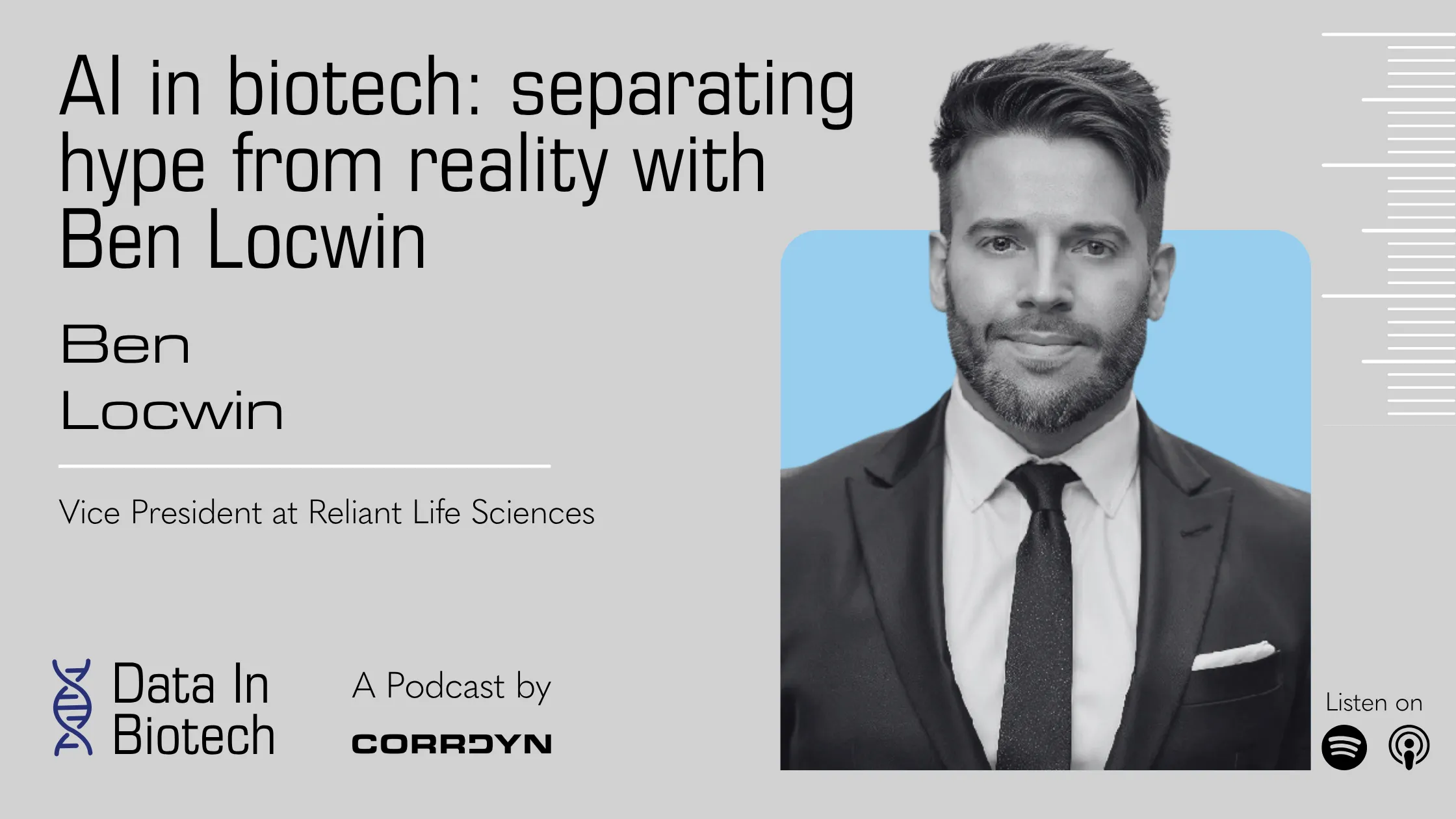
Many biotech companies claim to use AI, yet few apply it effectively beyond early-stage research. This disconnect between stated capabilities and practical implementation creates significant risk for investment and successful drug development. It leads to wasted resources, missed opportunities, and a failure to de-risk critical stages like clinical trials and regulatory submissions. In this episode, Ben Locwin, with over a quarter-century in the biotech landscape, dissects where AI truly adds value and where its application falls short.
Ross and Ben explore the nuances of AI adoption, from sophisticated molecular modeling tools like AlphaFold to the often-overstated use of AI in manufacturing and regulatory processes. They discuss the challenges of designing clinical trials and production systems to be AI-friendly, the critical distinction between correlation and causation in data analysis, and the inherent difficulties of applying precise computational models to the variability of human physiology and loosely defined regulatory frameworks.
The conversation offers a grounded look at AI’s current impact and future potential in life sciences, providing data leaders with insights to navigate the hype and focus on genuine, outcome-driven applications.
Key Takeaways
AI’s impact diminishes as drug development progresses from lab to patient.
Early-stage applications, such as molecular modeling, leverage highly quantified data and established physics principles, allowing AI to deliver precise, predictable results. However, as drugs move into clinical trials and regulatory submission, the inherent variability of human biology, diverse patient populations, and broadly defined regulations introduce ‘noise’ that makes AI models less effective and their outputs less reliable. Leaders should prioritize AI where data is most structured and measurable.
Simply adding more data to AI models without better design can lead to misleading outcomes.
For AI to provide accurate predictions in complex environments like clinical trials or manufacturing, the underlying processes must be designed to generate high-quality, structured input data. Blindly feeding models with noisy, high-resolution data risks overfitting and algorithmic opacity, making it difficult to trace errors or ensure the model’s outputs reflect true causal relationships rather than spurious correlations.
The promise of ‘one-click regulatory submissions’ faces significant economic and technical hurdles.
While vendors envision fully automated regulatory submissions, achieving this requires a level of control and data integration across the entire drug development lifecycle that is often economically prohibitive for many biotech firms. Furthermore, regulatory agencies themselves are developing AI for reviews, setting the stage for a complex interplay between submitting and reviewing AI systems that have yet to be defined or standardized. Companies must consider the cost-benefit of extensive automation in this area.
Prioritizing causality over correlation is paramount for effective AI in life sciences.
The ultimate goal in drug development is to establish causal links between a new molecular entity and its therapeutic effects, alongside safety signals. Overly complex or overfit AI models, while capable of finding vast correlations, can obscure true causality. Data leaders must ensure AI initiatives are grounded in falsifiable hypotheses, aiming to confirm or refute specific effects rather than simply identifying patterns.
Related: CorrDyn excels in data assessment to help clients pinpoint true AI opportunities. We frequently partner with clients in biotech and life sciences to build reliable data engineering foundations. For deeper dives into industry-specific data applications, see our blog post on how biotech manufacturers unlock data value.
Full Transcript
Jason: Hey everyone, it’s Jason, producer of Data and Biotech. Quick one, every episode of this podcast is now on YouTube with animated glossaries that break down the technical terms we discuss. Just search Data and Biotech on YouTube to watch. Welcome to Data and Biotech, a podcast from Core where we explore how companies leverage data to drive innovation in life sciences. Every two weeks we sit down with an expert from the world of biotechnology to understand how they’re using data science to solve technical challenges, streamline operations and further innovation in their business. Here we go.
Ross Katz: Ben Locwin, welcome to the Data and Biotech podcast.
Ben Locwin: Thank you, Ross, pleasure to be here.
Ross Katz: Awesome. Just to kick us off, would you mind giving us an introduction to your background and the work that you do?
Ben Locwin: I’ve been for more than a quarter century working in the biotech landscape, various organizations, both as an FTE, also consulting in the industry for quite some time. And in that time, of course, as there was the rise and fall of what was fashionable and not as fashionable in the drug industry, we saw similar sorts of trend architecture with regard to use of different computer modeling, computer techniques, use of data, which then became big data. Happy to be at the moving frontier of synthesizing those two pieces together.
Ross Katz: Yeah, that’s awesome. Today I’m really interested in surveying the landscape of applications of AI and computational methods with you. One of the things that you said when we first started talking was this idea that almost every biotech claims to use AI, but very few actually do. So I’m interested in hearing from you why there’s such a disconnect? Why are there such high claims, but so few applications?
Ben Locwin: Yeah, I think that one goes back to this idea that if you’re at a leading organization or an organization within the framework and fabric of an industry that’s moving in a future-looking direction, you don’t want to be perceived as a laggard. So whenever there’s adoption of new technology, new techniques, it could even be the techniques that are used for chemical synthesis and processing, or growth of cell culture, things that are specific to the industry. People love to be at the front edge of that so that the investors, the market doesn’t see them as falling behind. So, a lot of organizations I think would be better served by coming up with some idealized example of how they would want to use some big data, some different applications of AI, and then proceed in that direction, rather than just randomly touching on it.
Ross Katz: Are there particular applications across the biotech landscape where you see AI or applications of computational methods as being particularly valuable or where the opportunity is particularly easy to grab? And on the other hand, are there other AI applications where you’ve seen initiatives crash and burn, like you’re not as likely to succeed if you try to pursue an opportunity like that?
Ben Locwin: Yeah, probably the best use case is AlphaFold, competitors to that. So, in the molecular modeling front, Demis Hassabis from DeepMind, when putting that together, I think really laid down the gauntlet of what some of this technology could do. And again, we’re still very early on in this whole landscape and framework, but that’s probably the most evolved at this point. If you’re trying to use different AI approaches in other parts of the process, let’s say manufacturing processes, regulatory affairs or regulatory strategy for your drug submission, it’s a little bit more Wild West, and there are a lot of vendors on the market trying to jockey for position there. And there’s not a set of really clear use cases. Again, I think it boils down to who’s going to want to take which path forward in the future. So, for example, there are a lot of organizations that in the manufacturing process, they’re trying to use different AI approaches and tactics and models to look at things like their manufacturing parameters, could even be to the level of dissolved oxygen and pH and flows. That sort of modeling is really a weak AI, really a data simplistic approach. So you could lay the framework on there and say, well, we’re doing AI, but it’s really just more advanced modeling like we’ve done in the past. And of course, you can have the AI trained so that it’s trying to predict on what some of those parameters are looking like, so it requires less human intervention. Then the trick becomes some of those AI models, they have to be trained, and what does the training dataset look like? So I think we move, it’s interesting to me because we move from the front end of the process where we’ve got really sophisticated examples like something that looks like AlphaFold or AlphaFold itself, and then as you get into the bones of the production process and further beyond, and including quality functions, looking at deviations to a process, trying to figure out ways that AI can be plugged in there. It’s almost like we’ve got an answer in search of a question because nobody knows what the right question is.
Ross Katz: Yeah, that’s really interesting. It also highlights the way that the term AI or artificial intelligence has drifted over time for those who’ve been working with computational methods for a long time. So AI is this umbrella that can capture everything from descriptive statistics of a manufacturing process that you’re doing anomaly detection on and basically saying, oh, something’s wrong here, all the way up to AlphaFold and these large foundation models that have been specifically trained in a generative fashion to produce new proteins or binders, all the way to what people typically think of as generative AI right now, the large language models that people are using as chatbots and as research assistants. And so, traditional machine learning or physics-based machine learning for computational chemistry and similar applications. So, what I’m hearing is that from the market, from the investor class, there’s the expectation that we have to stay on the leading edge. We need to do AI, but the way that gets applied can fall into any of those buckets. Am I understanding that correctly? Or how would you update that?
Ben Locwin: Yeah, right on. And the thing that’s interesting to me about it is the principle of why should that be the case? Let’s say you’re getting closer to a regulatory submission in order to get your new drug approved, wouldn’t you want to have more AI interface later on in the process, so that you could argue this will repeatedly allow us to have a greater opportunity, a greater probability of getting this approved. However, that would presume that the regulatory process itself and every element of the quality function, what’s listed in 21 CFR, whether it’s 210, 211, all of the other subparts, that those are supremely quantified. And the reality is that by design, the regulations are, they leave a lot of gray area. So they create this boundary of what’s compliant versus what isn’t. But when you pass over that level into the space of being compliant, there’s a lot of different ways that can look. So it becomes a lot more difficult for an artificial intelligence model to parse that out and say, in your manufacturing process, you should be doing this that looks more like this. Or as you’re preparing your regulatory submission, make sure that it gets all funneled down and looks like this, because the guardrails are much broader. So it’s almost like earlier on when you’re looking at the computational chemistry, when you’re looking at molecular structures, things that the AI could do very well because they’re very quantified. And we have strong underpinnings from physics, from biophysics, from chemistry, from quantum chemistry. There’s a lot there that you can model very precisely and discretely. And then as you get further through into clinical trials, where now these face human patients and there’s a whole lot of variation there, whether it’s demographic variation, age bands, gender, individual physiology. Now this becomes all that biological noise that becomes a lot more difficult to say it looks like this. So it very rapidly goes from a point where the AI models can have very precise outputs to that funnel, the trumpet expands dramatic and in wild fashion. And now you’re trying to have the model wrangle in all this variation. So I think part of that is, how do we get our arms around different approaches so that the input data looks a lot less noisy? Or are there ways to design the clinical trials themselves? Is there a way to look at things like drug-drug interactions and those interactions within certain individual physiologies that will lend it to saying, if we design our trials like this, if we design our manufacturing processes like this, then the AI will have a better, more predictable and repeatable way of giving us more accurate results.
Ross Katz: Do you have any guidelines for either inside the clinical trial process or inside the manufacturing process, for how to design those processes to make them more friendly to computational approaches? The key term is de-risking; you’re trying to de-risk throughout the entire process. And the idea is that if you can better understand how the future will look if you choose to manufacture in this way, if you choose to design your clinical trial in this way, if you adapt the clinical trial in this way, then you’re more likely to reach approval, to go to market. But I’m interested from you if there are any guidelines or suggestions you would have for how companies can approach that.
Ben Locwin: Yeah, it’s a big question. I’ve been in a couple panels discussing exactly this. And for example, decentralized clinical trials versus more centralized clinical trials, the variation between the two, or looking at different patient populations and how might you best narrow those or expand those? Because if you think about some of the statistical basis of this, and you say, well, hold on a second, what about a design of experiments type framework? One of the great powers of design of experiments, and this dates back to Sir Ronald Fisher, is the idea that if you’re modeling a lot more factors at a lot more levels, you actually have greater resolution across your design space and ability to have better prediction compared to doing the old one factor at a time method where you’re only adjusting one factor, testing the output. So if you set some of these parameters up in a more DOE way, you now let the AI learn on a broader model. And then the AI will turn this into a very multi-dimensional space, a response surface model, but instead of a 3D surface model, it could be nine dimensions, 11 dimensions. And across all the dimensions now that this is measuring, it has more opportunities to train, test and fail, and then will also start feeding back better results. But the trick there is that it’s not just about giving it more data. It’s having to give the model more data, but also those more data have to be better data. Otherwise, it’s going to be making subtle mistakes in maybe a five-dimensional model that now you can’t see anymore because they’re in the black box. And it’s making some mistakes based on uncertainty in those data that are carrying forward in unknown ways. And then the output you say, looks pretty good. How do you get it a little better? Well, that would be very difficult, because now you have to do what we call backpropagation. Try to figure out where in the model it may have gone wrong. But again, all that is largely invisible because of the algorithmic opacity of the model.
Ross Katz: Yeah, that’s interesting. And what you’re describing, I think in the manufacturing space, particularly when manufacturing processes are being designed up front, there’s a certain amount of this DOE that’s going on in order to design the production process in the first case. But definitely in a clinical environment where the trials are being very closely monitored and where the tolerance for failure is very low, it’s hard for me to imagine what a clinical trial looks like that allows models to learn on the fly and to use small amounts of data early on to design the best possible experiments over time. Just because it’s a binary outcome, right? If your model takes a little bit too long to optimize, then you’re dead in the water. So, yeah, I can just see how the risk aversion plays into making that approach difficult.
Ben Locwin: Yeah, and we could tie in a few major themes here, too. So if you think about early on, as you were saying, you’ve got only a few parameters you’re looking at. And now the expectation is, what does this result in way out in time, as there’s all these inputs and variation in each of the inputs. So that then is really more chaos modeling. And so now you’ve got to draw something like chaos theory into this and say, how is this all bifurcating in time? And do we even have the capability to wrap our arms around it? Which then begs the question, how do we bring quantum computing into this?
Ross Katz: The way I think about quantum computing is, what if we were not compute bound in any meaningful way, what would we be able to do? It almost sounds like we’re talking about a digital twin or a simulation for the entire life cycle of drug development from the chemical compound, all the way through the development phase and designing the manufacturing, designing the formulation, through the clinical trial, and through injecting from chaos theory, what the exogenous variables might be that we need to account for, that we can’t quite understand yet, and see how that might impact a drug coming to market. I’m a little bit galaxy brained here, but how is that an accurate portrayal of what you’re saying, or where do you see it going?
Ben Locwin: Yeah, it is. So it brings up a couple thoughts, if I think about how all that might work. We have in silico modeling now. Obviously, that will ramp up. Because what the in silico component can actually do is vastly more rich. You could then say, we’ve got simulated twins. And you could in theory, you could get to the point where you say, our digital modeling of the human twin has gotten to the point where you could plug in input variables about who that hypothetical person is: their age, their sex, their race. You could even get really crazy and have lifestyle factors that you dial into this thing. And then you say, how might this molecule work? But there’s obviously a tremendous amount you wouldn’t be able to toggle there. You would have to get down to the level of individual genetic variation, way deeper than blood type, but do they have particular gene variants present? Not that that’s impossible, but I think that you may also get to the point where the model or the designers of the model may try to get it so granular that they’re not modeling reality anymore. So what I mean by that is, the best way to study sociology, let’s say, really broad, high-level interactions of humans. The best way to study that, that we know at the moment, is not particle physics. So we know a lot based on the standard model in particle physics, in quantum mechanics, how these interactions of particles work. But now as you scale those up to molecules, the ability to have precise measurements based on what we know of the standard model, what’s going on with the fermions and the bosons in a particular box, to see how that scales up predictably beyond the scale of individual molecules to clusters of molecules, that level of fine resolution is entirely unhelpful. I don’t think we would ever get to the point, no matter the size of the quantum computer, that would say, if you have these molecules in a box and these interactions with them, the actual change at the physiological level on the scale of a human, it would be wildly unpredictable because of the inherent unpredictability that’s baked into quantum mechanics. So it may be that we start pushing up against that boundary where we want to get finer and finer resolution with the AI models in order to create the prediction, that they become virtually useless for determining what’s happening at the physiological scale in a living human. And actually what the smart answer might be is looking at it at that higher level. And so what we will find as we start doing these actual experiments with the AI models is there’s probably some cutoff where it doesn’t make sense to put in these more high resolution, finer parameters, because they actually don’t improve the model. And this may get us back to if you think about in statistics, the idea of the principle of parsimony, where adding additional factors to your model doesn’t necessarily make it better. You end up just overfitting. And so the idea is to have only that number that allows you to really do appropriate inference and not put in everything. And then I guess the connection that makes is it’s the idea with big data. I think most data science isn’t. There are folks who say, I’m a data scientist or at this company we do data science. But you think about what that is, and it’s obviously a lot of coding and programming, but where it falls short of being actual science is a good randomized controlled trial, for example, needs to state a clear primary hypothesis. And many RCTs don’t do that. And so the idea is, if you don’t have a falsifiable hypothesis going in, a priori, then you’re not really doing science. So you could take the universe of data, plug it into a quantum computer and say, find correlations. And because of that, you could find correlations everywhere. But it doesn’t mean that they’re causal. Because at the end of the day, the question for all of us should be, what are we looking for? And what we’re looking for is causality. For example, does this new molecular entity, this new drug, have this effect in terms of efficacy in a human, or in veterinary, in an animal model? If there are correlations that are not causal, the real hard work is screening those out and saying, we want this to be efficacious and we also need to see appropriate levels of safety signals so that we can de-risk this. When we look at that, if you modeled everything and all of your models are super overfit, it’s correlations everywhere, all the way down. And we’re trying to get away from that. The idea is, what’s causal? And is our hypothesis supported or is it refuted?
Ross Katz: If it’s okay with you, I want to switch gears and give you some quicker one-off questions. You mentioned that you recently met with a bunch of CEOs of companies that are designing, building, delivering AI to pharmaceutical and biotech companies. I’m interested in what you learned from that community about either where they’re seeing success or what challenges they’re facing, things like that.
Ben Locwin: One of the interesting things is one-click regulatory submission. A lot of companies are trying to offer this, and a lot of companies are interested in this. And in speaking with some of these folks last week, some being vendors of this type of thing, some being users or potential users, the vendors believe it’s five minutes away in the future, we can do one-click submissions. And the difference between language and reality could be a big gulf. So there are platforms that can offer things like this. But then the trick becomes this is just one example, but the FDA hasn’t best decided how to solve the problem of AI-assisted or AI-augmented submission reviews. They have Elsa, they have their brand new agentic AI to help with different tasks. And I think what that’s leading to is the submitter’s AI is going to have to impinge upon the regulatory agency, whether it’s FDA, EMA, MHRA. Those two AIs now are going to have to come to battle, where you’ve submitted. The agency’s AI has reviewed, flagged, and then those two AI systems can fight back and decide how best they narrow in on what the truth is, who’s more correct and compliant. So I think that’s an interesting avenue. And the other thing that came out of it, too, was that it’s really still the Wild West. And it really goes back to what we covered at the outset here, where what does the Wild West mean? It means everybody wants to try it. Otherwise, they feel they’ll be left behind in the lens of history. And though they’re trying it, there’s not the best approach or the top three best approaches. So everybody’s dabbling, which is good and healthy. And there’s some pie in the sky dreamy visions about wanting to do continuous manufacturing, have the AI control all the inputs, all of the process, all of the outputs. And that’s a pretty ostentatious goal. I would love it. But then it would beg the question: if I run that thought experiment forward, you have to have control of everything coming in, so from the warehouse docks to inputting material into your bioproduction process, through the process, to filtration, final fill. We could get there. But economics also comes in. That’s a counterfactual where you would have to say, what is the cost to make that happen and can you ever recoup that cost? Or are some parts of that continuous process fine the way they are because it’s not worth the economics to fix it. So, short story is, a lot of discussion about we think we’ve tackled some of these earlier pre-clinical, some toxicology elements, some modeling of better trial designs, looking at patient data, missing data, so AI-augmented clinical monitoring of sites. Then there’s some wild disconnect still: okay, that’s that part. How does that then feed into the clinical production scale to commercial production scale? Or are there always going to be these impermeable membranes? That’s the clinical trial AI. This is clinical batch scale up in manufacturing. Now we have this, now it’s commercial scale up and that’s controlled by a different AI model. And maybe that’s the case. Or we think about that’s the case because that’s what we’re familiar with.
Ross Katz: It highlights how all of the companies that have done the degree of automation that you would need in order to do the end-to-end modeling are companies that are already at a scale where they know that the economic benefits are going to justify the investment that they’re making up front. And the biotech landscape is, relatively speaking, somewhat fragmented. Also, there’s a time limit, or there’s a limited number of drugs that can be brought to market that ever reach that scale. And then there’s a time limit to how long you can actually get the economic value from that scale. And so, it’s interesting how the economic incentives feed back into the way that automation and AI can’t be applied in the ecosystem at large.
Ben Locwin: Yep. And I think everybody, the developers, would tend to want to be less skeptical. They want to get their product developed. And to do that with any product or service, if you think about it, you really have to psychologically reel in your skepticism, and you have to be more on the optimistic side. We could do this. Why don’t we try this? And then either there’s a market need and demand or not. But I think it’s important for folks who develop and then in the industry, folks who use this, to be healthily skeptical. So, don’t take anything at face value. You have to see the data for yourself. And don’t just look at filtered data from a news report or a prospectus, but always try to look at primary data. Because the more highly filtered it is, there’s no direct link to the original truth, and that makes it so you can’t tell what the data provenance are.
Ross Katz: Well, we’ll leave it there. If listeners want to follow you or learn more about your work, where should they go?
Ben Locwin: They can find me on LinkedIn, easy enough.
Ross Katz: All right, Ben, it’s been a pleasure having you on the podcast. I really appreciate it and look forward to connecting down the line.
Ben Locwin: All right, thank you, Ross. Pleasure to be here.
Jason: And that’s it for this episode of Data and Biotech. If you enjoyed the episode, please subscribe, rate, or leave a review in your podcast platform of choice. See you next time.